
Table of Contents
Ancient Acoustics
More than 2,000 years before microphones and speakers, Greek and Roman theaters held crowds of 10,000 people or more, and the people in the back row could follow the play. There was no ancient sound technology in the electronic sense. The builders shaped the sound with stone, slope and geometry.
This guide covers how they did it: the theater at Epidaurus, the debate over Greek masks, the bronze “sound vases” Vitruvius described, and a few other ancient sites built around sound. It also covers what modern research says about how good these spaces really were.
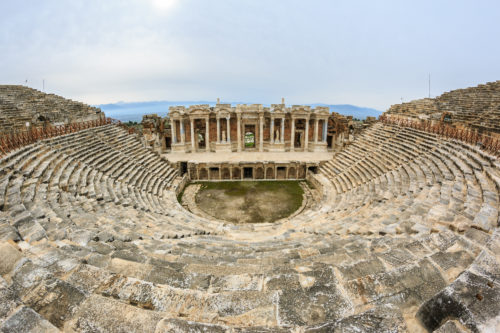
Quick answer Greek theaters were built into hillsides, with steep, semicircular rows of stone seats rising from a hard, round floor in front of the stage. The steep rows gave every seat a clear line to the actors with no heads in the way. The hard floor and the stage building reflected voices up toward the crowd, and the stepped stone seats damped low background rumble while passing the higher sounds of speech. Trained actors projecting their voices did the rest.
How Greek Theaters Carried Sound: Epidaurus
The Theater of Epidaurus, built in the 4th century BC, is the classic example of ancient acoustics. It seats about 14,000 people in 55 rows, and visitors still test it today by whispering or dropping a coin on the stage. Its design pulls together every trick Greek builders used:
- A hillside bowl. Cutting the seats into a hill made them steep, so each row sits above the heads in front. Sound reaches you directly instead of passing through a crowd of bodies that soak it up.
- A hard, round orchestra floor. The flat circle where the chorus performed bounced the actors’ voices up toward the seats, like a second source.
- The skene behind the stage. This stage building reflected sound that would have been lost behind the actors back out to the audience.
- Stepped limestone seats. In 2007, researchers at Georgia Tech found the rows of seats act as an acoustic filter. They hold back low frequencies, such as murmuring crowds and wind, and reflect the higher frequencies that make speech clear. The brain fills in the missing low tones of a voice on its own.
- No roof. An open-air theater has almost no echo. What reaches the back row is the direct voice plus a few quick reflections, so words don’t blur together the way they do in a big hard room.
Later Roman copies built with different seats and proportions never sounded as good, which suggests the Greeks found their layout by trial and error rather than by theory.
Ancient Greek Theater Masks: Did They Amplify Voices?
Greek actors wore full-head masks with wide, open mouths, and it is often claimed they worked like small megaphones. The real answer is: maybe a little. Tests on replica masks show the open mouth and the hollow around the face can boost and direct some frequencies of the voice, but the effect is modest.
The masks’ main jobs were visual. They let a few actors play many characters and made faces readable from the top rows. They were made of linen, wood or leather, so none survive; what we have are stone and clay copies like the one at the bottom of this page.
Roman Theaters & Vitruvius’s Sound Vases
The Roman architect Vitruvius, writing around 25 BC, gave the oldest surviving written guide to theater acoustics. Among other things, he described bronze vessels called echea. They were set in small chambers under the seats and tuned to different notes so they would resonate with the actors’ voices.
Whether they made much difference is still debated, and Vitruvius himself said few theaters in Rome used them. The same idea shows up again much later: clay jars built into the walls of medieval churches across Europe, often called acoustic jars.
Roman theaters also changed the shape. They cut the seating to a half circle and joined it to a tall, decorated stage wall, the scaenae frons, which reflected sound back to the audience. Many also stretched a cloth awning, the velarium, over part of the crowd for shade.
Ancient Acoustic Architecture Beyond Theaters
The field that studies how ancient places sounded is called archaeoacoustics. Some of its best-known sites:
- Chavín de Huántar, Peru (about 1200–500 BC). Archaeologists found decorated conch-shell trumpets inside the temple’s narrow stone galleries. Studies suggest the passages carried and distorted their sound, so worshippers heard it without seeing where it came from.
- Hal Saflieni Hypogeum, Malta (about 3600–2500 BC). In this underground burial complex, one carved chamber resonates so strongly that a low male voice seems to fill the rock around it.
- Chichén Itzá, Mexico. A handclap in front of the stairs of El Castillo pyramid echoes back as a chirp that many compare to the call of the quetzal bird. Whether the Maya planned it is unknown.
- Stonehenge, England. Researchers at the University of Salford built a 1:12 scale model in 2020 and found the complete stone circle would have had a short echo of about 0.6 seconds. That is enough to make voices and music sound fuller inside the ring than outside it.
Were Ancient Theaters Really That Good?
Good, but not magic. In 2017, a team from Eindhoven University of Technology took more than 10,000 measurements at Epidaurus and two other Greek theaters. A dropped coin or a whisper carried only partway up the seats. Loud, projected speech, the way a trained actor performs, could be understood all the way to the top.
Why the tour-guide coin trick works The coin drop works best when the theater is empty and quiet. A full house of 14,000 people adds noise and soaks up sound. The Eindhoven team also measured the theaters as ruins: the stage buildings that once reflected sound are mostly gone, so the originals likely sounded better than they do today.
Ancient vs Modern Acoustics
Many ancient ideas are still in use, just with different materials:
| What ancient builders did | Why it worked | Modern version |
|---|---|---|
| Steep, stepped seating in a half circle | Clear line of sight and line of sound from every seat | Stadium seating in auditoriums, lecture halls and arenas |
| Hard stage wall and orchestra floor | Reflect the voice toward the audience | Orchestra shells and angled reflectors over the stage |
| Building in quiet hillsides | Keep outside noise from drowning out the stage | Insulated walls, sound isolation and quiet HVAC |
| Bronze echea under the seats | Meant to resonate with and support the voice | Tuned bass traps and resonators |
| Open sky with no roof | Almost no echo to blur speech | Acoustic panels, baffles and clouds that absorb echo indoors |
| Trained actors projecting their voices | Loud enough to reach the back | Microphones and sound reinforcement |
What Modern Rooms Can Learn from Ancient Sound Technology
The big difference today is the roof. Ancient theaters were outdoors, so they only had to get the sound to the audience. A modern auditorium, gym or worship space has walls and a ceiling, and the sound bounces around inside them. The echo that a Greek theater never had is usually the main problem.
Indoor rooms solve it with absorption. Fabric-wrapped sound absorbing wall panels stop the echo between hard walls, and acoustic ceiling baffles soak up sound under high ceilings. That gets you closer to the clear, short sound of an open-air theater. The layout lessons still apply: keep sight lines clear and keep hard reflecting surfaces near the stage.
For real examples, see how we treat gym acoustic panels to cut echo in a gymnasium, or how to soundproof a music studio for recording and rehearsal.
Frequently Asked Questions
How did the Greeks make sure theater audiences could hear?
They built theaters into hillsides, with rows of seats that rose steeply from the stage in a semicircle. That gave everyone a clear line to the actors, while the hard floor and stage building reflected voices toward the audience.
How did people hear speeches before microphones?
Speakers trained to project their voices, and they spoke from places designed to carry sound. Those included theaters, raised platforms and open squares, often with a wall behind the speaker to reflect the voice forward.
Did ancient Greek masks amplify actors’ voices?
Possibly a little. Tests on replicas show the open mouth can boost and direct some of the voice, but not much. The masks mainly let actors switch characters and be seen from far away.
Which ancient theater has the best acoustics?
The Theater of Epidaurus in Greece is the most famous. Studies found its stepped limestone seats filter out low background noise and reflect the higher sounds of speech. Loud, projected speech can be understood from all 55 rows.
What is archaeoacoustics?
Archaeoacoustics is the study of how ancient places sounded and whether their builders designed them around sound. Sites studied include Greek theaters, Stonehenge and Chavín de Huántar in Peru.