Table of Contents
What Wall Blokker, Lite, & Pro Have in Common
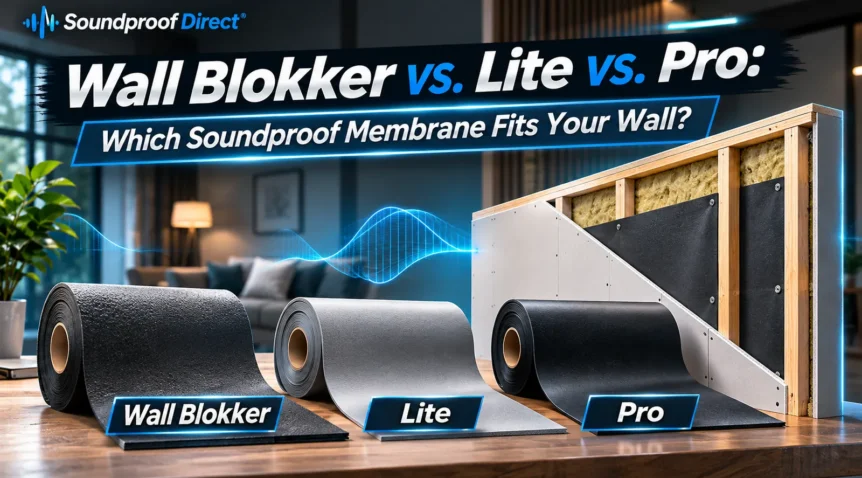
All three are mass loaded vinyl made for walls. Each is a thin, heavy, limp sheet that goes on the studs or over existing drywall, gets covered with new drywall, and blocks sound passing through the wall. They come in the same 4 ft x 25 ft roll covering 100 square feet, they install the same way, and none of them does anything for echo inside a room.
What changes is how much mass you get and whether the sheet has a scrim fused to its face. That sounds like a small difference. On the wrong wall, it means paying for weight that does very little, or leaving a few STC points behind on a wall where you needed them.
Quick answer Use Wall Blokker Lite on metal stud walls, Wall Blokker on most wood stud walls, and Wall Blokker Pro on wood stud party walls, home theaters, and retrofits over existing drywall. Lite adds 6 to 11 STC points on steel studs, Wall Blokker adds 6 to 12, and Pro adds another 3 to 5 points over Wall Blokker on the same wall.
Wall Blokker vs. Lite vs. Pro Comparison Chart
| Wall Blokker Lite | Wall Blokker | Wall Blokker Pro | |
|---|---|---|---|
| Weight | 0.6 lb/sf | 1 lb/sf | 1.1 lb/sf |
| Thickness | 1/16 in | 1/8 in | 3/16 in |
| Sheet rating | STC 21 | STC 26 | STC 26 minimum (ASTM E90) |
| Added to a stud wall | 6 to 11 STC on steel studs | 6 to 12 STC | 3 to 5 STC more than Wall Blokker |
| Roll weight (100 sf) | About 60 lb | About 100 lb | About 110 lb |
| Face | Plain vinyl | Plain vinyl | Fused polyethylene scrim |
| Best on | Metal studs | Wood or metal studs | Wood studs, party walls, existing walls |
Notice that Wall Blokker and Pro carry the same sheet rating. The number printed on the sheet is not what you will get through your wall, because the finished assembly is what counts: the studs, the drywall, the insulation, and how well the seams are sealed. The STC ratings guide shows how those layers add up.
How to Choose a Soundproof Membrane by Stud Type
Start with the framing. Steel studs are thin and flex a little, so a metal stud wall is already partly decoupled. What it lacks is mass, and a modest amount of it fixes most of the problem. Wood studs are stiff. They carry vibration from one face of the wall straight to the other, so a wood stud wall needs more mass, and it benefits from anything that breaks that rigid connection.
Then look at what the wall separates. A wall between two offices is not the same job as a wall between your bedroom and a neighbor’s surround sound, even if the framing is identical.
When Wall Blokker Lite Is the Right Membrane
On metal studs, I think Wall Blokker Lite is the smart buy, and not only because it is the cheapest of the three. It adds 6 to 11 STC points on 20 and 25 gauge steel studs. Full weight Wall Blokker adds 6 to 12. That is two thirds more vinyl for a range that tops out one point higher.
Lite has two practical advantages as well. At 1/16 inch it is half as thick as standard MLV, so door jambs, outlet boxes, and trim still line up when it goes over existing drywall. And a roll weighs about 60 pounds, light enough for one person to hang.
It fits office fit-outs, medical and professional offices that need speech privacy between rooms, and apartment or hotel corridor walls where the cost per square foot across a whole floor decides the spec. Where it falls short is wood framing. Lite will help on wood studs, but wood needs more mass than Lite carries, so do not use it to save money on a wood party wall.
Why Wall Blokker Is the Default for Most Walls
Wall Blokker is the full 1 lb/sf, 1/8 inch sheet, an EVA based mass loaded vinyl, and it works on wood or metal studs. It is what I would put in a home office wall, a shared bedroom wall, or a basement rec room. If you are not sure which of the three you need, it is the safe pick.
It is also flexible enough to wrap pipes and ducts, and it works as a cross-talk barrier above office partitions that stop at the ceiling grid. A roll weighs about 100 pounds, so plan on a helper.
People ask how it differs from our mass loaded vinyl sound barrier, since the weight and thickness match. The MLV roll is our general barrier for walls, floors, and ceilings. Wall Blokker is the one rated and sold for walls. For a wall, either does the job, and the best mass loaded vinyl guide compares them further.
What the Scrim on Wall Blokker Pro Adds
Wall Blokker Pro is a 1 lb/sf vinyl core with a polyethylene scrim fused to one face, 1.1 lb/sf finished. The extra tenth of a pound is not the point. The scrim keeps the vinyl and the drywall layers from behaving like one stiff panel, and that is where the extra 3 to 5 STC points come from. It also helps with impact and structure-borne noise, which plain vinyl does less for.
The scrim earns its keep during the install too. Staples and nails grip the scrim instead of tearing through the vinyl, which matters when a 110 pound roll is hanging from its fasteners. Pro is approved for UL U300, U400, and V400 rated assemblies, which matters in multifamily buildings where the wall has to keep its fire rating. It is EVA based rather than PVC, with no off-gassing.
Is it worth it? Every 10 STC points is roughly half as loud, so 3 to 5 points is noticeable without being dramatic. On a wood stud party wall, or a theater wall where bass is the complaint, I would pay for it. On an interior wall between two kids’ rooms, I would rather spend that money sealing gaps. On steel studs, Pro is usually not the better value.
Adding a Soundproof Membrane over Existing Drywall
All three can go over a finished wall without demolition. You fasten the membrane through the old drywall into the studs, seal it, and hang a new layer of drywall over it. On wood framing, Pro is the one built for this job. On metal studs, or anywhere every sixteenth of an inch counts at a door frame, use Lite.
Whichever you pick, the install decides the result more than the product does. Hang the sheets vertically with seams on a stud. Tape every seam that misses a stud and every overlap with MLV seam tape, run acoustical caulk around the perimeter, and cut tight around outlet boxes, which are holes in the wall otherwise. With Pro, the scrim side faces the studs or the existing drywall. Order 10 percent extra for overlap.
The full retrofit, including what to do at outlets and trim, is in how to soundproof existing walls, and the fastening details are in how to install mass loaded vinyl.
Which Wall Blokker to Buy for Your Wall
If I were building a wood stud wall between a home theater and a bedroom, I would buy Pro without much thought. For an office fit-out on steel studs, Lite, with the savings spent on caulk and sealing the outlets. Nearly everything else gets standard Wall Blokker.
One last thing, because it trips people up: a membrane stops sound going through the wall, but the room will sound exactly as echoey as before. If your own room rings, that is a job for sound absorbing wall panels, and the types of acoustic wall panels explains which ones to look at.
What is the difference between Wall Blokker, Wall Blokker Lite, and Wall Blokker Pro?
Weight and the scrim. Lite is 0.6 lb/sf at 1/16 inch and made for metal studs. Wall Blokker is 1 lb/sf at 1/8 inch for most walls. Pro is 1.1 lb/sf at 3/16 inch with a fused scrim that adds 3 to 5 STC points over Wall Blokker.
Can I use Wall Blokker Lite on wood studs?
It helps, but it is the wrong pick. Wood studs carry vibration more directly than steel and need more mass. Use Wall Blokker or Wall Blokker Pro on wood framing.
Is Wall Blokker Pro worth it over standard Wall Blokker?
On wood stud party walls, home theaters, and retrofits over existing drywall, yes. The 3 to 5 extra STC points are noticeable. On ordinary interior walls or steel studs, standard Wall Blokker or Lite is the better value.
Which side of Wall Blokker Pro faces the studs?
The scrim side goes toward the studs or the existing drywall, so the staples or nails hold in the scrim instead of the vinyl. Then cover it with drywall as normal.
How many rolls of Wall Blokker do I need?
One roll covers 100 square feet, which is a 12.5 ft run of 8 ft wall. Measure the wall area, add 10 percent for overlap, and round up. A 12 ft by 8 ft wall needs two rolls.