
Table of Contents
Gym Acoustic Panels
A gym is one of the loudest rooms in any building. Whistles, bouncing balls, squeaking shoes, music and a crowd all bounce off a hard floor, block walls and a steel roof deck, and the room keeps ringing long after each sound. Coaches can’t be heard, announcements turn to mush, and an hour in there is exhausting.
Gym acoustic panels fix that by soaking up sound before it can bounce around the room. This guide covers why gyms echo, which kind of panel to use where, how many a gymnasium needs, and what it costs.
Quick answer To reduce echo in a gym, cover about 25–40% of the wall area with 2 in fabric-wrapped acoustic panels mounted high, above the ball-strike zone, and add hanging ceiling baffles if the ceiling is high and open. Aim to bring the reverb time down to roughly 1 to 1.5 seconds. Acoustic panels fix echo inside the gym; they don’t stop noise leaving it.
Why Gyms Echo
Three things make a gym echo: a huge volume of air, almost no soft surfaces, and long parallel walls that bounce sound back and forth. The measure of it is reverberation time (RT60), how long a sound takes to fade away. An untreated gymnasium often rings for 2 to 3 seconds or more. Around 1 second is comfortable for a school gym where people need to understand speech.
Real gym: 2.3 seconds down to 1.1 Our sister company Commercial Acoustics treated the gym at St. Paul’s Episcopal School in New Orleans with 4 ft × 8 ft, 2 in fiberglass wall panels two weeks before a big event. The reverb time dropped from 2.3 to 1.1 seconds, and two installers on a scissor lift finished in one day.
Gym Acoustic Panels vs Baffles vs Ceiling Clouds
| Product | Where it goes | Best for |
|---|---|---|
| Sound absorbing wall panels | High on the walls, above the padding and bleachers | Most gyms; stops the slap between parallel walls |
| Acoustic ceiling baffles | Hung vertically from the trusses or roof deck | High, open ceilings; walls taken up by bleachers, doors and windows |
| Acoustic ceiling clouds | Hung flat below a lower ceiling | Fitness studios, weight rooms and multipurpose rooms with lower ceilings |
All three are 2 in thick and fabric wrapped. The wall panels and clouds have a 6 pcf fiberglass core, test at NRC 1.05 and are rated Class A for fire. Baffles absorb on both faces because they hang on edge. Many gyms use wall panels and baffles together: panels to stop the wall-to-wall slap, baffles to soak up the volume under the roof.
How Many Acoustic Panels Does a Gym Need?
A good starting point is 25–40% of the total wall area, or the equivalent in baffles. Use the low end for a gym that is mainly for sport, and the high end where speech matters: assemblies, PE classes, events.
- Measure the walls. Add up length × height for each wall you can use, leaving out doors, windows and the padded strip at the bottom.
- Take 25–40% of that. That is your panel area in square feet.
- Divide by the panel size. A 4 ft × 6 ft panel covers 24 sq ft; a 4 ft × 4 ft covers 16.
For example, a 70 ft × 50 ft high school gym with 24 ft walls has about 5,760 sq ft of wall. At 25% that’s about 1,440 sq ft of panels, or 60 panels at 4 ft × 6 ft. Send us the room’s length, width, ceiling height and what it’s used for, and we’ll lay it out with you: 855-667-6863.
Where to Put Acoustic Panels in a Gym
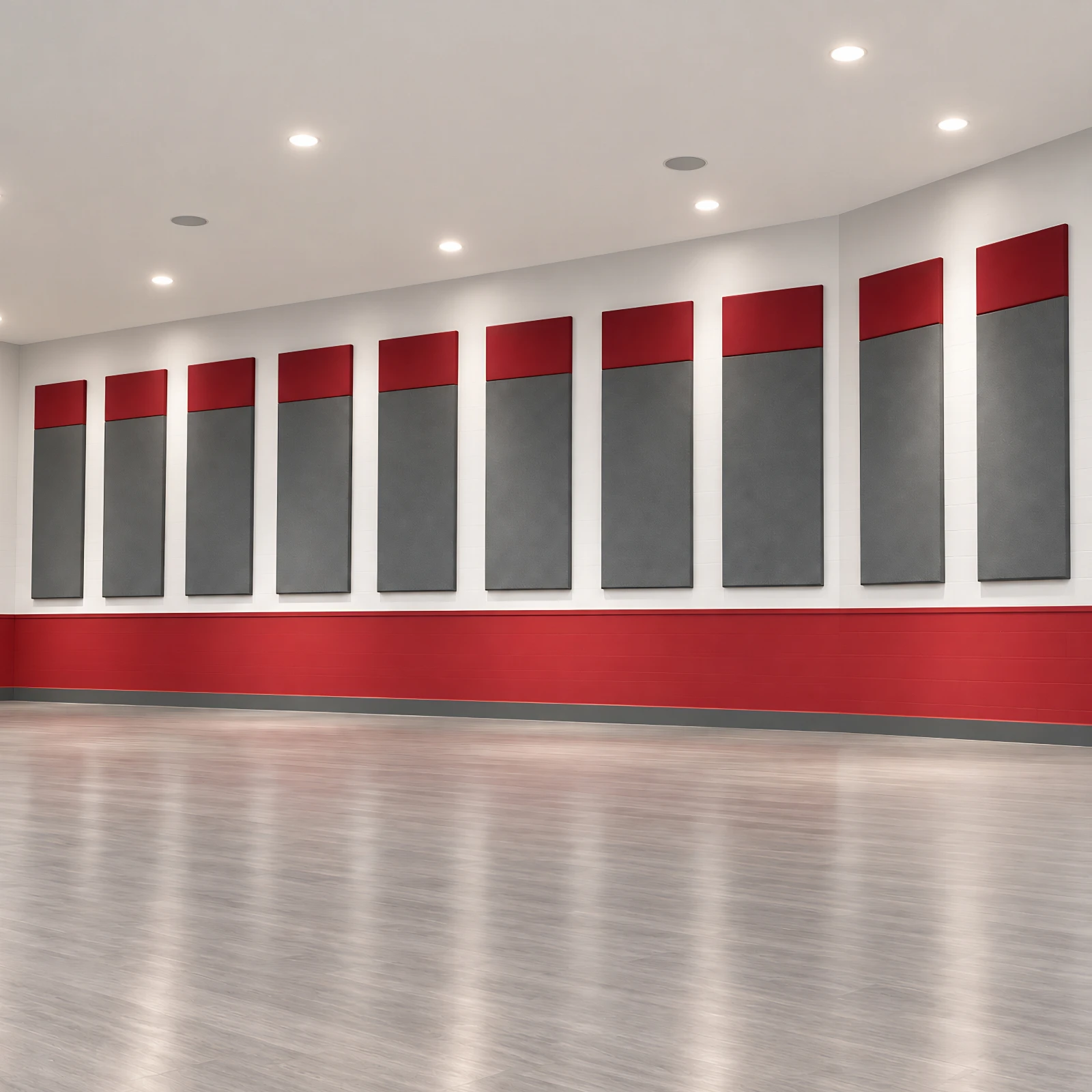
- High on the walls. Mount the bottom edge above the reach of balls and players, usually 8 to 10 ft up and above any wall padding. Up there they still catch the echo and stay out of trouble.
- On facing walls. Spread panels across both long walls, staggered rather than directly opposite, to break up the flutter between parallel walls.
- Above the bleachers and on the end walls, behind the hoops, where the walls are often the largest open areas.
- Baffles in even rows across the ceiling, all running the same direction, clear of lights, sprinkler heads and HVAC diffusers.
Fabric-wrapped panels aren’t built to take a direct hit from a basketball or volleyball, so keeping them high (or using baffles) is what makes them last. For mounting hardware and layouts, see how to hang acoustic panels.
Cost of Gym Acoustic Panels
| Product | Size | Price each |
|---|---|---|
| Sound absorbing wall panel | 4 ft × 6 ft × 2 in | $359 |
| Sound absorbing wall panel | 4 ft × 4 ft × 2 in | $259 |
| Sound absorbing wall panel | 2 ft × 4 ft × 2 in | $159 |
| Acoustic ceiling baffle | 4 ft × 4 ft × 2 in | $219 |
| Acoustic ceiling baffle | 4 ft × 2 ft × 2 in | $124 |
| Acoustic ceiling baffle | 4 ft × 1 ft or 2 ft × 2 ft | $99 |
The 60-panel example above comes to about $21,500 in 4 ft × 6 ft wall panels before shipping and installation. A smaller middle school gym or a fitness studio is often a fraction of that. All panels come in 24 fabric colors, so they can match school or team colors.
Home Gyms & Fitness Studios
A home gym, garage gym or small fitness studio needs far fewer panels: a few 2 ft × 4 ft or 4 ft × 4 ft wall panels on the walls facing the speakers and mirrors, or a couple of ceiling clouds over the main floor, takes the harsh edge off music and coaching cues.
If the problem is noise reaching the neighbors or the unit below, from music, dropped weights or class cues, panels won’t solve it. That needs mass in the walls and ceiling and an impact underlayment under the floor; see how to block noise from neighbors and the best soundproof underlayment for floors.
Frequently Asked Questions
How do you reduce echo in a gym?
Add sound absorption: fabric-wrapped acoustic panels high on the walls, and hanging baffles under a high ceiling. Covering 25–40% of the wall area typically brings a gym’s reverb time down to around 1 to 1.5 seconds.
Are acoustic panels or baffles better for a gymnasium?
It depends on the room. Wall panels suit most gyms and stop echo between parallel walls. Baffles suit high, open ceilings or gyms where the walls are taken up by bleachers, doors and windows. Many gyms use both.
How high should acoustic panels be mounted in a gym?
Keep the bottom edge above where balls and players can reach, usually 8 to 10 ft up and above any wall padding. They still absorb the echo from up there.
Do acoustic panels soundproof a gym?
No. Panels reduce echo inside the gym, but they are too light to stop sound leaving it. To keep gym noise from neighbors, you need mass in the walls and ceiling and an impact underlayment under the floor.
How much do gym acoustic panels cost?
Our 2 in fabric-wrapped wall panels run $109 to $359 each depending on size, and ceiling baffles $99 to $219. A full high school gym often takes 1,000 sq ft of panels or more.