Table of Contents
Does Acoustic Foam Work?
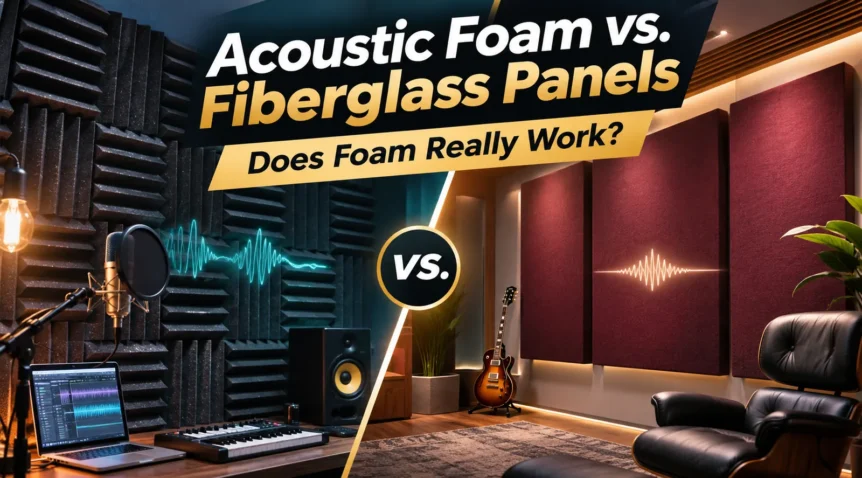
Acoustic foam works, within limits. It absorbs sound, so a room covered in it echoes less. The trouble is where most foam stops working. Thin foam squares soak up high frequencies, the hiss and sizzle, and leave the middle and low end, where voices and music actually live, almost untouched. The room sounds duller but still boxy, and people assume they need more foam.
The second misunderstanding is bigger. Foam does not soundproof. It is far too light to stop sound passing through a wall, so if you bought it to block a neighbor’s TV, it was never going to help.
Quick answer Thin acoustic foam reduces harsh high frequencies but does little for the voice range or bass, and it does not block noise between rooms. Thicker, denser panels such as 2 inch fiberglass absorb much more of the range that matters. For blocking noise, you need mass in the wall, not foam on it.
Acoustic Foam vs. Fiberglass Panels Compared
| Thin acoustic foam (1 to 2 in) | Fabric-wrapped fiberglass (2 in, 6 pcf) | |
|---|---|---|
| What it absorbs well | High frequencies | Highs and mids, and reaches lower |
| Effect on voices | Takes off the edge, leaves the boxiness | Removes most of the room sound |
| Our rating | Varies widely by product | NRC 1.05 |
| Fire rating | Often none, so check | Class A, ASTM E84 |
| Look | Wedges or pyramids, usually grey or black | Flat fabric face in 24 colors |
| Mounting | Adhesive or spray glue, hard to remove | Impaling clips, come off cleanly |
| Lifespan | Can crumble and fade over years | Holds its shape |
| Blocks noise through walls? | No | No |
That last row is the same for both on purpose. Neither one is soundproofing. They are both absorbers, and the choice between them is about how well they absorb, how safe they are, and how they look.
Why Panel Thickness Matters More Than Shape
Low frequencies have long wavelengths, and an absorber has to be deep enough to catch a decent part of the wave. That is why thickness matters so much. A 1 inch sheet of anything is too shallow for the low mids, whatever its shape. Two inches of dense fiberglass gets much further down, which is why our sound absorbing wall panels rate NRC 1.05, against 0.85 for the 1.2 inch polyester felt panels many shops sell.
Pyramid and wedge shapes add some surface area and scatter a little sound, but mostly they look like acoustics. If you compare two foams of the same thickness, the profile makes less difference than the marketing suggests. Spacing a panel an inch or two off the wall helps more, because it lets the panel work on slightly lower frequencies.
Is Acoustic Foam a Fire Risk?
This is the part people skip, and it matters. Many low cost foams are plain polyurethane with no fire rating, and polyurethane foam burns fast and gives off toxic smoke. For a bedroom studio that is a risk you should know about. For any business, school, church, or rental, it can be a code violation.
Before you buy any absorber, foam or otherwise, look for a Class A rating tested to ASTM E84 and ask for the paperwork. Our wall panels and acoustic ceiling clouds are Class A. If a foam seller cannot show you a test report, I would not put the product on a wall in a building other people use.
When Acoustic Foam Is Good Enough
Foam is not useless. In a small vocal booth, a closet-sized space where you only need to kill the high end reflections close to the mic, a few thick foam pieces can do the job. It is light, easy to cut, and cheap to experiment with. For temporary setups, such as a corner of a room you record in once a week, it is fine.
Where foam falls short is a whole room. Treating a home theater, office, classroom, or podcast room with thin foam usually ends with every wall covered and the room still sounding wrong. A handful of thicker panels placed at the first reflection points does more. The types of acoustic wall panels compares the other options, and how to make DIY acoustic panels shows how to build fiberglass panels yourself.
How Much Acoustic Treatment a Room Needs
Whatever you use, coverage matters as much as the material. For speech rooms such as offices, classrooms, and dining rooms, cover about 15 to 25 percent of the floor area in panels. For music, tall ceilings, or rooms with a lot of glass, go to 25 to 35 percent. A 600 square foot room needs roughly 90 to 150 square feet of panel, which is eleven to nineteen 2 ft x 4 ft panels.
Spread them out rather than filling one wall, and start at ear height, between about 3 and 7 feet off the floor, where the reflections that matter arrive. Scattered panels also expose their edges, which absorb too. This is another place thin foam struggles: to reach the same absorption, you need far more of it, and that is usually where people end up with every wall covered.
Acoustic Foam on the Ceiling
People glue foam to ceilings because it is light. It will absorb some high frequency echo, but the same limits apply, and the adhesive usually takes paint or drywall paper with it when the foam comes down. Ceiling foam is also the worst place for an unrated material, because heat and smoke rise.
For a ceiling, a hung cloud does more. It sits below the ceiling with air behind it, so its back and edges absorb as well as its face. That gives roughly twice the working surface of the same panel glued flat. How to hang acoustic panels covers the hardware.
What to Use Instead of Foam for Noise
If your real problem is noise coming in from another room or outside, set the foam aside. Blocking sound takes mass and sealed gaps: caulk around the edges, a solid door with seals, and mass loaded vinyl under a new layer of drywall on the noisy wall. That work is not as satisfying as sticking squares on a wall in an afternoon, but it is the only thing that stops the sound. Echo inside the room can wait until after that. How to reduce reverberation explains how much absorption a room needs once you get there.
Do acoustic foam panels actually work?
For echo, partly. Thin foam absorbs high frequencies well but does little for the voice range and bass, so rooms often still sound boxy. Thicker, denser panels such as 2 inch fiberglass absorb far more of the range that matters.
Does acoustic foam soundproof a room?
No. Foam absorbs sound inside the room but is far too light to stop sound passing through walls. Blocking noise takes mass, such as mass loaded vinyl, and sealed gaps.
Is pyramid foam better than flat foam?
Not by much. The pyramid shape adds some surface area, but thickness and density matter far more than the profile. A thicker flat panel will outperform a thin pyramid sheet.
How thick should acoustic panels be?
At least 2 inches for voice and general room treatment. Thinner panels mostly absorb high frequencies. For deep bass, you need much thicker corner bass traps.
Is acoustic foam fire safe?
Not always. Many cheap foams are unrated polyurethane, which burns quickly. Look for a Class A rating tested to ASTM E84, and ask for the test report, especially in any commercial or rental space.