
Table of Contents
How to Reduce Reverberation
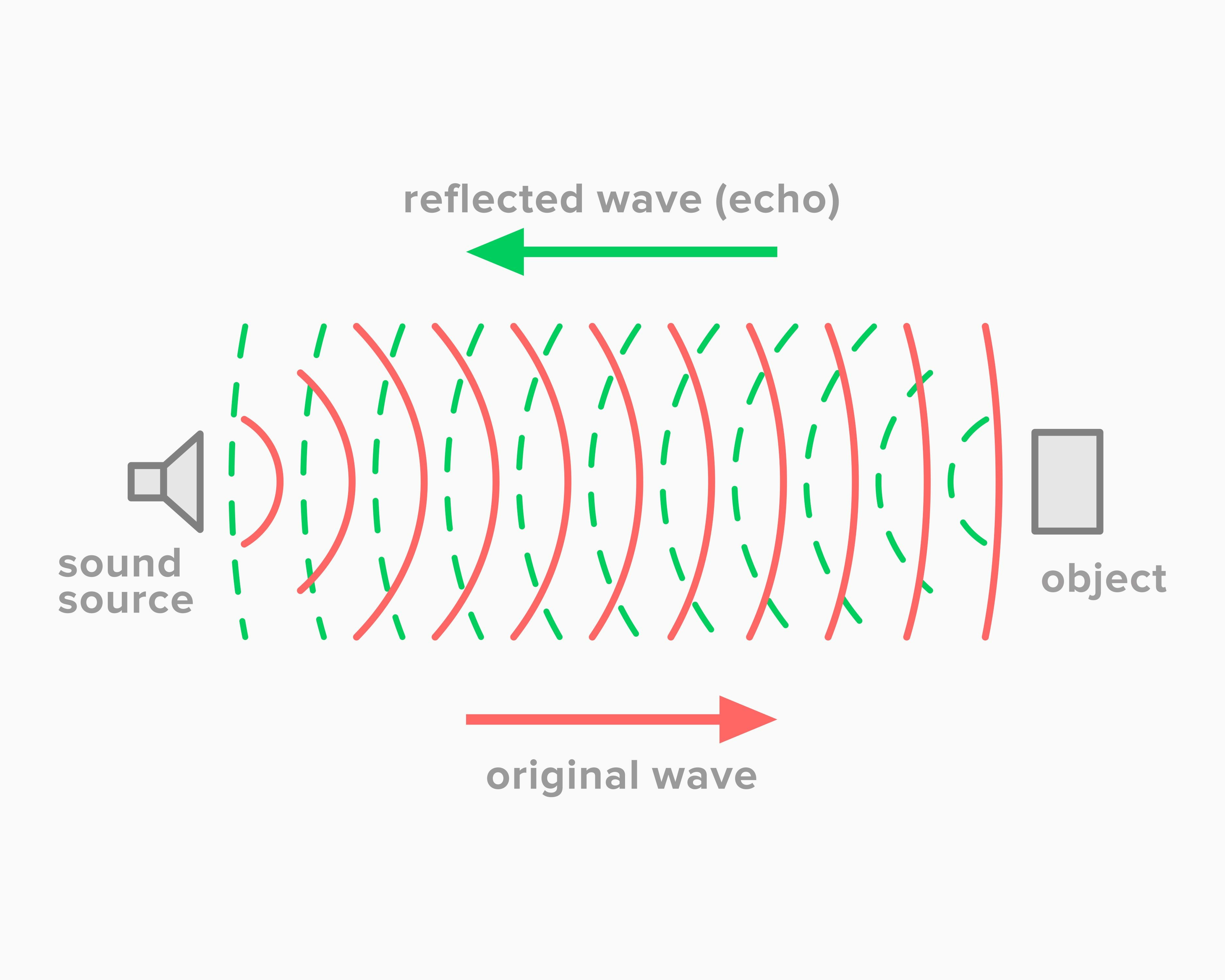
If a room sounds loud and muddy, with voices that seem to hang in the air, you’re probably hearing reverberation. People usually call it echo, and in everyday speech that’s fine. But the two are different, and in most rooms the one you need to fix is reverberation.
Quick answer To reduce reverberation, add sound-absorbing material to the room’s hard surfaces, such as acoustic wall panels, ceiling clouds or baffles. Spread them across more than one surface, and size them to the room. An echo is a distinct repeat of a sound, while reverberation is many reflections blending into a lingering tail. Heavier walls won’t help with either one inside the room.
Echo vs. Reverberation: What’s the Difference?
Both are sound that bounces back off a surface. The difference is timing. A reflection that arrives about 50 milliseconds or more after the original can be heard as a separate sound, which is an echo. Anything sooner blends with the original. Simpler explanations, like The Physics Classroom, use 0.1 seconds.
| Echo | Reverberation | |
|---|---|---|
| What you hear | A distinct repeat | A continuous, fading tail |
| Timing | About 50 ms or more | Many reflections, too close together to separate |
| Where it happens | Canyons, empty gyms, long halls | Almost any room with hard surfaces |
| How it’s measured | Delay | RT60, in seconds |
A true echo needs distance, with a reflecting surface about 28 ft or more away. That’s why you don’t get one in a small office, but you can still get plenty of reverberation there. Our sister company Commercial Acoustics has a longer guide to echo vs. reverberation if you’d like more detail.
What Is Reverberation Time (RT60)?
Reverberation time, or RT60, is how long a sound takes to fade by 60 dB after it stops. Longer times make speech harder to follow, because each word runs into the tail of the one before it. The right number depends on the room. Here are general ranges from Commercial Acoustics, though a specific project may aim a little higher or lower:
| Room | RT60 |
|---|---|
| Recording studios and vocal booths | Under 0.3 seconds |
| Offices, classrooms and conference rooms | 0.3 to 0.5 seconds |
| Restaurants and libraries | 0.5 to 0.8 seconds |
| Lecture halls and speech-led worship | 0.8 to 1.2 seconds |
| Gymnasiums and large worship spaces | 1.2 to 2.0 seconds |
| Concert halls and cathedrals | Over 2.0 seconds |
How to Measure Reverberation in a Room
- The clap test. Clap once and listen. A ring or lingering tail tells you there’s a problem, but it won’t give you a number.
- A phone app. RT60 apps give a rough reading, good enough to compare a room before and after treatment.
- A calculation. The Sabine formula estimates RT60 from the room’s size and surfaces, as shown below.
- A professional test. Worth paying for in large or critical rooms, or when you need numbers to show someone.
An empty room usually reads higher than a full one, because people and clothing absorb sound. Measuring it empty gives you the worst case.
What Reduces Reverberation: Panels, Clouds, & Baffles
Reverberation comes from sound reflecting off hard surfaces, so the fix is to swap some of those surfaces for absorbing ones:
- Sound absorbing wall panels: the usual starting point. Ours are 2 in fiberglass, rated NRC 1.05. See how to hang acoustic panels.
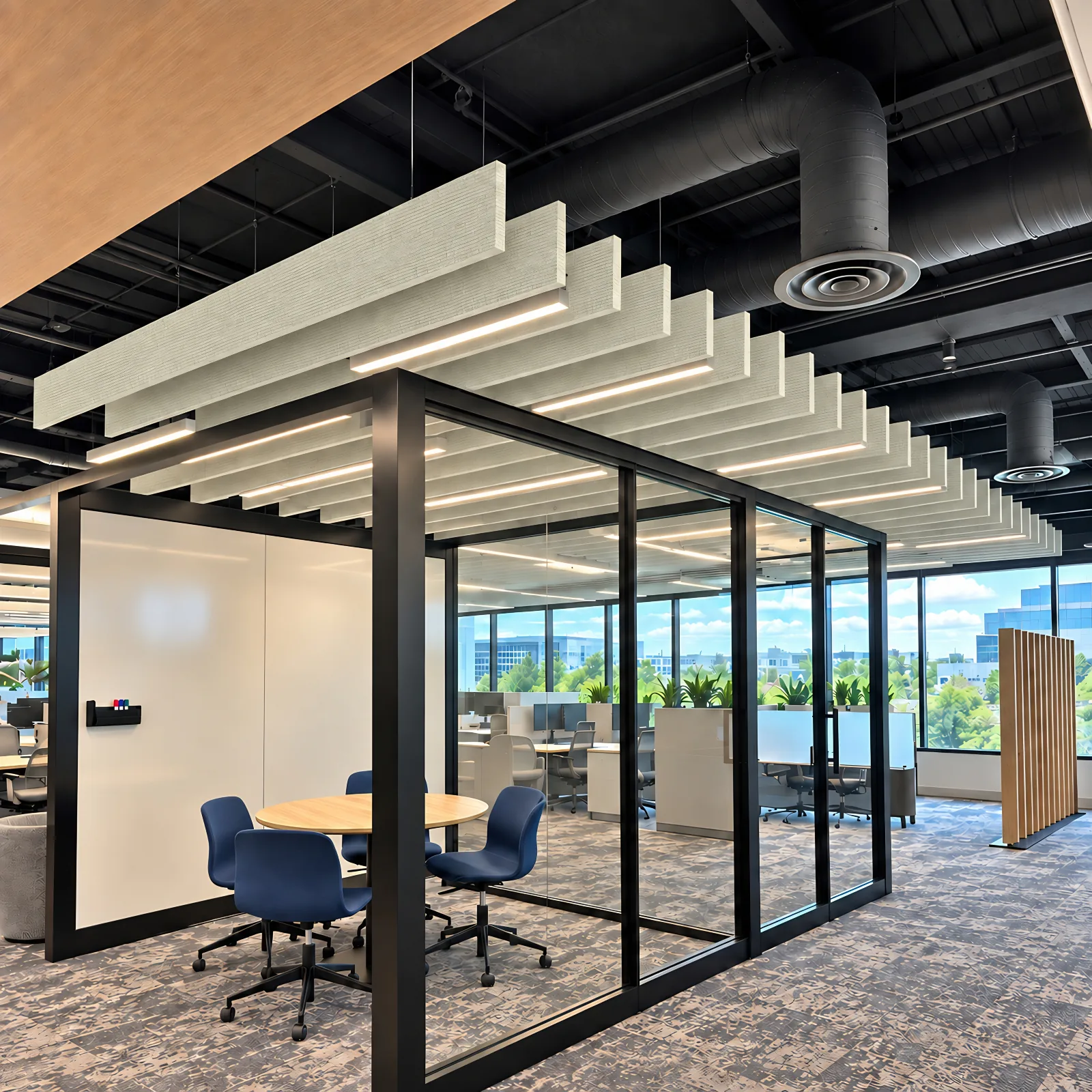
- Acoustic ceiling clouds: a good choice when windows, shelves or glass leave little wall space.
- Acoustic ceiling baffles: these hang on edge and absorb on both faces, which suits high, open ceilings.
- Soft finishes: carpet, rugs, drapes and upholstered seating all help, and they’re often enough for a mildly bright room at home.
Where you put them matters too. Treat more than one surface, including walls that face each other and the ceiling, instead of filling one wall. For room-specific advice, see our guides to conference rooms, coffee shops and gyms.
Real project: 1.1 seconds down to 0.7 Cena, an Italian restaurant in Tampa, had tall ceilings, full-height windows and painted drywall, and it measured 1.1 seconds, too long for guests talking across a table. Commercial Acoustics added 2 in fiberglass ceiling clouds and wall panels in fabric matched to the decor, and the room measured 0.7 seconds afterward. The project cost under $6,000 turnkey, and the install took one afternoon.
How Much Absorption Do You Need?
A good rule of thumb is panels equal to 15–25% of the floor area. To get closer, use the Sabine formula: RT60 = 0.049 × room volume in cubic feet ÷ total absorption in sabins.
Say you have a 20 ft × 25 ft room with a 10 ft ceiling, which is 5,000 cu ft, and it measures 1.2 seconds:
- Now: 0.049 × 5,000 ÷ 1.2 = about 204 sabins of absorption.
- Target of 0.8 seconds: 0.049 × 5,000 ÷ 0.8 = about 306 sabins.
- The gap: about 102 sabins to add.
- One 4 ft × 4 ft panel at NRC 1.05: 16 sq ft × 1.05 = about 16.8 sabins.
That works out to 6 or 7 panels, which at $259 each is $1,554 to $1,813 before shipping. It’s an estimate, not a guarantee, since the formula is less reliable in very large or oddly shaped rooms. Commercial Acoustics has a full walkthrough of how many panels a room needs.
What Doesn’t Fix Reverberation
- Soundproofing materials. Mass loaded vinyl blocks sound from passing through a wall, but it doesn’t absorb much. The reverse is true as well: panels reduce reverberation, but they won’t stop neighbors hearing you.
- Thin foam tiles. These mostly absorb high frequencies, so a room can end up sounding dull while the lower part of voices and music still rings.
- Egg cartons. They don’t absorb enough to matter.
- Diffusers alone. Sound diffusers scatter reflections, which can make a room sound better, but they won’t lower reverberation much by themselves.
Frequently Asked Questions
How do you reduce reverberation in a room?
Add sound-absorbing material to the hard surfaces. Acoustic wall panels, ceiling clouds and baffles are the main options, and carpet and drapes help in smaller rooms. Spread the treatment across more than one surface.
What is the difference between echo and reverberation?
An echo is a distinct repeat, and reverberation is a blended tail. A reflection arriving about 50 milliseconds or more after the original can be heard separately as an echo. Reflections arriving sooner blend together into reverberation.
What is a good reverberation time for a room?
It depends on the use. Commercial Acoustics’ general ranges are about 0.3 to 0.5 seconds for offices and classrooms, 0.5 to 0.8 for restaurants, and 1.2 to 2.0 for gymnasiums and large worship spaces.
Does soundproofing reduce reverberation?
Not really. Soundproofing uses mass and sealing to stop sound from passing through walls and floors. Reverberation happens inside the room, so it needs absorption instead. Many rooms need both, but they’re separate jobs.