Quick answer Screw impaling clips to the wall, about one per 4 sq ft of panel, and press the panel onto them. Start at ear height on the side walls and the wall facing the listener, and spread the panels around the room.
Table of Contents
How to Hang Acoustic Panels
Acoustic panels go up like heavy picture frames, but a real fiberglass panel is heavier than a frame, so the hardware matters. With impaling clips, a typical room takes about 15 minutes:
- Mark the layout. Decide where each panel goes (see placement below) and mark the outline lightly in pencil, using a level for the top edge.
- Screw the impaling clips to the wall inside each outline, spaced so they’ll sit evenly behind the panel. Use drywall anchors where a clip doesn’t land on a stud.
- Line up the panel with the pencil marks and press it firmly onto the clips. The angled spikes bite into the fiberglass core and hold it flush to the wall.
- Check it’s level and press again along the edges. To move a panel later, pull it straight off the spikes and press it on somewhere else.
Our sound absorbing wall panels come with impaling clips in every order, so there’s nothing else to buy.
Ways to Mount Acoustic Panels
Most guides treat acoustic panels like light foam squares. A 2″ fiberglass panel weighs 4 to 24 lb depending on size, so some methods that work for foam don’t hold up:
| Method | How it works | Easy to move? | Best for |
|---|---|---|---|
| Impaling clips | Screw the clip to the wall, press the panel onto its spikes | Yes | Fiberglass panels – the standard method |
| Z-clips | One half on the wall, the other set into the back of the panel; slide them together | No | Permanent installs, panels held tight to the wall |
| Picture wire or sawtooth hangers | Hang from a hook like a framed picture | Yes | Light framed panels |
| Construction adhesive | Glued straight to the wall | No, damages the wall | Rarely the right choice |
| Velcro or adhesive strips | Stick-on strips | Yes | Lightweight foam only, not fiberglass |
Impaling Clips
Impaling clips are flat metal plates with sharp angled teeth. They’re the most common way to hang fiberglass panels because they’re quick, hold the panel flush, and let you reposition panels later. Use about one clip for every 4 sq ft of panel: two for a 2′ × 4′, four for a 4′ × 4′, six for a 4′ × 6′.
Z-Clips
Z-clips come in two parts. One screws to the wall with its open side facing up; the other is set into the back of the panel, usually hardened into the fiberglass with resin, with its open side facing down. Lower the panel so the two hook together. Z-clips hold panels very tight to the wall, but moving one later takes real work, so use them where the layout is final.
Hanging Acoustic Panels on the Ceiling
Panels can be mounted flat against the ceiling, but in a room with heavy echo they work better hung a few inches down as acoustic ceiling clouds. With air above and below, both faces absorb sound. If the ceiling is the biggest hard surface in the room, treat it first and come back to the walls.
Where to Place Acoustic Panels
Where the panels go matters as much as how many you hang. Follow these rules in order:
- Start at the first reflection points. These are the spots on the side walls where sound bounces once on its way from the speaker or talker to the listener. Sit in the listening position and have someone slide a mirror along the wall: wherever you can see the speaker in the mirror, hang a panel.
- Treat the wall facing the listener or talker, then the wall behind them.
- Never leave two parallel walls bare. Sound bouncing between two hard, parallel walls causes flutter echo, even in a small room.
- Spread panels out. The same number of panels spread across several walls works better than one big block on a single wall.
- Hang them at ear height and above. The reflections that matter arrive roughly 3 to 7 feet off the floor. Keep the bottom edge above chair backs so panels don’t get knocked or dirty.
- Keep the face clear. A bookcase or TV in front of a panel cuts what it can absorb.
Acoustic Wall Panels for a Recording Studio
A studio needs more treatment than an office, and where it goes depends on what the room is for:
- Mixing or control room: set up symmetrically. Panels at the first reflection points on both side walls, on the wall behind the monitors, and on the ceiling between the monitors and your chair. Then treat the rear wall, or use barrel or pyramid diffusers there so the room doesn’t sound dead.
- Vocal booth or tracking room: cover the walls around the microphone so the voice doesn’t bounce back into it. Symmetry matters less here than coverage.
- Corners: bass builds up in corners, so panels straddling a corner help a boomy room.
Studios often end up with 25 to 35% of the floor area in panels or more. For a full build, see our guides to radio studio soundproofing and soundproofing a music room.
How Many Acoustic Panels Do You Need?
Work it out from the floor area:
- Speech spaces – offices, classrooms, restaurants: panels covering 15 to 25% of the floor area.
- Music rooms, studios, high ceilings or a lot of glass: 25 to 35%.
For example, a 30′ × 20′ dining room is 600 sq ft, so it needs 90 to 150 sq ft of panels: eleven to nineteen 2′ × 4′ panels, or six to ten 4′ × 4′.
Do Acoustic Panels Work?
Yes, for the job they’re designed for: echo. Acoustic panels absorb sound inside a room, so speech is easier to understand, recordings are cleaner, and a loud room calms down. They do not soundproof – they won’t stop noise passing through a wall to the next room. That takes mass, like mass loaded vinyl in the wall.
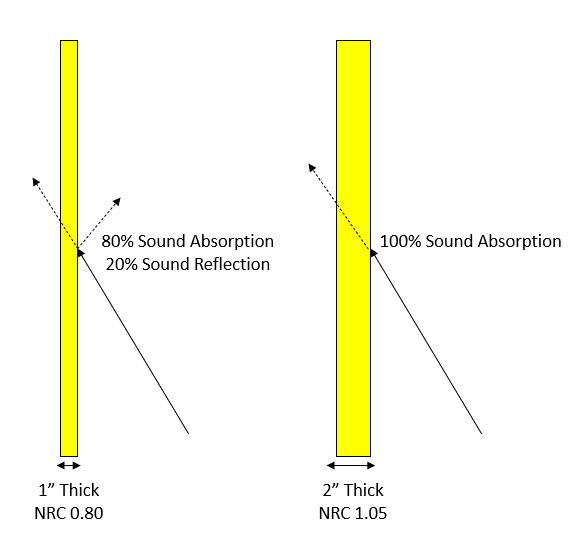
Sound passes through the acoustically transparent fabric into a fiberglass core, where it turns into a tiny amount of heat instead of bouncing back. How much a panel absorbs is its NRC, roughly 0 to 1: a 1″ panel is around NRC 0.80, and our 2″ panels of 6 pcf fiberglass are NRC 1.05. Thicker panels also reach lower into the bass, so choose 2″ for most rooms. For other materials and styles, see the 13 types of acoustic wall panels.
Frequently Asked Questions
What is the best way to hang acoustic panels?
Impaling clips, for fiberglass panels. Screw the clips to the wall and press the panel onto them. They hold the panel flush and let you move it later.
Can you hang acoustic panels without drilling?
Only light foam panels. Adhesive strips and Velcro won’t reliably hold a fiberglass panel over time, and construction adhesive damages the wall. For a 2″ fiberglass panel, use clips.
How high should acoustic panels be hung?
Centered around ear height, covering roughly 3 to 7 feet off the floor where the important reflections land. Keep the bottom edge above chair backs.
Where should acoustic panels go in a room?
At the first reflection points on the side walls first, then the wall facing the listener and the wall behind them. Spread them across the room and never leave two parallel walls bare.
Do acoustic panels soundproof a room?
No. Acoustic panels reduce echo inside a room; they don’t block noise from getting in or out. To stop sound passing through a wall, add mass, like mass loaded vinyl under drywall.