Table of Contents
Acoustic Baffles vs. Clouds: The Difference
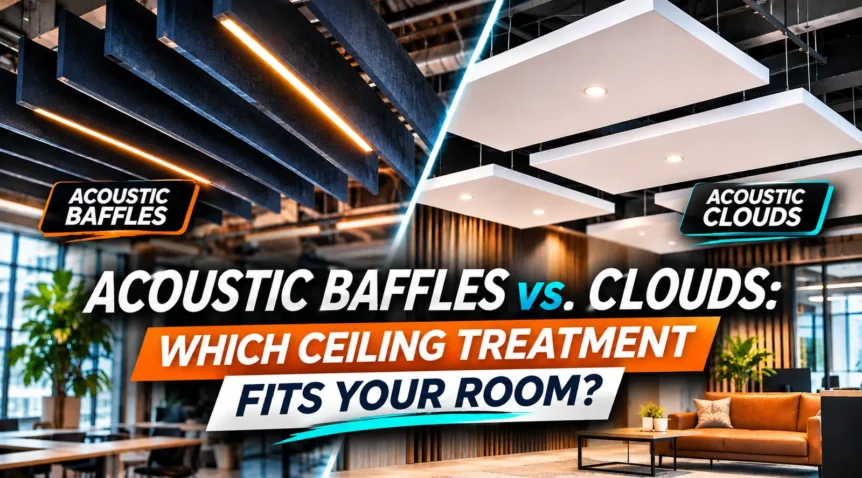
Baffles and clouds are the same idea turned 90 degrees. Both are sound absorbing panels that hang from the ceiling to cut echo. A cloud hangs flat, parallel to the floor. A baffle hangs on edge, like a sign. That one change decides which rooms each one suits, and in most rooms the choice is obvious once you look up.
Neither one is soundproofing, by the way. They stop sound bouncing around inside the room they hang in. They do not stop noise from the floor above or the room next door.
Quick answer Use baffles in rooms with high, open ceilings full of trusses, lights, and ductwork, such as gyms, warehouses, and cafeterias. Use clouds in rooms with lower or flat ceilings, such as classrooms, offices, restaurants, and home theaters. Big rooms with mixed ceilings can use both.
How Baffles & Clouds Absorb Sound Differently
A baffle hanging on edge has both large faces and its bottom edge exposed to the room. In a tall space, sound travels up, passes between the rows, and gets caught by the faces on the way up and again on the way back down. Baffles also slot into the gaps between lights, sprinkler heads, and duct runs, which matters in a gym or warehouse where the ceiling is already crowded.
A cloud hangs flat a short distance below the ceiling. Its front faces the room, and because there is air behind it, the back face and the edges absorb too. That gives it roughly twice the working surface of the same panel screwed flat to the ceiling. In a room with an ordinary ceiling height, the face pointing straight down is exactly where the reflections between talkers and listeners happen.
Baffles vs. Clouds Comparison Chart
| Acoustic ceiling baffles | Acoustic ceiling clouds | |
|---|---|---|
| How it hangs | Vertically, on edge | Horizontally, flat |
| Faces working | Both faces and the bottom edge | Front, back, and edges |
| Best ceiling | High and open to the structure | Lower, flat, or a hard deck |
| Typical rooms | Gyms, warehouses, cafeterias, arenas, atriums | Classrooms, offices, restaurants, worship spaces, home theaters |
| Our sizes | 4 ft x 1 ft, 2 ft x 2 ft, 4 ft x 2 ft, 4 ft x 4 ft | 2 ft x 2 ft, 2 ft x 4 ft, 2 ft x 6 ft, 4 ft x 4 ft, 4 ft x 6 ft |
| Thickness | 2 in, fabric wrapped | 2 in, 6 pcf fiberglass, NRC 1.05 |
| Layout | Parallel rows across the room | Spread out, covering 15 to 35 percent of the floor area |
| Fabrics | 24 colors | The same 24 colors |
When Hanging Sound Baffles Are the Better Choice
Pick baffles when the room is tall, hard, and loud, and the walls are already taken. A school gym is the classic case. The walls are bleachers, doors, and windows, the ceiling is steel deck 20 or more feet up, and every whistle hangs in the air for seconds. Warehouses, factories, natatoriums, big cafeterias, and atriums have the same problem.
My rough rule: once the ceiling is well above 12 feet and open to the structure, start with acoustic ceiling baffles. In that kind of room, a flat panel would cover lights and sprinklers, and you would run out of usable ceiling before you got enough absorption up there. Baffles take up very little plan area, so you can hang a lot of them between the things already overhead.
Hang them in parallel rows running the same way across the room, spread evenly instead of bunched in one corner. Use the large 4 ft x 4 ft size to cover ground fast, and the smaller sizes to fill spaces around beams and ducts where a big one will not fit. Acoustic panels for gyms shows how that plays out in a real gym.
When Acoustic Ceiling Clouds Are the Better Choice
Pick clouds when the ceiling is at a normal height or flat, and the room is about speech. Classrooms, open offices, conference rooms, restaurants, and churches with flat ceilings all fall here. A baffle in a 9 foot office would hang into people’s sight lines and still not do as much as a flat panel. A cloud keeps to the ceiling and points its face down at the room.
Clouds also suit rooms with exposed structure where you want a finished look. A cloud hanging under an open ceiling in a restaurant reads as a design choice. Rows of baffles in the same room can feel industrial, which is great in some spaces and wrong in others.
For coverage, aim for 15 to 25 percent of the floor area in speech rooms and 25 to 35 percent for music, high ceilings, or a lot of glass. A 1,200 square foot classroom needs 180 to 300 square feet of panel, about twelve to nineteen 4 ft x 4 ft acoustic ceiling clouds. They are Class A fire rated and come with Rotofast mounts that twist into the core, so there is no frame to build. You supply the eyebolts and cable to suit your structure.
Using Baffles & Clouds Together in One Room
Big buildings often have both kinds of ceiling. A school cafeteria might have a tall open middle and a lower soffit along the serving line. A church can have a high vaulted nave and a flat ceiling over the side aisles. Baffles go in the tall part and clouds go in the low part, and since both come in the same 24 fabrics, they can match.
If the room still rings after the ceiling is treated, add sound absorbing wall panels on the walls you can reach. The ceiling comes first because it is usually the largest hard surface and it faces every person in the room. How to reduce reverberation explains why, and how to hang acoustic panels covers the hardware.
What Baffles & Clouds Will Not Fix
This is where people get burned. If the problem is footsteps from the floor above or a loud neighbor through the wall, neither baffles nor clouds will touch it. That takes mass in the structure itself, such as mass loaded vinyl under a new layer of drywall. The ceiling treatment handles echo and the mass handles noise coming through. Plenty of rooms need both, but they are separate jobs and separate purchases.
What is the difference between acoustic baffles and clouds?
Orientation. Baffles hang vertically on edge and suit high, open ceilings. Clouds hang flat below the ceiling and suit lower or flat ceilings. Both absorb echo inside the room.
Are baffles or clouds better for a gym?
Baffles, in most gyms. Gym ceilings are tall and crowded with lights, sprinklers, and ductwork, and baffles hang in rows between them while absorbing on both faces. Clouds work in gyms with lower, flat ceilings.
Can you use acoustic baffles on a low ceiling?
You can, but clouds usually do better there. On a ceiling around 8 to 10 feet, a baffle hangs into the room’s sight lines, while a cloud stays close to the ceiling and faces the sound coming up from below.
Do ceiling baffles or clouds block noise from upstairs?
No. They absorb echo inside the room they hang in. Blocking footsteps or voices from the floor above takes mass and isolation in the ceiling itself.
How many ceiling clouds does a room need?
Cover 15 to 25 percent of the floor area for speech rooms such as classrooms and offices, and 25 to 35 percent for music, high ceilings, or a lot of glass. Spread them out instead of grouping them.