Table of Contents
How to Compare Acoustic Wall Panel Types
Most people picture the standard 2’x4′ fabric-wrapped rectangle. That is one of thirteen types in common use, and they are not interchangeable — some are built to absorb sound, and some are built mostly to look like they do.
Most guides sort panels by material. Acousticians sort them by how they work, because the mechanism decides which frequencies a panel actually handles, and a panel that kills harsh treble does nothing for a boomy room. This guide follows the acousticians.
What Is an Acoustic Wall Panel?
An acoustic wall panel is a panel mounted to a wall to absorb sound energy inside a room, reducing echo and reverberation and making speech easier to understand. Most use a 6 pcf fiberglass core wrapped in acoustically transparent fabric, though mineral wool, polyester, felt, foam, wood, metal and plaster are all used.
Panels absorb sound within a room. They do not stop it passing between rooms — if you can hear your neighbor through the wall, that is a mass and isolation problem and needs a different product entirely.
How Acoustic Wall Panels Absorb Sound
Every panel below works by one of three mechanisms, and knowing which one you’re buying tells you more than any product page will.
- Porous absorbers turn sound into a tiny amount of heat as air is forced through fibers or open cells. They are excellent from the mid frequencies up, and they need real thickness to reach low frequencies. Most acoustic panels are porous absorbers.
- Resonant absorbers use a cavity of trapped air behind a solid or perforated face. The air resonates at a tuned frequency and the energy is lost there. These reach low frequencies at thicknesses a porous absorber can’t touch, but they work over a narrower band.
- Micro-perforated absorbers are a modern middle ground: thousands of sub-millimetre holes in a thin sheet, with the friction happening in the holes themselves. They need no fibrous fill at all, which is why they can be made from clear acrylic.
The practical version: if your room sounds harsh and echoey, you want porous. If it sounds boomy and thick, you need something resonant or something very thick. Most real rooms want a mix.
Porous Acoustic Wall Panels
1. Fabric-Wrapped Fiberglass Panels
- Material: Rigid fiberglass board at 6-7 pcf (pounds per cubic foot), 1″ or 2″ thick, wrapped in fabric loose enough for sound to pass straight through it.
- Impact option: A hardened 16 pcf face, 1/8″ thick, for gyms, corridors and schools.
- Mounting: Impaling clips (spikes glued to the wall) or z-clips (interlocking rails).
The benchmark the other twelve get measured against, and what most people mean when they say acoustic wall panels. A 2″ panel absorbs across the whole speech range where a 1/2″ decorative panel only touches the top end, and because the fabric is acoustically transparent the finish costs nothing in performance.
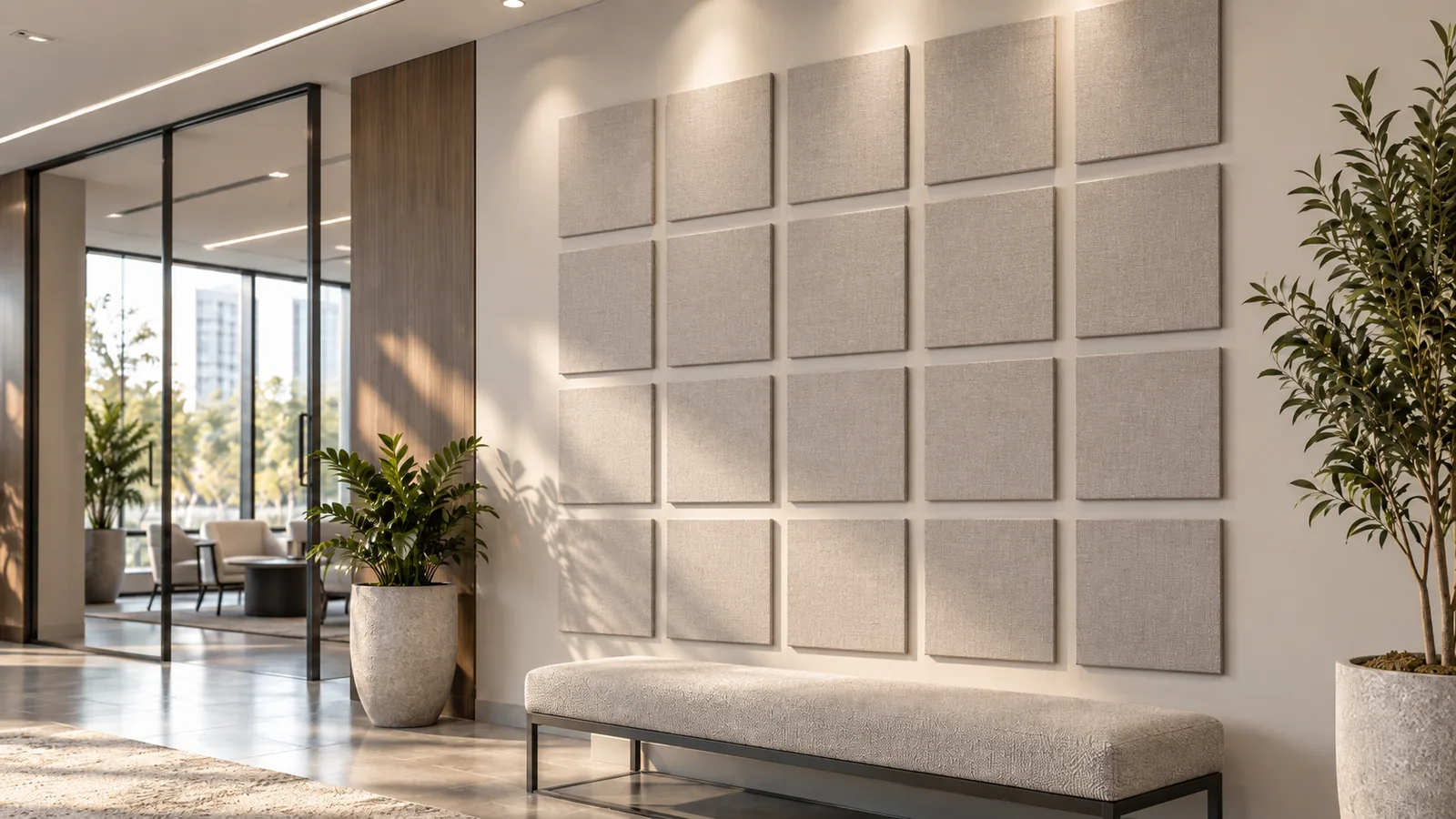
Best for Conference rooms, classrooms, restaurants, worship spaces and studios. Anywhere absorption performance is the actual goal.
2. Mineral Wool Acoustic Panels
- Material: Stone wool – basalt rock melted at around 1,500°C and spun into fiber, then bonded into board. Also sold as rockwool or mineral wool.
- Fire: Resists flame with no added treatment, because rock does not burn.
- Build: Will not hold a rigid edge, so it needs a frame and cannot be cut on site.
Acoustically this is a near twin of fiberglass, so the choice is almost never about performance. It wins where a fire inspector is involved, because it passes with no added treatment. It loses on fabrication: with no bonded edge, every panel needs a frame built around it, which adds cost and rules out trimming to fit.
Best for DIY builds, and jobs where fire performance is scrutinised. In a finished commercial panel there is rarely a reason to pay the premium over fiberglass.
3. Field-Fabricated (Stretched Fabric) Wall Systems
- Material: Built in place rather than delivered: a track frame screwed to the wall, insulation batt set inside it, fabric stretched over and tucked into the track.
- Look: A seamless fabric wall instead of a grid of panels.
- Cost: Higher, and it needs a skilled installer.
The acoustics match fiberglass panels exactly – what you are buying is coverage. Because it is built in place it runs around doors, outlets and columns that would force awkward gaps, and on a full wall it removes the visible panel grid, which is usually why an architect picks it.
Best for Floor-to-ceiling or wall-to-wall coverage, and partitions with outlets, doors or columns that force awkward panel layouts.
4. PET Felt Acoustic Panels
- Material: PET is polyethylene terephthalate, the plastic used for drinks bottles. The fiber is heat-pressed into a rigid board and dyed right through, so it needs no fabric cover. Panels sold as felt are usually the same PET pressed finer and denser.
- Thickness: Normally 1/2″ or 1″, which is what limits it.
- Fabrication: Cuts with a blade or circular saw into hexagons, circles, any shape.
The gap between these and fiberglass is not subtle: at 1/2″ they do almost nothing low down, so a room that booms will still boom. What they do well is look good and cut into shapes, which is why they have taken over offices where a designer leads the specification.
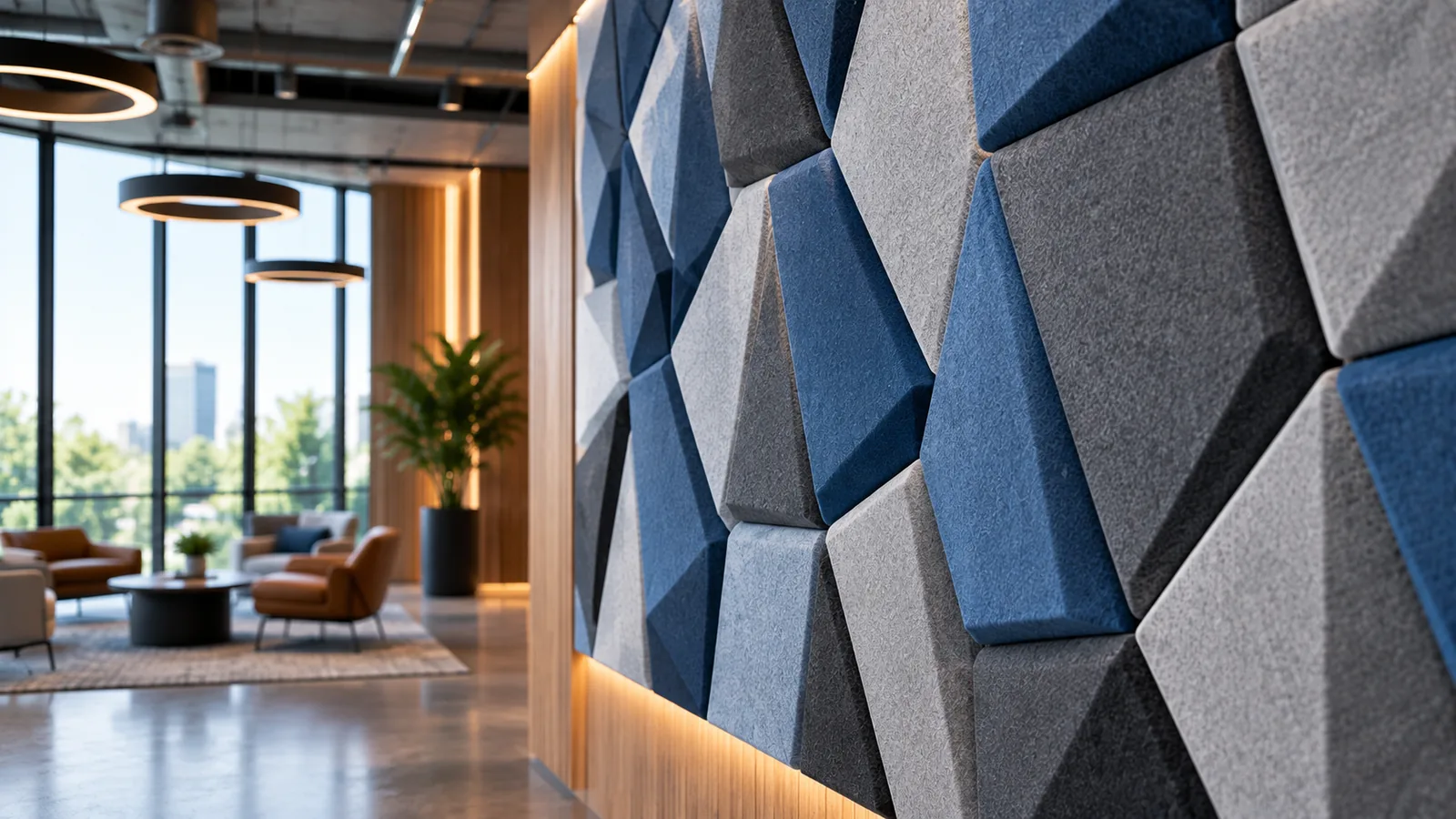
Best for Small conference rooms, team rooms and phone booths where the echo is mild and the look matters as much as the performance.
5. Melamine Foam Acoustic Panels (Basotect)
- Material: Melamine resin whipped into an open-cell foam. It contains no petroleum, which is why it resists flame without any treatment added. BASF sells it as Basotect.
- Fire: Class A untreated.
- Absorption: NRC around 0.65 to 0.95 at 2″ depending on mounting – NRC is a 0 to 1 scale where higher absorbs more.
This is the foam that is not a compromise. It reaches fiberglass-class absorption at a fraction of the weight, which is what makes it viable on curved and suspended work. The fire rating is intrinsic rather than sprayed on, so it survives the scrutiny that ordinary acoustic foam fails.
Best for Commercial spaces needing a Class A rating with complex or curved surfaces, and installs where panel weight is a constraint.
6. Polyurethane Acoustic Foam
- Material: Open-cell polyurethane foam, the same chemistry as upholstery foam, cut into wedges or pyramids. This is the cheap studio foam sold in packs online.
- Absorption: High frequencies reasonably, very little in the low mids.
- Fire: Class B at best untreated, against melamine’s Class A.
The distance between polyurethane and melamine is the whole reason to know they are different materials. They photograph the same and behave similarly at high frequencies, but only one of them passes a commercial fire inspection. And if the room sounds boxy, neither will fix it – that is a thickness problem, not a foam problem.
Best for Home studios and hobby spaces on a tight budget. Not for commercial installs.
Melamine vs. polyurethane: what actually separates them
- Fire rating: Melamine is Class A with nothing added to it – the resin does not sustain a flame on its own. Polyurethane is Class B at best and needs a chemical retardant to go anywhere near a commercial wall or ceiling. This is the difference that fails inspections.
- What they absorb: Melamine works across the whole speech range and keeps going into the low mids. Polyurethane handles the top end and gives up below it, so it takes the harshness off a room without touching the boom.
- How they hold up: Polyurethane is the tougher surface – it shrugs off handling, dust and damp. Melamine is light enough to hang on curves and suspended work, but it is friable and crumbles where people brush past it.
- Cost: Polyurethane is the cheap foam sold in packs online. Melamine costs several times more, and on a commercial job the fire rating is what you are paying for.
7. Cementitious Wood Fiber (Tectum) Panels
- Material: Wood fibers, usually aspen, bound with Portland cement into a rigid coarse board. Tectum is the best known brand.
- Mounting: Needs to stand off the wall with insulation in the gap behind it, not sit flat, or most of the absorption is lost.
- Finish: Field cut on a table saw, hung, then painted.
You specify this for survival, not for absorption numbers. Fixed flat it performs modestly and the airspace behind does most of the work, so the mounting detail matters more here than anywhere else on this list. What it buys is a surface that shrugs off a basketball.
Best for Gymnasiums, natatoriums, corridors and mechanical rooms. Anywhere panels get hit by a ball or a cart.
Resonant & Perforated Acoustic Panels
8. Perforated Wood Acoustic Panels
- Material: A wood veneer or MDF (medium-density fiberboard) face drilled with holes or cut with slots, over acoustic fleece and usually insulation behind that.
- What decides performance: Open area – how much of the face is actually hole – and what sits in the cavity.
- The trap: A tight pattern with nothing behind it is close to a solid wood wall.
Unlike a fabric panel, the surface you can see here is reflective – the absorbing happens behind it. That makes open area the single number that matters, and it is the one catalogues bury. Slot width and cavity depth also tune which frequencies get absorbed, which is why these appear in rooms an acoustician designed rather than ones picked from a brochure.
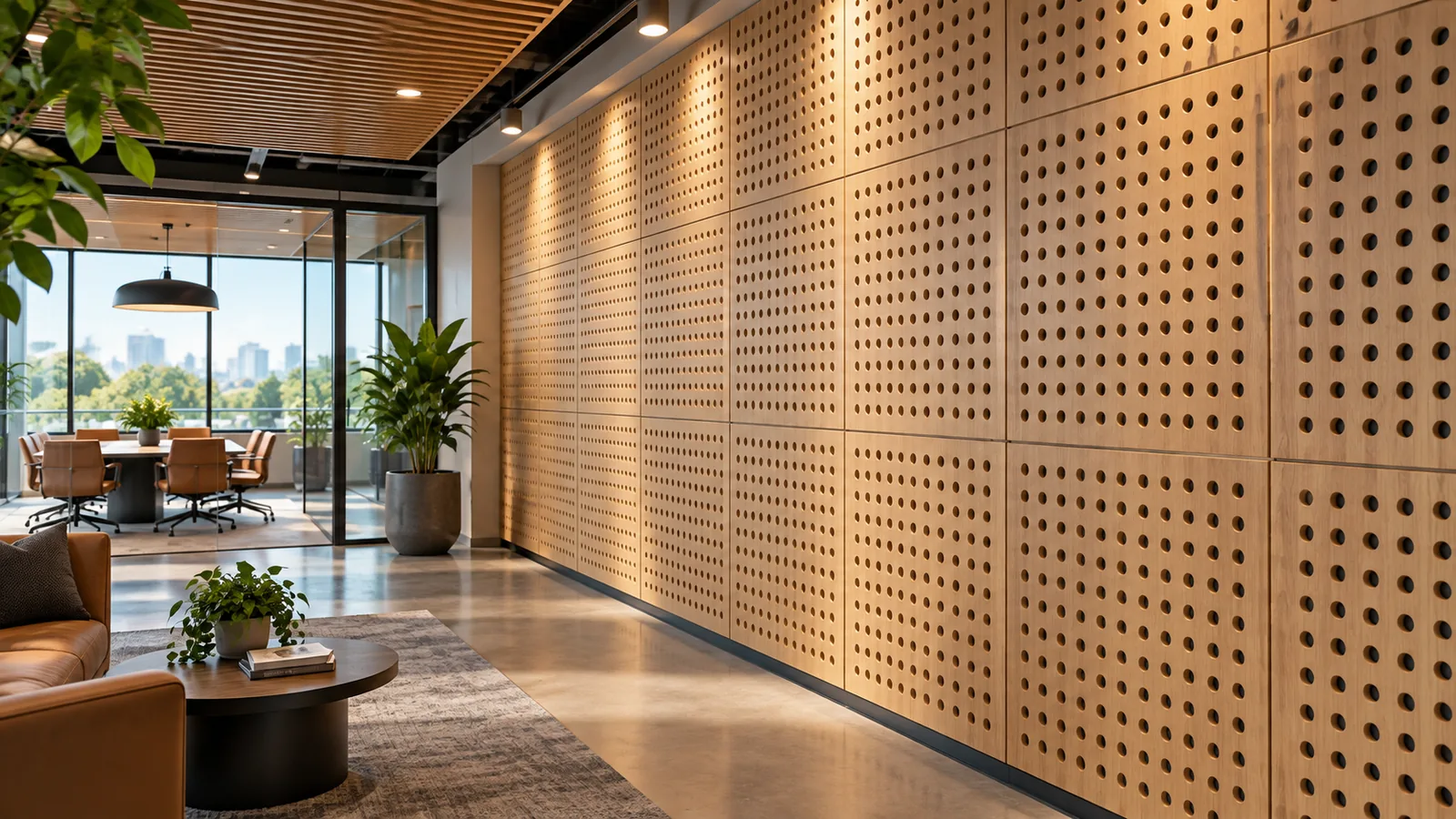
Best for Auditoriums, lecture halls, libraries and lobbies where the design calls for a wood finish and the budget supports it.
9. Perforated Metal Acoustic Panels
- Material: Perforated aluminium or steel sheet over a cavity holding mineral fill wrapped in fleece.
- Survives: Washdown, moisture and impact.
- The trap: A decorative pattern with too little open area absorbs almost nothing.
Metal gets specified where every other absorber fails the environment, not because it absorbs better. In a pool hall or a commercial kitchen, fabric and exposed fiber are non-starters and this is what remains. It also forms into curves while keeping the perforation consistent, which no rigid panel type manages.
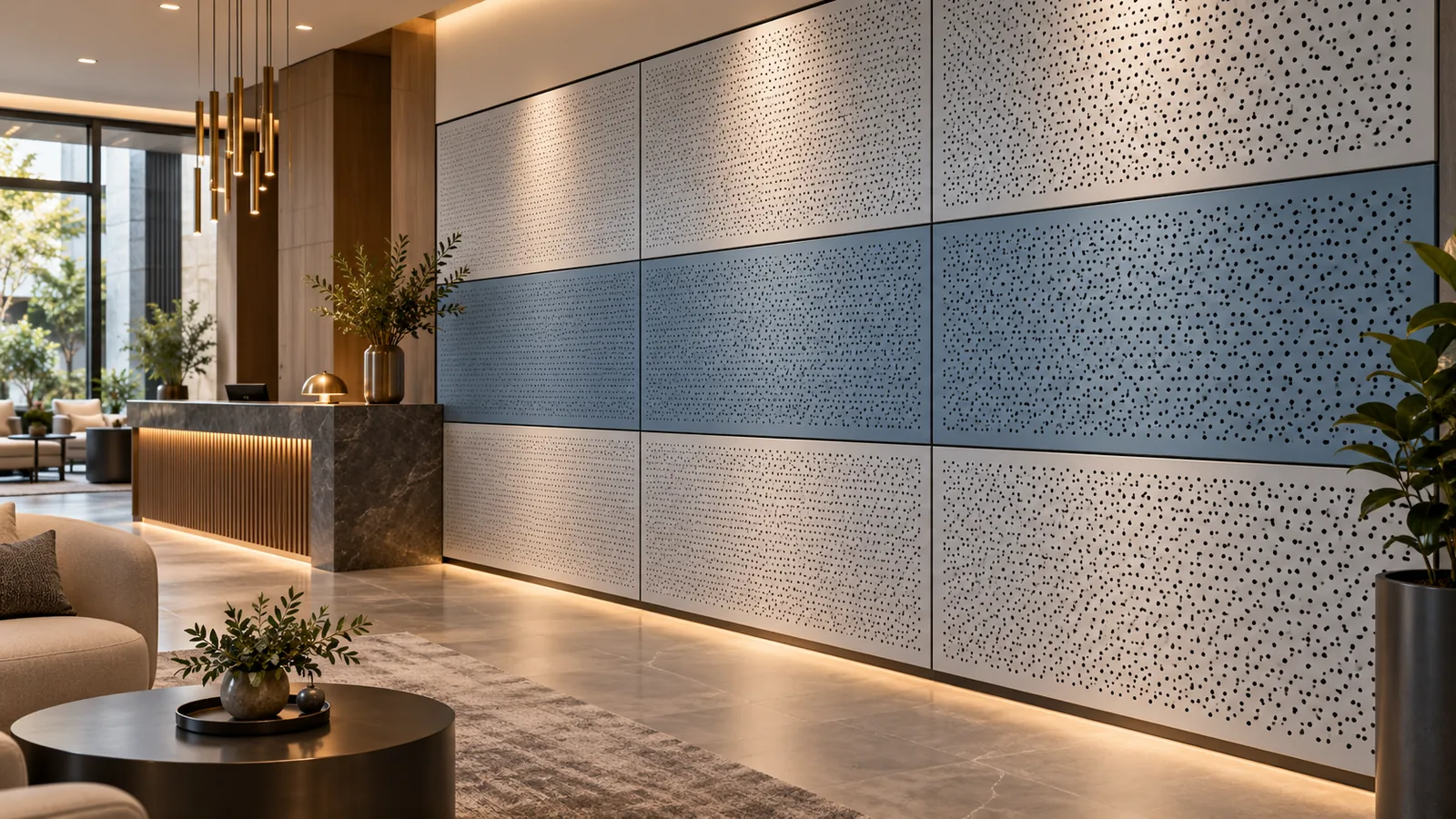
Best for Transit stations, pools, industrial spaces, commercial kitchens and exteriors. Anywhere that gets hosed down or hit.
10. Micro-Perforated Acoustic Panels
- Material: A thin rigid sheet – metal, acrylic or polycarbonate – punched with holes under a millimetre across, hung over an air gap. No insulation anywhere in it.
- How it works: Air forced through the tiny holes loses energy to friction inside them, so the holes do the job fiber normally does.
- Materials: Includes clear acrylic and polycarbonate.
This is the only absorber here that can be transparent, which makes it the answer in front of glazing or a display where nothing else is even an option. With no fibrous fill there is nothing to shed, so it also clears cleanrooms, labs and food production. The tradeoff is cost, and a narrower useful band than a thick porous panel.
Best for Glazed atriums, control rooms, cleanrooms, food and pharma. Anywhere fibers are unacceptable or the wall needs to stay see-through.
11. Membrane (Diaphragmatic) Bass Absorbers
- Material: A solid unperforated sheet – plywood, MDF or a limp membrane – sealed over an air cavity, often with light damping inside.
- Tuning: Panel mass and cavity depth decide its target frequency.
- Limit: Narrowband, so the room has to be measured first.
Every other absorber on this list works by friction; this one works by flexing, which is how it reaches low frequencies at a depth porous material cannot. A tuned membrane a few inches deep can outperform a foot of fiberglass down low. The catch is that it only works near the frequency it was built for, so it belongs in rooms someone has actually measured.
Best for Control rooms, mixing rooms and home theaters with a specific low frequency problem identified by measurement.
Decorative Acoustic Wall Panels
12. Wood Slat Acoustic Panels
- Material: Solid timber battens glued to a felt or PET backing board. The wood is what you see; the backing is what absorbs.
- What you get: Some absorption and a little high-frequency scattering.
- Coverage: The battens cover a good share of the backing, which is what caps performance.
Sold as acoustic panelling, this is a finish that happens to absorb a little. The felt behind the slats is the working part and the timber covering it cuts the exposed area, so measured performance sits well below a fabric panel of the same size.
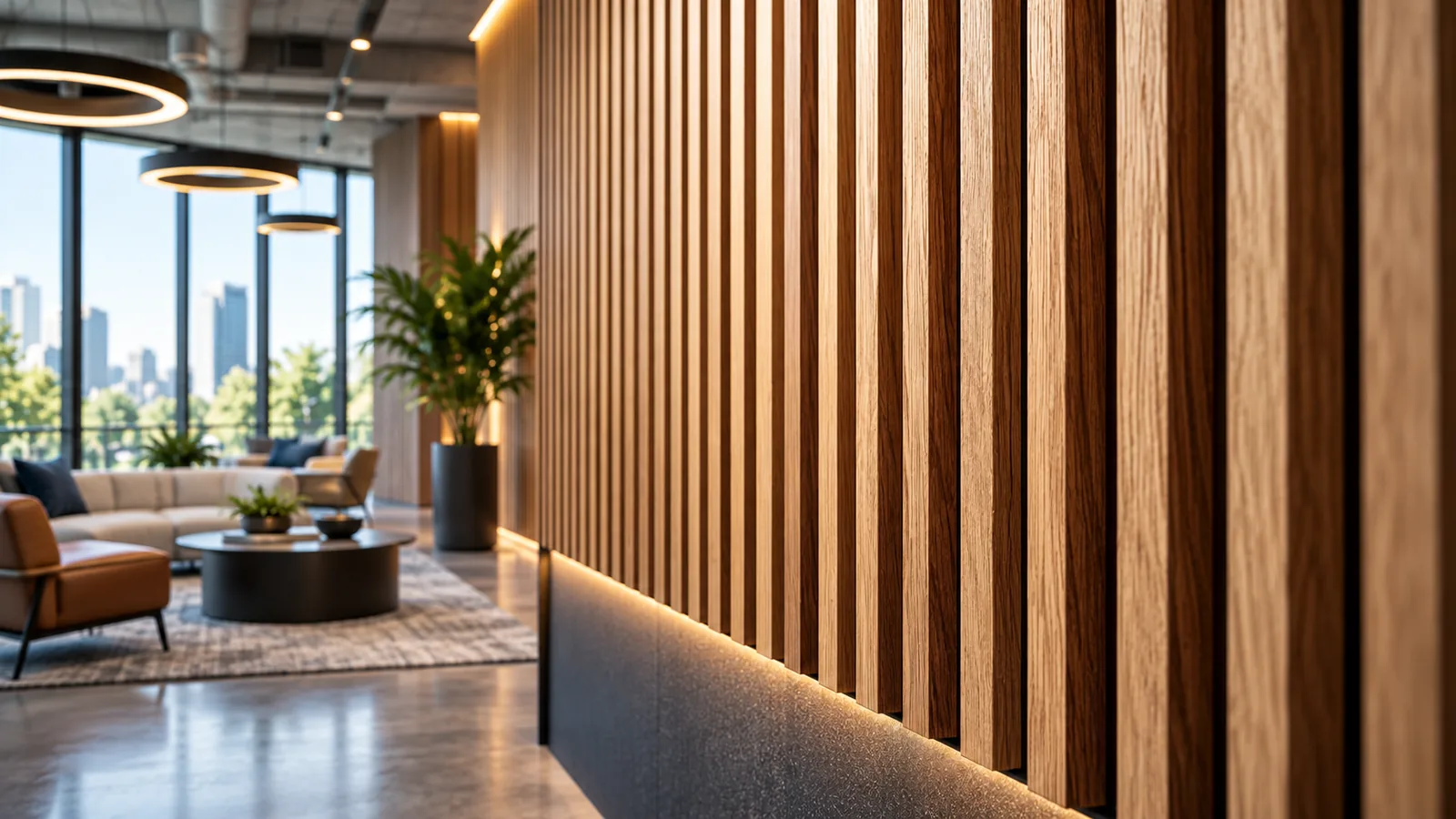
Best for Feature walls, living rooms and entryways where the look is the point and the acoustic gain is a bonus.
Specialist Acoustic Treatments
13. Acoustic Bass Traps and Diffusers
- Material: Traps are thick porous absorbers, the same fiberglass or mineral wool as a wall panel but 4″ or deeper. Diffusers are hard shaped surfaces – wood, plaster or moulded plastic – that reflect rather than absorb.
- Traps go in corners: Low frequency pressure builds where two walls meet.
- Diffusers need room: A few feet from your head is too close to work.
These sit at opposite ends of the same problem. Traps remove low-frequency energy where it collects in corners; diffusers keep a room alive by scattering reflections instead of killing them. In a small room the order matters – absorb first, and if a 4″ trap still is not enough, the answer is a tuned membrane absorber rather than more of the same.
Best for Recording studios, mixing rooms and home theaters. Traps for a boomy low end, diffusers where the risk is an over-absorbed, dead-sounding room.
Acoustic Wall Panel Types Compared
Absorption is rated by NRC, a 0 to 1 scale where higher absorbs more. The figures below are typical published ranges for the material and mounting, not test data for a specific product. Always work from the manufacturer’s tested data for the exact thickness and mount you’re specifying.
| Panel type | Mechanism | Typical thickness | Typical NRC | Best use |
|---|---|---|---|---|
| Fabric-wrapped fiberglass | Porous | 1″–2″ | 0.75–1.05 | Serious echo control, commercial |
| Mineral wool core | Porous | 1″–2″ | 0.85–0.95 | Fire-sensitive jobs, DIY |
| Stretched fabric wall | Porous | 1″–2″+ | 0.75–1.05 | Full-wall coverage, obstructions |
| PET / felt | Porous | 1/2″–1″ | 0.30–0.60 | Small rooms, decorative |
| Melamine foam | Porous | 1″–2″ | 0.65–0.95 | Class A, complex shapes |
| Polyurethane foam | Porous | 1″–2″ | 0.30–0.70 | Home studios only |
| Cementitious wood fiber | Porous | 1″–2″ | 0.55–0.85 | Gyms, high impact areas |
| Perforated wood | Resonant | Varies + cavity | 0.50–0.85 | Auditoriums, lobbies |
| Perforated metal | Resonant | Varies + cavity | 0.50–0.90 | Wet, harsh, high-traffic |
| Micro-perforated | Micro-perforated | Thin + air gap | 0.40–0.75 | Transparent, fiber-free |
| Membrane / diaphragmatic | Resonant | Tuned cavity | Narrowband, low freq | Studio low end |
| Wood slat | Porous (backer) | ~3/4″ incl. backer | 0.20–0.45 | Feature walls, residential |
| Bass traps / diffusers | Porous | 4″+ | 0.90–1.10 | Low frequency control |
How Many Acoustic Wall Panels Do You Need?
Panel type matters less than how much of it you install and where. As a rough working rule, treating 15% to 25% of a room’s total surface area handles most speech and echo complaints, and heavier treatment is reserved for studios and critical listening.
Spread coverage across opposing surfaces rather than clustering it on one wall. Two facing hard parallel surfaces are what produce flutter echo, so breaking up at least one of each pair does more than doubling up in a single spot. Thickness buys low frequency performance: a 2″ panel does meaningfully more in the low mids than a 1″ panel of the same material.
If the room’s problem is a hard ceiling rather than hard walls, wall panels are the wrong product. That job belongs to acoustic ceiling cloud panels, which hang below the deck and expose more surface area to the room.
Choosing the Right Acoustic Wall Panel
If the room sounds harsh and echoey you want a porous absorber, and fabric-wrapped fiberglass answers nearly every commercial room — thickness, coverage and fabric are the only decisions left. If it sounds boomy, you need thickness or a tuned membrane absorber, and no amount of thin decorative panel will help.
After that it is constraints. Panels that get hit go cementitious or impact resistant. Wet or washed-down spaces go perforated metal. Somewhere fibers are unacceptable, or the wall has to stay transparent, goes micro-perforated.
Frequently Asked Questions
Are wood slat acoustic panels actually acoustic?
Only mildly. The absorption comes from the thin felt or PET backing rather than the wood slats, and the slats cover part of that backing. They’re a decorative product with a small acoustic benefit, not a substitute for proper absorption.
Is acoustic foam safe to use in a commercial building?
It depends entirely on which foam. Melamine foam is inherently flame resistant and achieves a Class A rating without treatment, so it’s accepted in commercial architectural environments. Untreated polyurethane foam is typically Class B and is generally restricted to residential use or sprinklered spaces. Always check the documented rating rather than the product description.
How thick should an acoustic wall panel be?
1″ handles speech frequencies and suits conference rooms and classrooms. 2″ is the better default when the room has music, a lot of hard surfaces, or noticeable low frequency boominess. Below 1″, absorption drops off quickly outside the high frequencies. For low frequency problems, 4″ or a tuned membrane absorber.
Can acoustic wall panels be custom sizes and colors?
Yes. Fabric-wrapped panels are made to order in custom sizes and shapes, with fabric from ranges including Guilford of Maine, Designtex, Maharam and Wolf Gordon. Dye-sublimation printing allows artwork or photography to be printed directly onto acoustically transparent fabric.