Table of Contents
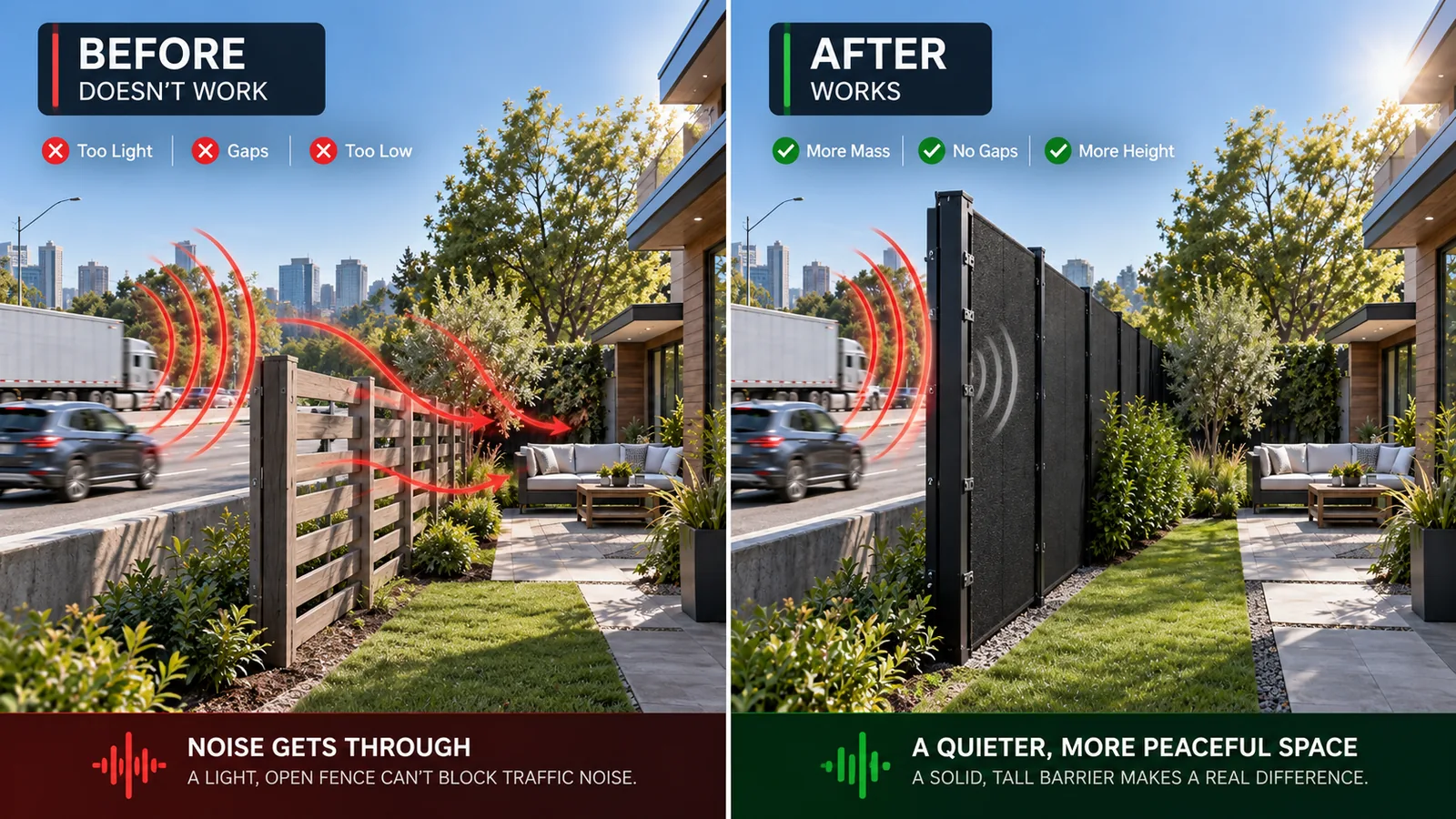
Why Most Outdoor Soundproofing Doesn’t Work
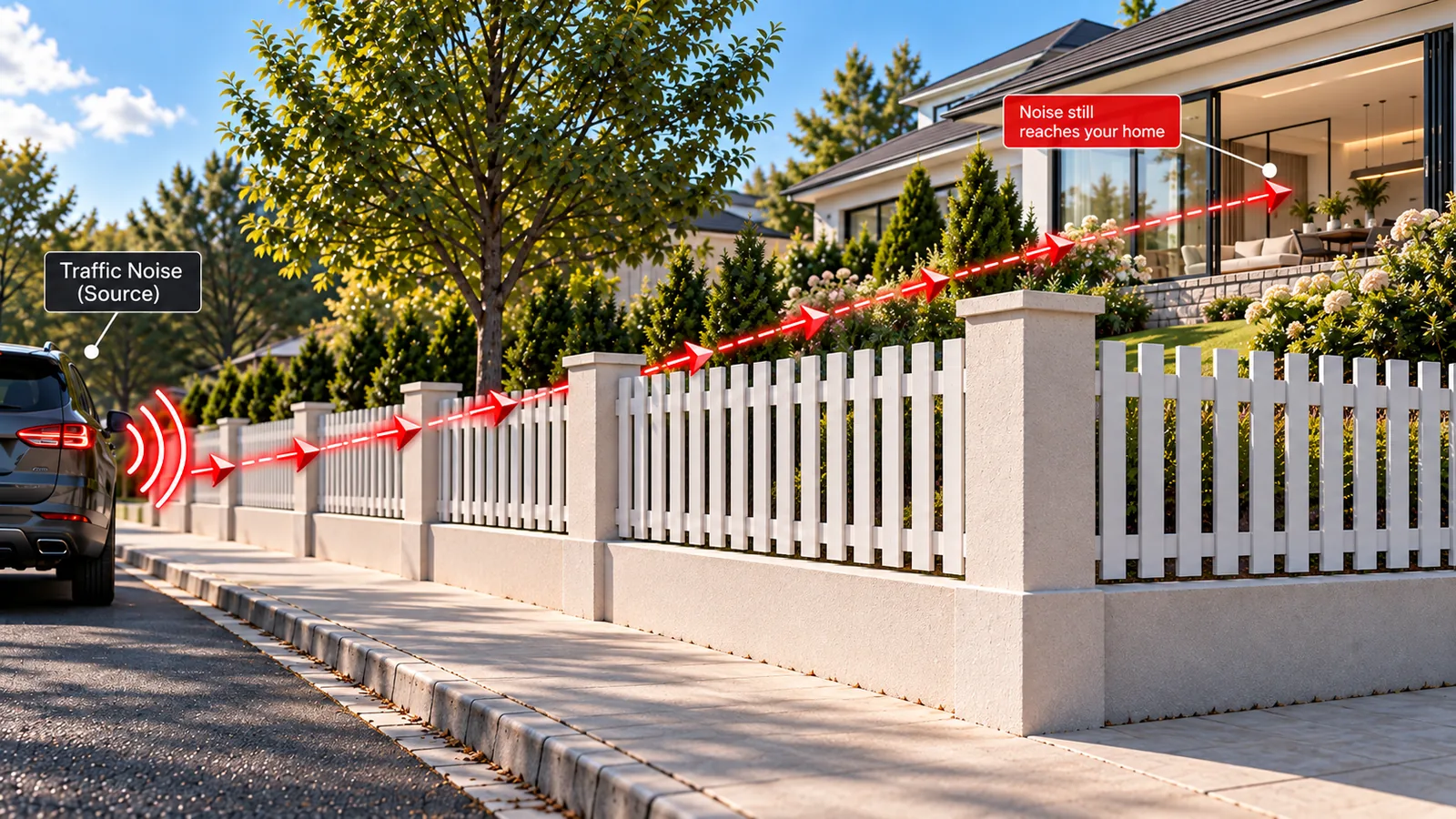
Outdoor soundproofing has one advantage over indoor work: there is nothing for sound to bounce off. It travels in a straight line from the source to your ear, so the only thing that helps is putting something heavy and solid in the way, tall enough to break that line.
That rules out a lot of what gets sold as outdoor soundproofing. This guide compares the materials that actually block noise outside, what each costs to put up, and the height rule that decides whether any of them work.
Quick answer For an existing fence, the best outdoor soundproofing material is outdoor-grade mass loaded vinyl hung along it. For new construction with the budget, a masonry wall. Either only works if it blocks your line of sight to the noise.
What Makes an Outdoor Soundproofing Material Work
Every outdoor barrier that works has the same three things:
- Mass. Light materials let sound pass straight through. If a barrier flexes easily or you can see daylight through it, noise is getting through too.
- No gaps. Sound goes through any opening: between fence boards, under the bottom rail, between panels that butt together instead of overlapping.
- Height and position. Sound bends over the top edge. A heavy barrier that sits below your sightline to the noise does very little.
It also has to survive outside: sun, rain, wind load and years of hanging under its own weight. That is where most indoor soundproofing materials fail.
Best Outdoor Soundproofing Materials Compared
| Material | Blocks noise? | Outdoors | Cost |
|---|---|---|---|
| Outdoor Mass Loaded Vinyl | Good, when tall enough | Carbon-fiber reinforced, UV protected | About $4.44–$5.18 per sq ft |
| Masonry or Concrete Wall | Best | Lasts decades | $$$$, plus footings and often a permit |
| Earth Berm | Very good | Permanent | $$, but needs a lot of land |
| Absorptive Acoustic Fence Panels | Very good | Built for exterior use | $$$$ |
| Solid Wood Fence, No Gaps | Moderate | Boards shrink and open gaps over time | $$ |
| Vinyl Privacy Fence | Poor, hollow and light | Long lasting | $$ |
| Indoor Mass Loaded Vinyl | Good at first | Stretches and goes brittle in sun | Cheaper, until you replace it |
| Hedges and Trees | Very little | Grows back gaps every season | $–$$ |
| Outdoor Acoustic Panels | No — they absorb echo | Varies | $$–$$$ |
Price Check: Australia vs USA Fence wraps sold in Australia, such as this acoustic fence wrap, run A$300 for a 1 m × 5 m roll (about 54 sq ft), or about A$5.57 per sq ft. Converted at A$1 = US$0.70 (September 2026), that is roughly US$211 a roll and US$3.92 per sq ft, before shipping to the US.
Why Sound Barrier Height Matters More Than Weight
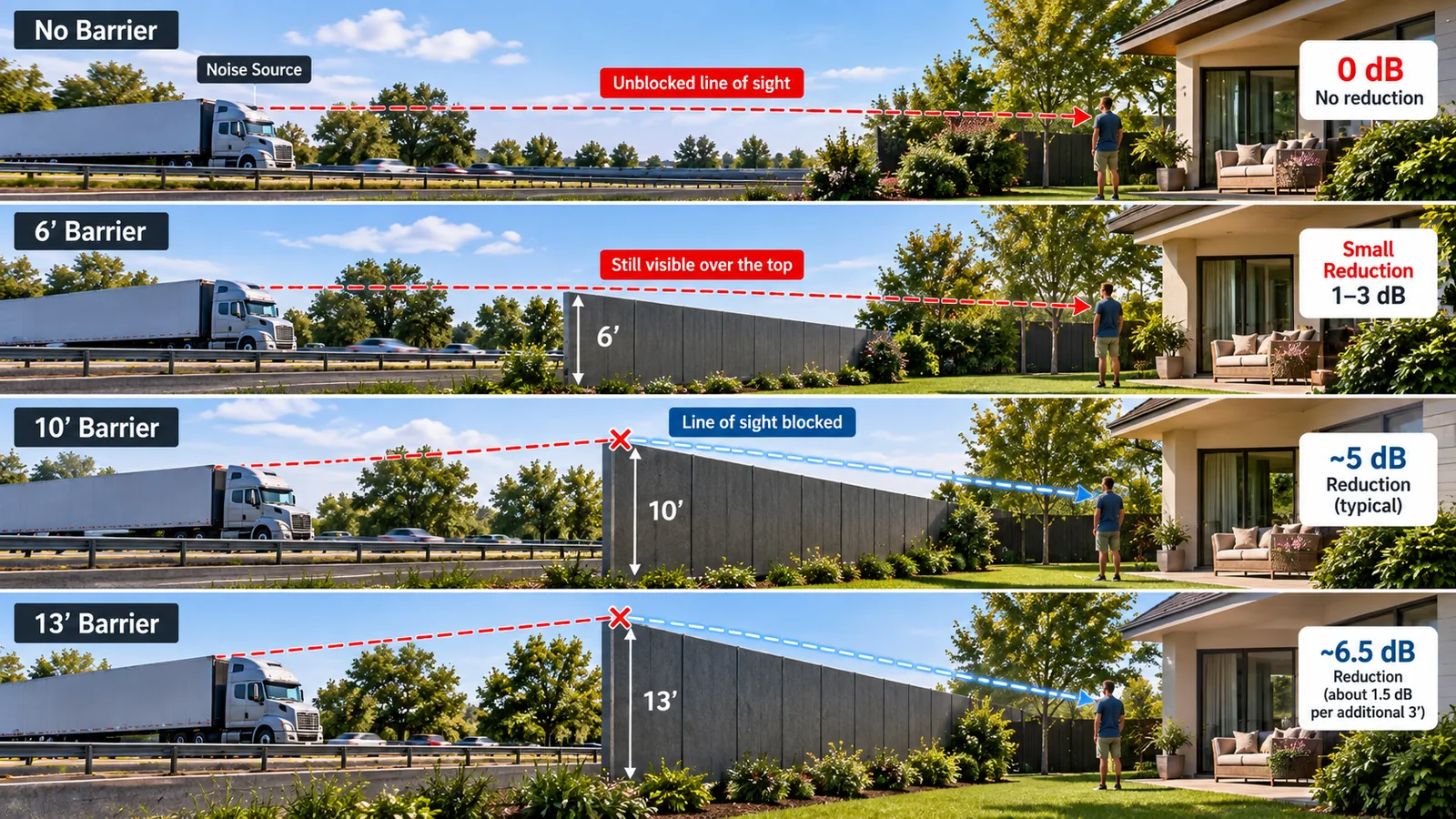
Stand where you want it quiet and look toward the noise. If you can see the source over the top of the barrier, you will hear it. Sound bends around the top edge, so a barrier only starts working once it breaks that line of sight, and every extra foot of height past that point helps.
- Fences between 6′ and 12′ tall are where a hung barrier does its best work.
- Put the barrier close to the noise or close to you, not halfway between. Close to either end, the same height blocks far more of the sightline.
- Run it past the source. Extend the barrier at least 5′ beyond the noise source in each direction, or sound simply goes around the ends.
- Expect a clear reduction, not silence. The Federal Highway Administration puts a barrier at about 5 dB of reduction once it is tall enough to break line of sight, and roughly 1.5 dB more for each additional meter (about 3′) of height.
Can Mass Loaded Vinyl Be Used Outside?
Standard mass loaded vinyl should not be. It is made to be sealed inside a wall where nothing pulls on it and nothing shines on it. Hung on a fence, it stretches under its own weight, tears out at the fixings and goes brittle in the sun.
Outdoor-grade MLV fixes both problems. Fence Blokker keeps the same 1 lb/sf mass but adds a carbon-fiber reinforcing layer so it hangs vertically without creeping, and has UV protection extruded into the material rather than sprayed on the face, so it does not wear off after a few summers.
Best for Turning a chain link, wood or post fence you already own into a sound barrier, with no footings or concrete pour.
How to Hang a Sound Barrier on a Fence
- Measure the run and the height. Fence Blokker comes as a 4.5′ × 60′ roll (270 sq ft). Order it plain and cut on site, or cut and grommeted to the panel height you give in the order notes: 4.5′ × 6′, 8′, 10′ or whatever suits your fence.
- Fix it along the top edge. Zip ties, wire or hog rings through the grommets into chain link. Screws with fender washers into wood fences and posts. For vinyl fences you would rather not drill, use hooks that hang over the top rail.
- Overlap every joint by 3″–6″. Butted edges leak. Overlap the vertical edges rather than lining them up.
- Close the bottom. Let the sheet reach the ground so noise cannot pass underneath.
- Check the fence can take the wind. A solid sheet catches wind like a sail, and that load goes into the fence posts, so fix it at close spacing and make sure the fence is sound before covering a long run.
For fence-by-fence install steps, heights and costs, see how to soundproof a fence.
Best Outdoor Sound Barrier for Each Noise Source
| Noise | Best approach | What matters most |
|---|---|---|
| Road or highway traffic | Tall barrier along the property line | Height. The road is far off, so the sightline is shallow |
| Neighbor’s barking dog | Barrier on the shared fence | The noise is at fence height and close to it, which suits a hung barrier |
| AC condenser, pool pump, generator | Small barrier wrapped close around the unit | Keep it tight to the source, and leave space for airflow |
| Your own speakers or hot tub | Barrier behind the source, facing the neighbor | Run it past the source on both sides |
| Construction site | Temporary hung barrier | It comes down and moves to the next job |
| Vibration through the ground | Not a barrier problem | No fence material fixes ground-borne vibration |
How to Block Highway Noise
Highway noise is the hardest outdoor noise to block. The road is a long line of sound, so a short barrier lets noise in around its ends. Truck exhaust stacks sit about 12′ up, so a fence that hides the cars can still leave the trucks in view. And above about 35 mph most of what you hear is tire roar, a steady low sound that carries further than the noise a barrier stops best.
The Federal Highway Administration puts an effective highway noise wall at a 5 to 10 dB reduction, which at best makes traffic sound about half as loud. It also names where walls fail: homes on a hillside looking down over the wall, and any opening, such as a driveway gap, that lets noise straight through.
State transportation departments build these walls under federal noise rules, usually when a highway is built or widened and homes nearby would hear 67 dB or more. Most are precast concrete panels slotted between posts on drilled footings, sized to hide the truck stacks, run well past the last house, and overlapped wherever there has to be an opening. The same rules scale down to a backyard:
| Highway sound wall practice | Your backyard barrier |
|---|---|
| Tall enough to hide truck exhaust stacks | From where you sit, you should not see truck roofs over the barrier |
| Designed for a 7–10 dB cut | Expect traffic to drop to background noise, not disappear |
| Heavy enough that little comes through; the budget goes on height | A 1 lb/sf outdoor MLV sheet has the mass. Spend on height and length |
| Openings covered by overlapping, offset sections | Overlap every seam 3″–6″ and put a return panel across the driveway gap |
| Runs well past the last home it protects | Turn the barrier along the side fences at each end |
| Useless for homes above the wall | On a slope above the road, put the barrier around the patio instead of at the property line |

Outdoor Sound Dampening Panels vs Sound Barriers
These two get mixed up constantly, and buying the wrong one is the most common outdoor soundproofing mistake. Outdoor sound dampening panels, also sold as outdoor sound absorbing panels, are soft and porous. Sound goes into them instead of bouncing back, which is what makes a covered patio, outdoor kitchen, pavilion or pool enclosure calmer to be in. That same porous core is why they cannot block noise: air passes through them, so sound does too.
| Sound absorbing panels | Sound barrier | |
|---|---|---|
| What it does | Cuts echo inside a covered space | Stops noise getting from one side to the other |
| How it works | Porous core soaks up sound | Heavy, airtight sheet or wall blocks it |
| Rated by | NRC (how much it absorbs) | STC (how much it blocks) |
| Where it goes | Under a patio roof or pavilion ceiling | On the fence or property line |
A hard barrier also reflects sound, which is why highway walls face the road with absorbing material. At home that matters mostly when the noise is yours: a barrier behind a hot tub or outdoor speakers can bounce it back toward your own house unless the barrier has an absorbing face.
Which one do you need? Noise coming from somewhere else needs a barrier with mass. A space that sounds loud and echoey on its own needs panels. If it is both, put the barrier up first.
Do Hedges & Trees Block Noise?
Very little. Sound passes through the gaps between leaves and branches, and a typical hedge is only a few feet deep, so it barely slows noise down. The Federal Highway Administration puts it at about 200′ of dense planting, tall enough and thick enough that you cannot see through it, to cut traffic noise by 10 dB. That is more land than almost any home has.
Hedges also change with the seasons. Deciduous trees and shrubs drop their leaves in winter, and even evergreens thin out near the ground as they grow, which leaves a gap at the height where most noise travels.
Plants do help in one way: hiding the source makes noise feel less intrusive. That makes a hedge or climbing vines in front of a barrier a good pairing. The barrier does the blocking, and the planting hides the barrier.
Before You Order an Outdoor Sound Barrier
- Do the sightline test. Stand where you want it quiet. If you will still see the noise source over the planned barrier, go taller before you go heavier.
- Measure the full run. Fence length plus at least 5′ past the noise source on each side, and allow extra for 3″–6″ overlaps.
- Check the fence. Loose posts or a leaning run will not carry a solid sheet in wind. Fix the fence first.
Frequently Asked Questions
What is the best outdoor soundproofing material?
For most homes with an existing fence, outdoor-grade mass loaded vinyl hung along the fence gives the best result for the cost. A masonry wall blocks more, but costs far more and usually needs footings and a permit. Whatever you choose, it has to be solid, gap-free and tall enough to block your line of sight to the noise.
Is a concrete wall better than a fence sound barrier?
A concrete or masonry wall has more mass and lasts decades, so it blocks more sound through the wall itself. In practice both are limited by sound bending over the top, so a tall fence barrier can outperform a short wall. Height usually matters more than the material.
Does a regular wood fence block noise?
Somewhat, if the boards are tight with no gaps. Most wood fences have gaps between boards and at the bottom, and boards shrink over time, so noise leaks through. Adding a heavy barrier to the fence closes those gaps and adds mass.
Do outdoor sound absorbing panels reduce neighbor noise?
No. Absorbing panels reduce echo in a covered outdoor space, but sound passes through and over them. To reduce noise from a neighbor or a road, you need a solid barrier with mass that blocks line of sight.
Can I put a sound barrier around my AC unit or pool pump?
Yes, and a small barrier close to the unit works better than a big one far away. Leave enough clearance for airflow and service access, and check the equipment maker’s clearance requirements first.