Table of Contents
Soundproofing a Church: Echo or Outside Noise?
Most churches that ask about soundproofing have one of two problems. Either the sermon turns to mush in the back rows because the room echoes, or noise from outside (traffic, the nursery, the youth room with a drum kit) is getting into the service. Some church buildings have both.
The fixes for each problem are completely different. Acoustic panels will not keep road noise out, and a heavier wall will not do anything about echo. This guide covers both, starting with how to tell which one you are dealing with.
Quick answer To soundproof a church, first decide whether the problem is echo inside the room or noise coming through the walls. For echo, put acoustic panels on the rear wall and side walls and hang ceiling clouds or baffles overhead. For outside noise, seal the gaps, upgrade the doors, and add mass to the walls that face the noise.
Church Echo vs Church Soundproofing
“Soundproofing” gets used for both jobs, which is how churches end up buying the wrong thing. Acoustic treatment uses soft, absorbent panels to control how sound behaves inside the sanctuary. Soundproofing uses mass and airtight seals to stop sound passing through walls, doors and ceilings. Match what you hear to the fix:
| What people notice | The actual problem | What fixes it |
|---|---|---|
| Sermon is hard to follow in the back rows | Too much reverberation | Acoustic panels and ceiling clouds or baffles |
| A distinct repeat of the pastor’s words, a beat late | Slap echo off the rear wall or balcony front | Panels on the rear wall and balcony front |
| Band sounds muddy, turning up the PA makes it worse | Reverberation plus bass build-up | Panels, with thicker coverage near the stage and in corners |
| Traffic, sirens or lawn equipment heard during prayer | Sound coming through walls, windows and doors | Mass, sealed gaps, better doors and windows |
| Nursery or youth room heard in the sanctuary | Sound through interior walls, doors and over the ceiling | Sealing, mass in the shared wall, and closing the space above it |
Acoustic Panels for a Church Sanctuary
Echo in a sanctuary comes from hard, parallel surfaces: plaster walls, glass, tile or hardwood floors, and high ceilings. Sound keeps bouncing long after the words were spoken, and each new syllable lands on top of the last one. The measure acousticians use is reverberation time (RT60), the number of seconds it takes a sound to die away.
There is no single right number for a church. It depends on how you worship:
- Contemporary services with a band and PA: roughly 1.0–1.5 seconds. The sound system does the work, so the room should stay out of its way.
- Blended services: roughly 1.5–2.0 seconds, enough life for congregational singing while speech stays clear.
- Traditional liturgy with pipe organ and choir: often 2.0 seconds or more. Organs and choirs are written for a live room. Treating the whole sanctuary would take away sound the congregation values.
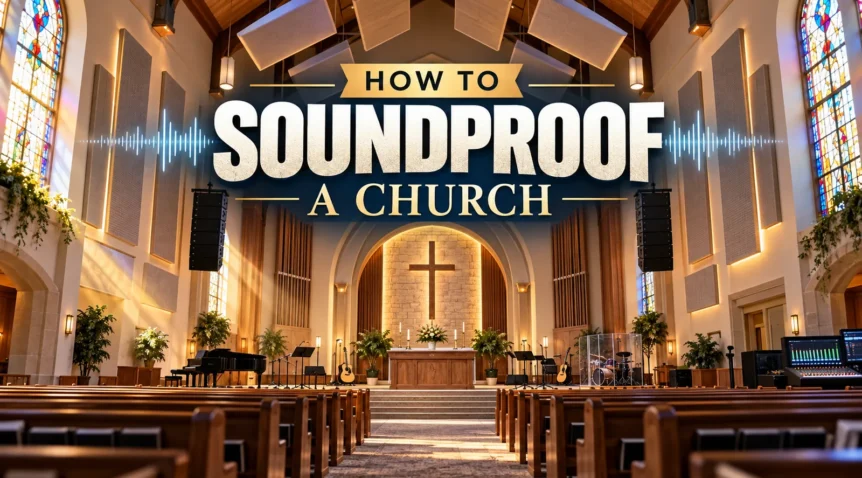
Where the panels go matters more than how many you buy. Start with the surfaces that send sound back toward the platform and the congregation:
- Rear wall first. A bare, flat rear wall throws the sermon back at the pulpit as a late echo, which pastors notice straight away. Covering most of it is the biggest single improvement in most sanctuaries.
- Balcony front. The same problem at a lower height. A row of panels along the balcony face is cheap and effective.
- Side walls between the windows, spread out at ear height and above, not bunched in one area.
- Leave the front live in a traditional church. A reflective wall behind the choir helps it project into the room.
Our sound absorbing wall panels have a 2″ 6 pcf fiberglass core (NRC 1.05), wrapped in fabric in 24 colors, so they can be matched to the sanctuary’s walls. A 4 ft × 6 ft panel is $359. As a starting point, most sanctuaries need panels on 10–20% of the wall area. Use the low end if the pews are padded and the floor is carpeted, and the high end for a hard room used for contemporary worship. For a 60 ft × 45 ft sanctuary with 20 ft walls, 10% is about 18 of the 4 × 6 panels, or roughly $6,500. For a closer look at fabric, wood and other panel styles, see types of acoustic wall panels.
Ceiling Clouds and Baffles for High Church Ceilings
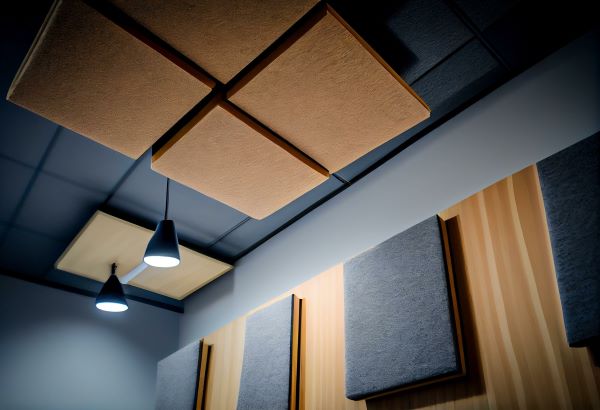
A high ceiling is one of the main reasons sanctuaries echo, and it is also where treatment is least visible. Hanging absorption overhead works on reflections that wall panels never reach, and it keeps the walls clear for windows, art and banners.
- Ceiling clouds hang flat, a foot or more below the ceiling, so sound is absorbed on both the underside and the top. They suit flat or gently sloped ceilings over the congregation or the platform. Our acoustic ceiling cloud panels start at $119 for a 2 ft × 2 ft cloud and hang from anchors above.
- Ceiling baffles hang vertically on edge, in rows. They are the better choice for open-truss ceilings and tall multipurpose rooms, because each baffle absorbs on both faces and a row of them covers a lot of air volume. Acoustic ceiling baffles start at $99.
In very tall sanctuaries, hang clouds or baffles low enough to be in the path of the sound, not tucked up in the peak. Work out the mounting points and lift access before ordering. Most churches install overhead treatment on a weekday with a rented lift.
How to Soundproof Church Walls
When the problem is noise getting in or out of the church building, panels will not help. Soundproofing walls takes three things, in this order:
- Seal the gaps. Sound goes wherever air can. Run acoustical caulk ($17.99 a tube) along the edges of the drywall, around outlets and around every pipe and cable that passes through the wall.
- Add mass. A layer of 1 lb/sf mass loaded vinyl behind the drywall adds 10 or more STC points to a stud wall, about the same as 3–4 extra layers of drywall. A 4 ft × 25 ft roll covers 100 sq ft for $199. Wall Blokker is the same idea, tested in dozens of wall assemblies. Tape every seam with MLV seam tape so the barrier has no gaps.
- Decouple for bass. A worship band’s kick drum and bass guitar go straight through walls that stop speech. Resilient clips and hat channel, or a separate stud wall, keep the two sides of the wall from shaking together.
In church buildings the most common leak is not through the wall at all. Classrooms, nurseries and offices are often built with walls that stop at a suspended ceiling, leaving one open space above them all. Sound goes up and over. Extending the wall to the deck above, or laying a barrier over the ceiling tiles along the wall line, often does more than anything you add to the wall itself.
Soundproofing Church Doors, Windows and HVAC
A well-built wall is only as good as the openings in it, and a church has a lot of openings.
- Sanctuary doors. Solid-core doors with perimeter seals and an automatic door bottom, which drops onto the threshold as the door closes. A lobby or narthex between the entrance and the sanctuary works like an airlock. Keeping one set of doors shut during the service blocks most lobby and street noise.
- Windows and stained glass. Single-pane glass is the weakest part of most older churches. An interior secondary window, set a few inches in from the original with its own seal, blocks far more noise and protects stained glass without changing how it looks from outside.
- HVAC. Ducts carry sound between rooms, and fast-moving air is noise in its own right. Lined ductwork, lower air speeds at the grilles, and keeping rooftop units away from the area above the platform all lower the background noise during quiet moments of the service.
How to Reduce Echo in a Church Hall
Fellowship halls are often louder than the sanctuary. They tend to be square rooms with hard floors, block or drywall walls, folding tables, and no padded pews to soak up sound. Add a hundred people talking over lunch and nobody can hear the person across the table.
Treat a church hall like a gym or cafeteria: more coverage than a sanctuary, spread around the whole room. Wall panels around the perimeter are the easiest option. Baffles over the tables work well if the ceiling is open. At Ebenezer India Pentecostal Church in Lakeland, Florida, a 40 ft × 40 ft fellowship hall with a 25 ft ceiling had a reverberation time of more than 3 seconds. About 90 wall-mounted panels brought it down to roughly 1.2 seconds, without any ceiling work.
Church Acoustics Checklist Before You Buy
Good church acoustic design starts with a few facts about the room. Collect these before ordering anything:
- Room size: length, width and ceiling height, including the peak if the ceiling slopes.
- Surfaces: what the walls, floor and ceiling are made of, and whether the pews are padded.
- Service style: spoken word, contemporary band, choir and organ, or a mix.
- The complaint, in the words people use: “can’t understand the pastor,” “hear the road,” “hear the nursery.” That tells you whether it is echo, soundproofing or both.
- A clap test. Stand in the middle of the empty sanctuary, clap once, and record it on a phone. How long the ring lasts, and whether you hear a distinct repeat, shows how far you have to go.
- Wall space you can use: the rear wall, balcony front and side walls between the windows, plus any ceiling mounting points.
Frequently Asked Questions
How do you soundproof a church building?
Work out whether the problem is echo or noise coming through the building. For echo, add acoustic panels to the rear wall, balcony front and side walls, and hang ceiling clouds or baffles. For outside noise, seal gaps with acoustical caulk, fit solid doors with seals, add secondary windows, and add mass loaded vinyl to the walls that face the noise.
How many acoustic panels does a church need?
Most sanctuaries need panels on 10–20% of the wall area, placed on the rear wall first. For a 60 ft × 45 ft sanctuary with 20 ft walls, that is roughly 18 to 35 panels at 4 ft × 6 ft. Hard rooms used for contemporary worship need the higher end, and fellowship halls usually need more than the sanctuary.
How much does it cost to soundproof a church?
Echo control is the cheaper job. Treating a mid-size sanctuary with 4 ft × 6 ft panels at $359 each typically runs about $6,500 to $12,500 in panels, and it can be done in stages starting with the rear wall. Blocking outside noise costs more, because it means work on the walls, doors and windows themselves.
Do acoustic panels block outside noise in a church?
No. Acoustic panels absorb echo inside the room, but sound passes through them and through the wall behind them. To keep traffic or neighbor noise out, you need mass, airtight seals and better doors and windows.
Will acoustic panels hurt the sound of an organ or choir?
Not if they are placed with care. Traditional music needs a longer reverberation time than speech, so treat the rear wall and balcony front to remove echo, and leave the front of the sanctuary and the ceiling mostly reflective. The goal is a clear sermon, not a dead room.