Table of Contents
What Is Mass Loaded Vinyl?
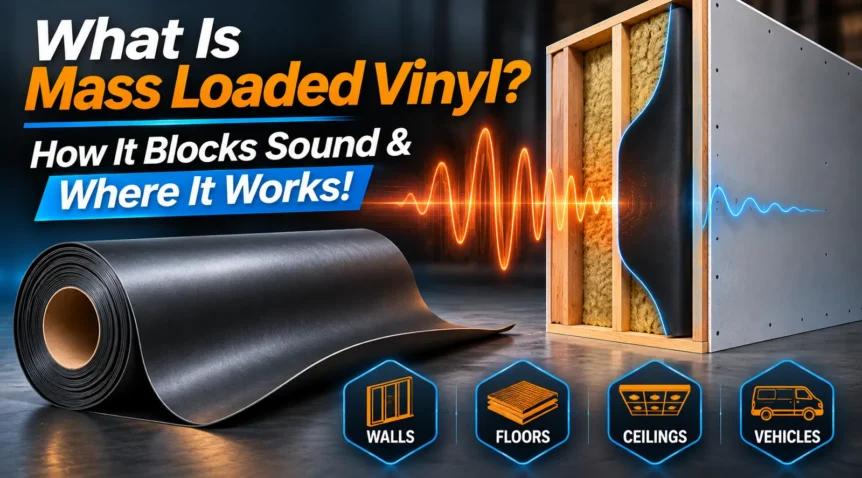
Mass loaded vinyl, or MLV, is a thin, heavy, flexible sheet that goes inside a wall, floor, or ceiling to stop sound from passing through. It is vinyl packed with dense mineral filler, which is why a sheet only 1/8 inch thick weighs a pound per square foot. You will also see it called a sound barrier or a soundproofing membrane. It is the same thing.
Almost nobody sees it once the drywall goes up, but it often does most of the work in a wall that is actually quiet. Ours comes in 4 ft x 25 ft rolls, which cover 100 square feet and weigh about 100 pounds each.
Quick answer MLV is a thin, heavy vinyl sheet that blocks sound between rooms. One layer adds roughly 6 to 12 STC points to a stud wall, about what 3 or 4 layers of drywall would. It does nothing for echo inside a room, and it only works if the seams are sealed.
How Mass Loaded Vinyl Blocks Sound
Sound crosses a wall by making it flex, like a drum skin you cannot see. Two things stop that. A heavier layer moves less for the same push, which is why a concrete wall is quiet and a hollow door is not.
The other is limpness. Stiff materials like drywall have resonant frequencies where they leak badly. MLV is heavy but floppy, so it has no weak frequency for sound to slip through. That is the whole trick, and it is why 1/8 inch of MLV can beat materials many times thicker.
How Much STC Does Mass Loaded Vinyl Add?
STC, or Sound Transmission Class, rates how much sound an assembly stops. Every 10 points is roughly half as loud. The vinyl sheet on its own rates STC 26, but you never install it on its own, so the number that matters is what it does to the finished wall.
On a wood or metal stud wall, one layer typically adds 6 to 12 points. Put MLV and drywall on each side of a single stud wall and you can reach STC 56 or better, which clears the code requirement for multi-family and hotel work. The STC ratings guide for mass loaded vinyl and sound batts has the full chart.
Where Mass Loaded Vinyl Works Best
Use it anywhere sound travels through a structure instead of bouncing around a room.
- Shared walls in apartments, condos, hotels, and student housing.
- Home theaters and studios, where it keeps the low end in and the rest of the house out.
- Floors and ceilings, usually paired with underlayment or a second layer of drywall.
- Ducts and pipes, because the sheet wraps and molds around them, which a rigid barrier cannot do.
- Outdoors, as the barrier layer in a fence. How to soundproof a fence covers that setup.
What Mass Loaded Vinyl Can’t Do
It will not stop echo. MLV keeps sound from leaving or entering a room, and it does nothing about sound bouncing around inside one. If your room sounds boomy, you want absorption, such as sound absorbing wall panels.
It will not work with gaps. Sound is air pressure, so an open seam or an unsealed edge passes it as if the barrier were not there. Overlap the edges, tape every seam, and caulk the perimeter. The MLV installation guide shows how.
And it will not fix footsteps on its own. Impact noise through a floor needs a proper underlayment as well. See the best soundproof underlayment for floors.
Which Mass Loaded Vinyl Do You Need?
All four are 4 ft x 25 ft rolls covering 100 square feet. They differ in weight, and the right one depends on what you are fixing it to.
| Product | Weight | Thickness | Wall improvement | Best for |
|---|---|---|---|---|
| Wall Blokker Lite | 0.6 lb/sf | 1/16 in | +6 to 11 STC | Metal stud walls, or anywhere weight matters |
| MLV Sound Barrier | 1 lb/sf | 1/8 in | +10 STC or more | Walls, floors, and ceilings |
| Wall Blokker | 1 lb/sf | 1/8 in | +6 to 12 STC | Wood or metal stud walls, the default choice |
| Wall Blokker Pro | 1.1 lb/sf plus scrim | 3/16 in | +3 to 5 STC over Wall Blokker | Wood studs, party walls, or over an existing wall |
If you want the weights and densities in more detail, the density, weight, and thickness chart has them, and how to choose the best mass loaded vinyl goes into the trade-offs.
How Mass Loaded Vinyl Is Installed
Staple or screw it to the studs, with seams landing on a stud where you can. Tape the seams, caulk the perimeter, and cover it with drywall. On a finished room you can skip the demolition: hang it over the existing drywall and put a new layer on top. A roll weighs about 100 pounds, so plan on two people and a sharp utility knife. The details are in installing mass loaded vinyl over an existing wall.
Is Mass Loaded Vinyl Worth It?
If your problem is voices, TV, or music coming through a shared wall, yes. It is thin enough to fit where extra drywall layers would eat the room, and it costs a fraction of building the wall out.
If your problem is that the room itself sounds loud or hollow, no. Save the money and spend it on panels. And if you are not going to seal the seams, you may as well skip it too, because an open joint leaks no matter how good the sheet is.
What is mass loaded vinyl made of?
A flexible vinyl sheet loaded with dense mineral filler. The filler makes it heavy, and the vinyl keeps it floppy, which is the combination that blocks sound.
Does mass loaded vinyl go over or under drywall?
Either. On the studs under new drywall is the tidiest for new work. Over existing drywall with a fresh layer on top avoids stripping a finished room.
How much mass loaded vinyl do I need?
One 4 ft x 25 ft roll covers 100 square feet, which is an 8 ft high wall 12 ft 6 in long. Add about 10% on longer runs for overlap, and cover the whole surface, because gaps leak.
Will mass loaded vinyl stop echo in a room?
No. It stops sound passing between rooms, not sound bouncing around inside one. For echo you want absorption, like wall panels or ceiling clouds.
Is mass loaded vinyl sound deadening or soundproofing?
People use both terms for it. Strictly, it blocks airborne sound and damps the surface it is fixed to. It does not make the room you are standing in quieter, because that takes absorption.