
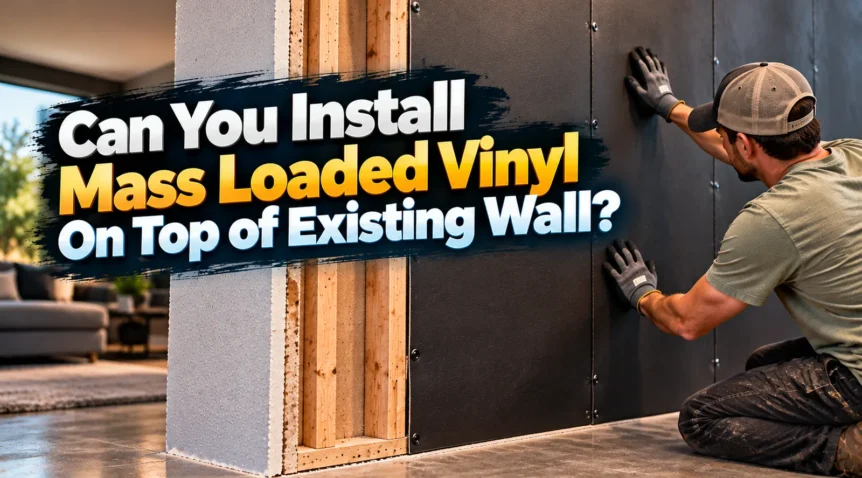
Quick answer Yes. Screw the MLV through the drywall into the studs, tape the seams, and cover it with a new layer of drywall caulked at the edges. It works, just not as well as MLV installed directly on the studs.
Table of Contents
Can You Put Mass Loaded Vinyl Over Drywall?
A common question that we receive daily is whether customers can install mass loaded vinyl over existing drywall or CMU partitions. While it is well-publicized that Mass Loaded Vinyl (also called MLV) is best utilized when installed directly on studs, during the initial construction process, this is not possible if a tenant has already moved into the space. When this happens, then you may install MLV directly to the existing wall, but it may be less effective. Read more below to determine if it’s the right option for you.
MLV over drywall is one of six ways to soundproof a finished wall. To compare it with sealing, insulation, a second layer of drywall and building a new wall in front, see how to soundproof an existing wall without removing drywall.
Why Does MLV Perform Differently Under and Over Drywall?
This answer is simple. Mass Loaded Vinyl works in 2 ways.
- It adds mass to the wall (hence the name). It generally weighs 1 lb/square foot, and can add a significant amount of overall weight to the wall if installed consistently across the entire space.
- It adds flexibility to the wall. That’s why Mass Loaded Vinyl is so much more effective at blocking sound than simply adding a piece of drywall (which is often 2 lbs/sf). The MLV separates the rigid drywall from the rigid studs, and stops sound from transferring directly through the system.
When installed under the drywall, the MLV separates the drywall and stud, which takes full effect of both of its soundproofing properties. However, when installed on top of drywall, the only benefit is the added mass, which can sometimes result in more than a 50% reduction in effectiveness!
What are your options if the wall is already constructed? It is highly recommended that you install a sheet of 1/2″ drywall on top of a layer of 1/8″ thick mass loaded vinyl, so that the top layer may then be decoupled (separated) from the underlying layers. If you do this, it’s also important to remember to add acoustic caulk around the sides of the wall (top, bottom, and sides) so that the finish layer of drywall is not directly touching the adjacent walls.
While still not as ideal as directly installing to the studs, this drywall-MLV-drywall sandwich does make a significant improvement from the initial design. Mass Loaded Vinyl may be unrolled and screwed or stapled to substrate. Due to its weight, it is recommended to install with two people.
How to Install MLV Over Existing Drywall
- Find the studs and mark them on the existing drywall, top to bottom.
- Take off the outlet and switch covers and anything hanging on the wall.
- Hang the MLV from the top, fastening through the drywall into the studs about every 12″ along the top edge and every 24″ down each stud. Use screws long enough to reach well into the framing.
- Butt the sheets edge to edge and tape every seam with MLV seam tape. Over drywall, the seams rarely land on a stud, so tape them all.
- Cut around outlets and switches with no more than 1/4″ of gap, and fit box extenders so the boxes come out flush with the new drywall.
- Hang the new layer of drywall over the MLV, screwed into the studs.
- Caulk the new layer at the top, bottom and sides with acoustical caulk, leaving a small gap so it doesn’t touch the ceiling, floor or adjacent walls.
For fastener spacing, cutting tips and fixing mistakes, see our full guide on how to install mass loaded vinyl.
MLV Between Two Layers of Drywall
Putting MLV between two layers of drywall is exactly what you build when you add it to an existing wall: the old drywall, then the vinyl, then new drywall. The two layers of board add mass on their own, and the limp vinyl between them keeps them from acting as one stiff panel, so sound loses energy crossing from one to the other.
It also works on new construction, as MLV on the studs with two layers of drywall over it, when you need more than a single layer can give. Either way, the details matter more than the materials: sealed seams, caulked edges, and no rigid contact between the new layer and the surrounding walls. To compare ratings for different wall builds, see STC ratings for mass loaded vinyl.
Which MLV to Use on an Existing Wall
- Wall Blokker PRO – the best choice over an existing wall. Its polyester scrim keeps the drywall layers from acting as one stiff panel, which wins back some of the decoupling you lose by not going on the studs, and it adds 3–5 STC points more than standard MLV on the same wall. Hang it scrim side toward the existing drywall.
- Wall Blokker Lite – only 1/16″ thick, so it adds the least to the wall and door jambs, outlets and trim still line up.
- Standard 1 lb/sf MLV – 1/8″ thick and the most common choice, between the two.
Do’s and Don’ts of Installing Mass Loaded Vinyl Over Drywall
- Consider taking off existing drywall, and installing directly to the studs beneath.
- If that’s not possible, you may install Mass Loaded Vinyl on top of existing drywall, and cover with another layer of drywall.
- When installing new drywall layers, ensure that acoustic caulk is used around all sides so that new drywall layers do not contact existing rigid construction elements around the exterior/periphery.
- If extremely high STC ratings are needed (60+), consider building a new wall in front of the existing wall, with a 1–2″ air gap between the two.
Frequently Asked Questions
Can you put mass loaded vinyl over drywall?
Yes. Fasten it through the drywall into the studs, tape the seams, and cover it with a new layer of drywall caulked at the edges. It’s less effective than MLV on bare studs, but still a big improvement on the original wall.
Does mass loaded vinyl need to be covered with drywall?
On a finished wall, yes. A new layer of drywall over the MLV is what turns it into a drywall-MLV-drywall sandwich and holds it in place long term.
Is MLV better under or over drywall?
Under, directly on the studs. There it adds mass and separates the drywall from the framing. Over drywall it mainly adds mass, which can cut its effect by more than half.
Can you install mass loaded vinyl on a concrete block wall?
Yes, the same way: fasten it to the block or to furring strips, then cover it with drywall caulked at the edges. For the biggest improvement, build a new framed wall in front of the block with a small air gap.
Which mass loaded vinyl is best for an existing wall?
Wall Blokker PRO, whose scrim adds some decoupling back and gives 3–5 STC points more than standard MLV on the same wall. If thickness matters most, Wall Blokker Lite is only 1/16″.