
Table of Contents
What Is an STC Rating?
The STC rating, or Sound Transmission Class rating, of a material correlates to the amount of sound that a material is able to block. Some low STC rated products include glass windows and hollow-core doors, while some high STC rated products include mass loaded vinyl and solid-core doors.
The higher the number, the less sound gets through. As a rough guide to what you hear through a wall:
- STC 25–35: normal speech is clearly audible. A basic wall with one layer of drywall on each side is around STC 33–35.
- STC 36–49: voices are muffled, loud speech still comes through.
- STC 50–59: normal speech is inaudible. STC 50 is the building code minimum between apartments and hotel rooms.
- STC 60 and above: loud music and shouting are mostly blocked, as in studios and theaters.
Quick answer On its own, 1 lb/sf mass loaded vinyl is rated STC 26. That number is for the sheet alone: added to a stud wall, one layer typically raises the whole wall by 10 or more STC points, and the right assemblies with MLV reach STC 55 and above.
While there are a lot of materials that have their own STC ratings, they can also combine in the form of an STC rated wall or floor/ceiling assembly. And, contrary to popular belief, STC ratings of materials don’t just add up normally. For example, if you have a wall assembly with an STC rating of 33, you can’t add a layer of MLV with an STC of 26 to result in a wall with an STC of 59, it would be more like 39. We won’t get into the science behind that here, but just keep this in mind when considering wall and floor soundproofing using sound membranes.
Mass Loaded Vinyl STC Ratings
Different weights and thicknesses of mass loaded vinyl have different STC ratings. Also, different weights and thicknesses of MLV each have their own unique purpose either in certain wall assemblies or on their own.
| Weight | Thickness | STC |
|---|---|---|
| 2 lb/sf MLV | 1/4″ | 31 |
| 1 lb/sf MLV (MLV Sound Barrier, Wall Blokker) | 1/8″ | 26 |
| 1.1 lb/sf MLV With Polyethylene Scrim (Wall Blokker PRO) | 3/16″ | 26 minimum (+3–5 over standard MLV on the same wall) |
| 0.6 lb/sf MLV (Wall Blokker Lite) | 1/16″ | 21 |
Uses for 1 & 2 Pound Mass Loaded Vinyl
2 lb/sf mass loaded vinyl is by far the heaviest, thickest and most expensive version of MLV. People often use 2 lb/sf MLV when soundproofing extremely loud areas such as mechanical rooms. The heavier and thicker the MLV, the better it is at also reducing low frequency sound transmission from mechanical and other similar noises. Learn more: best uses for 2 lb/sf MLV.
1 pound mass loaded vinyl is most often used for wall soundproofing in both commercial and residential settings. When using 1 lb/sf MLV on wood studs, you can usually achieve an STC rating in the 40’s, but on metal studs, it can help you hit STC 55+. If the wall will need to reduce sound transmission of more vibrational and low frequency sound, or if you’ll be installing MLV on existing drywall, you should use 1.1 lb/sf MLV with a polyethylene scrim (Wall Blokker PRO), which adds 3–5 STC points more than standard MLV on the same wall. This scrim layer allows for more decoupling between rigid surfaces, helping to mitigate more vibrational noise.
Benefits of Light Weight MLV & When to Use
Using 0.6 lb/sf mass loaded vinyl is the most cost-effective option when used on metal stud wall assemblies. At 60% of the weight, and $169 per 100 sq ft roll, lighter mass loaded vinyl like this performs only 1 STC point lower in lab tests on metal wall stud assemblies than 1 lb/sf MLV. For example, a wall with 25 gauge metal studs, 24″ o.c., 1+1 drywall and Wall Blokker Lite is STC 55, while the same assembly with Wall Blokker is STC 56.
STC Ratings Chart for Walls
Typical STC ratings for common wall, door and window assemblies, from Commercial Acoustics’ STC rating chart:
| Assembly | STC | What you hear |
|---|---|---|
| Single ½″ drywall each side, wood studs 16″ o.c. | 33–35 | Speech clearly audible |
| Double ½″ drywall, insulation, wood studs | 40–42 | Loud voices muffled |
| Double ⅝″ drywall, insulation, resilient channel | 50–52 | Building code minimum |
| ⅝″ drywall + Wall Blokker each side | 54–56 | Normal speech inaudible |
| Staggered stud wall, ⅝″ drywall each side | 55–60 | Hotel-grade privacy |
| Double stud wall, insulation, ⅝″ drywall | 60–65 | Studios and media rooms |
| Solid core wood door (1¾″) | 30–35 | Limited speech privacy |
| Double-glazed window (¼″ + ¼″) | 32–35 | Moderate street noise |
A wall is only as good as its weakest part. A STC 55 wall with an STC 30 door in it performs much closer to the door, so doors, gaps and outlets need the same attention as the wall itself.
STC Ratings for Sound Batts vs Mineral Wools
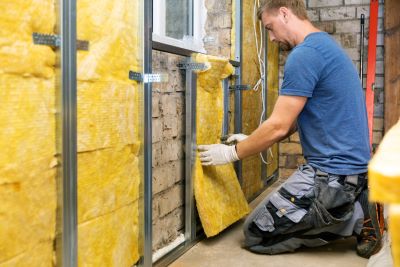
Fiberglass insulation is often used in the wall cavity to help with heat insulation, but it can add around 1-3 STC points to a wall. Although insulation cannot block sound on its own, it does help to stop some sound from traveling through a wall.
Although Sound Batts and Mineral Wools can be added to a wall assembly to help improve the overall STC rating by 1-3 points, the material itself is not STC rated, and doesn’t block sound transfer. This is a common misconception for these types of materials, as some people think they can cover an existing wall with fiberglass batt to make a wall more soundproof.
Sound batt and mineral wool on their own have an NRC, or Noise Reduction Coefficient, which shows how much sound they’ll absorb – not block. Sound absorption is important when there is echo in a space. When sound absorbing materials are placed on an existing wall, they’ll help absorb sound waves, and prevent them from reverberating around a room and creating echo.
Mass Loaded Vinyl in Ceilings with Batts
Batts and MLV work together in a ceiling the same way they do in a wall: the batts absorb sound inside the joist cavity and the MLV adds the mass that blocks it.
- Batts first, filling the joist bays above.
- MLV across the joists below the batts, fastened to the joists, with every seam taped with MLV seam tape.
- Drywall on resilient channel below the MLV, so footstep vibration isn’t carried straight into the ceiling.
- Seal the edges and every light and vent with acoustical caulk.
Don’t simply lay MLV on top of batts in an attic: it needs to be a continuous, sealed layer fixed to the framing to block sound.
STC vs NRC vs OITC
- STC measures how well a wall, floor, door or window blocks sound, mainly in the speech range.
- NRC measures how much sound a surface absorbs instead of reflecting, from 0 to about 1. It applies to panels and insulation, not walls. Our sound absorbing wall panels are NRC 1.05.
- OITC is like STC but weighted toward low frequencies such as traffic, aircraft and bass. Use it for exterior walls and windows facing traffic noise.
STC Ratings for Mass Loaded Vinyl & Sound Batts
To review – there are a few different weight and thickness options for mass loaded vinyl, and each type has a different STC rating. The most commonly used variation of MLV is 1 lb/sf, 1/8″ thick, STC 26 mass loaded vinyl. There’s also 2 lb/sf MLV with a stand-alone STC rating of 31, and 0.6 lb/sf MLV with a stand-alone STC rating of 21. The type of mass loaded vinyl that someone selects to help soundproof a wall can depend on the target STC or building code required STC, and cost per square foot.
As discussed earlier, sound batts don’t have stand alone STC ratings, but they can help improve the STC of a wall when installed within the wall cavity. When exposed, sound batt and mineral wool have an NRC, or Noise Reduction Coefficient, which conveys how much sound a material absorbs, not blocks.
Frequently Asked Questions
What is the STC rating of mass loaded vinyl?
1 lb/sf mass loaded vinyl, 1/8″ thick, is rated STC 26 on its own. 2 lb/sf MLV is STC 31, and lighter 0.6 lb/sf MLV is STC 21. Those are stand-alone ratings: added to a wall, MLV raises the whole assembly by roughly 10 or more points.
What is a good STC rating for walls?
STC 50 is the building code minimum between apartments and hotel rooms, and normal speech becomes inaudible around there. STC 55–60 is a good target for real privacy, and studios and home theaters aim for 60 or higher.
Do STC ratings add up?
No. Adding an STC 26 layer of MLV to an STC 33 wall gives roughly STC 39, not 59. The rating of a wall depends on the whole assembly, so combining materials always adds less than the two numbers suggest.
What STC rating is soundproof?
No wall is completely soundproof, but at STC 60 and above, loud speech and most music are blocked. Bass and very loud sources can still come through, which is why studios also look at low-frequency performance.
What is the difference between STC and NRC?
STC measures how well a wall or material blocks sound passing through it. NRC measures how much sound a surface absorbs inside a room. Mass loaded vinyl has an STC rating; acoustic panels and insulation have an NRC.