
Table of Contents
How Much Does Mass Loaded Vinyl Weigh?
If you’ve ever worked with mass loaded vinyl in a wall soundproofing project, you’ve probably noticed that it’s a pretty heavy material. As the name states, mass loaded vinyl is used to add mass to walls and improve the amount of sound they can block, which is measured by the wall’s STC rating.
Quick answer Standard mass loaded vinyl weighs 1 lb per square foot (4.9 kg/m²) and is 1/8″ thick, so a 4′ × 25′ roll covering 100 sq ft weighs about 100 lb. Its density is about 96 lb per cubic foot (roughly 1,540 kg/m³). Lighter 0.6 lb/sf MLV is 1/16″ thick, and the heaviest common grade is 2 lb/sf at 1/4″.
MLV is sold by weight per square foot, not by thickness, because the weight is what blocks sound. Double the weight and you double the mass in the wall; the thickness simply follows from that.
Mass Loaded Vinyl Weight, Density and Thickness Chart
Every common grade of MLV in imperial and metric. All of ours come as a 4′ × 25′ roll covering 100 square feet.
| MLV | Weight per sq ft | Weight per m² | Thickness | 100 sq ft roll | STC alone |
|---|---|---|---|---|---|
| Wall Blokker Lite | 0.6 lb | 2.9 kg | 1/16″ (1.6 mm) | about 60 lb | 21 |
| MLV Sound Barrier, Wall Blokker | 1 lb | 4.9 kg | 1/8″ (3.2 mm) | about 100 lb | 26 |
| Wall Blokker PRO (with scrim) | 1.1 lb | 5.4 kg | 3/16″ (4.8 mm) | about 110 lb | 26 minimum |
| 2 lb/sf MLV | 2 lb | 9.8 kg | 1/4″ (6.4 mm) | about 200 lb | 31 |
1 lb/sf is the most common weight. Wall Blokker Lite is the cost-effective choice on metal stud walls, 1 lb MLV is ideal on wood studs or metal stud walls that need STC 55+, and PRO adds 3–5 STC points over standard MLV on the same wall. 2 lb MLV is typically used for mechanical rooms, since the extra mass is better at blocking low-frequency, vibrational noise. For what each rating means on a finished wall, see STC ratings for mass loaded vinyl.
Mass Loaded Vinyl Density
Mass loaded vinyl comes in a variety of weights and thicknesses, however, the density of the material remains the same no matter the thickness or weight per square foot. A 1/8″ sheet weighing 1 lb/sf works out to about 96 lb per cubic foot, or roughly 1,540 kg/m³, around one and a half times the density of water. Thicknesses are nominal, so the figure calculated from any one product varies a little.
Searches for “MLV density in lb/sq ft” are really asking for the surface weight, sometimes called surface density: 0.6, 1, 1.1 or 2 lb/sf, or 2.9 to 9.8 kg/m² in metric. To convert, multiply lb/sf by 4.88 to get kg/m².
Does Heavier MLV Have a Higher Density?
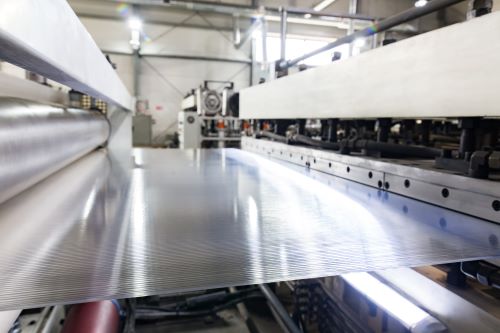
No. Light mass loaded vinyl has the same density as heavier mass loaded vinyl. Factories have special extrusion machines so they can adjust the thickness at which the material is extruded, and a thicker sheet is heavier per square foot.
Although each thickness and weight of MLV is the same density, they do not have the same STC rating. Each one has its own stand-alone STC rating and will impact the soundproofing of a wall assembly differently.
Mass Loaded Vinyl Thickness
MLV ranges from 1/16″ (1.6 mm) to 1/4″ (6.4 mm), and the most common thickness is 1/8″ (3.2 mm). Thickness matters for two practical reasons:
- Fitting it in. Under new drywall, 1/16″ Wall Blokker Lite adds so little that door jambs, outlets and trim still line up, which is why it is the easier retrofit over existing drywall.
- Handling it. A 100 sq ft roll of 1 lb MLV weighs about 100 lb, so plan on two people. Cut it with a sharp utility knife and tape every seam with MLV seam tape.
What Is Mass Loaded Vinyl Made Of?
MLV is a vinyl polymer loaded with a dense mineral filler, which is what makes it so heavy for its thickness while staying limp and flexible. There are two different types of mass loaded vinyl: PVC based MLV and EVA based MLV.
PVC based mass loaded vinyl is made using plasticizers, which make the normally rigid vinyl flexible. Plasticizers can cause harsh off-gassing, and as the plasticizers break down over time, the MLV becomes very brittle and will start to crumble.
Higher quality mass loaded vinyl is EVA based, which is naturally flexible and does not require the use of plasticizers. Since it does not off-gas, it does not cause unwanted odors or cause the material to break down as quickly. EVA based vinyl lasts much longer than its PVC counterpart, and also provides better STC rating results in lab tests. Wall Blokker is EVA based.
Reinforced MLV is extruded with carbon fiber reinforcement and UV protection so that it can be used outdoors. Fence Blokker is the same 1 lb/sf as standard MLV. People typically hang it on an exterior fence to reduce noise from a busy road or noisy neighbors.
MLV Weight vs Drywall
Multiple layers of drywall can also be used to increase the mass of a wall, however, to achieve the same results as one layer of MLV you would need 3 to 4 additional layers of drywall. Standard 1/2″ drywall weighs roughly 1.6 to 2 lb/sf, so pound for pound it is heavier than MLV, yet it blocks less.
The difference is stiffness. Drywall is rigid, and at certain frequencies it vibrates and lets sound straight through. MLV is limp, so it has no weak spots like that, and it decouples the layers on either side of it. That is why 1/8″ of MLV is a much more cost-effective and labor-effective option than stacking drywall, and why it adds only 1/8″ to the wall. For how MLV compares to other options, see the best soundproofing materials.
Density of Other Sound Materials
Unlike mass loaded vinyl, acoustic panels come in different thicknesses AND different densities, and both change how they perform. Panels are rated by how much sound they absorb (NRC), not how much they block, and they are far lighter than MLV.
A typical acoustic panel has a 6 pcf (pounds per cubic foot) fiberglass core, about one sixteenth the density of MLV. Some people opt for a 3 pcf core to save on cost, but it is not as absorptive, so you need more square footage to get similar results. Our sound absorbing wall panels are 2″ of 6 pcf fiberglass, NRC 1.05, and a 2′ × 4′ panel core weighs about 8 lb.
Frequently Asked Questions
How much does mass loaded vinyl weigh per square foot?
Standard MLV weighs 1 lb per square foot (4.9 kg/m²). Lighter grades are 0.6 lb/sf, PRO with a scrim is 1.1 lb/sf, and the heaviest common grade is 2 lb/sf.
What is the density of mass loaded vinyl?
About 96 lb per cubic foot, or roughly 1,540 kg/m³. The density is the same at every thickness; heavier MLV is simply extruded thicker.
How thick is mass loaded vinyl?
Most MLV is 1/8″ (3.2 mm) thick at 1 lb/sf. It also comes 1/16″ at 0.6 lb/sf, 3/16″ with a scrim at 1.1 lb/sf, and 1/4″ at 2 lb/sf.
What is mass loaded vinyl made of?
A vinyl polymer loaded with a dense mineral filler. Cheaper MLV is PVC based and uses plasticizers that off-gas and turn brittle over time; better MLV is EVA based and needs no plasticizers.
How heavy is a roll of mass loaded vinyl?
A 4′ × 25′ roll of 1 lb/sf MLV weighs about 100 lb. The same size roll is about 60 lb at 0.6 lb/sf and about 110 lb for PRO, so plan on two people to hang it.