
Table of Contents
How Soundproof Underlayment Works
Do you constantly hear footsteps and talking above your head? If you live in a multi-story home or apartment building, you’re probably no stranger to noise from the floor above. Soundproofing a floor isn’t complex as long as you have the right materials and access to the floor that needs it. If it’s your upstairs neighbor’s floor, there isn’t much you can do from below; if it’s your own home or condo, a sound underlayment is the fix.
Quick answer The best soundproof underlayment depends on the floor. Under vinyl plank, carpet and nail-down hardwood, a mass loaded vinyl underlayment like Floor Blokker blocks both footsteps and voices. Under laminate and engineered hardwood, a thin polyester mat like Floor Blokker Lite cuts footstep noise. Under tile, use a rubber sound mat like AcoustiStep glued to the subfloor.
A sound underlayment is a separating layer between the subfloor and the finish floor. It works on two kinds of noise:
- Impact noise – footsteps, dropped objects, chairs scraping. It travels as vibration through the floor structure, and it’s measured by the IIC (Impact Insulation Class) rating. A cushioned underlayment absorbs the impact before it reaches the subfloor.
- Airborne noise – voices, TV and music, measured by the STC rating. Only an underlayment with real mass, like mass loaded vinyl, blocks it.
Building codes require IIC 50 and STC 50 between apartments and condos stacked on top of each other. Underlayments are compared by Delta IIC: how many points they add over the same floor with no underlayment.
Best Soundproof Underlayment by Floor Type
Start with the finish floor you’re putting down. Each one has an underlayment it works best with:
| Finish floor | Best underlayment | How it goes in |
|---|---|---|
| Vinyl plank (LVP), floating | Floor Blokker or AcoustiStep | Floor Blokker MLV side down; plank floats on top |
| Glue-down vinyl (LVT) | Floor Blokker or AcoustiStep | Floor Blokker MLV side up; vinyl adhered on top |
| Laminate | Floor Blokker Lite or Floor Blokker | Lite poly side up, seams taped; laminate floats on top |
| Engineered hardwood | Floor Blokker Lite | Poly side up; floated or adhered on top |
| Nail-down hardwood | Floor Blokker | Stapled to the subfloor; wood nailed through it |
| Ceramic or porcelain tile | AcoustiStep or Floor Blokker | Adhered to the subfloor; polymer-fortified grout |
| Carpet | Floor Blokker | MLV side up; carpet on top |
If voices and TV from the room below are part of the problem, not just footsteps, choose Floor Blokker. It is the only one of the three with a mass loaded vinyl layer to block airborne sound.
Mass Loaded Vinyl Underlayment
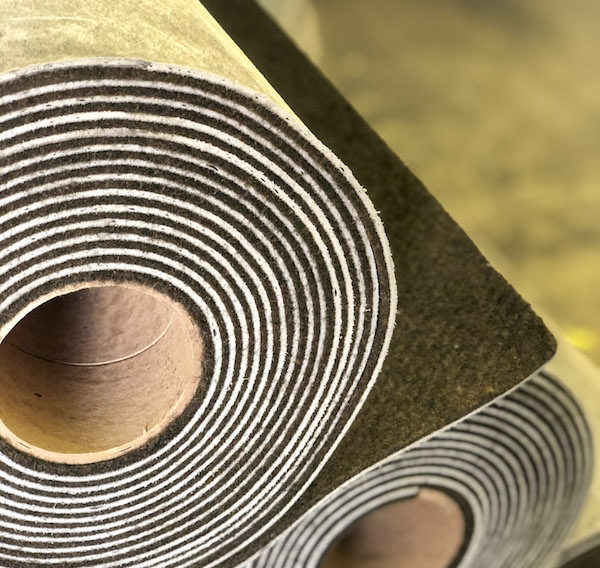
Floor Blokker is a 1 lb/sf EVA-based mass loaded vinyl fused to a soft polyester scrim, 1/4″ (6 mm) thick, in 4′ × 25′ rolls. The MLV adds the mass that blocks airborne noise like voices and music; the scrim cushions footfall. Together they add Delta IIC 26, and it is the most cost-effective way to meet the code’s STC/IIC 50 on many wood and concrete floors.
Tested results include IIC 56 with LVT on a wood truss floor, IIC 70 with LVT on 6″ concrete, and IIC 53 with ceramic tile on concrete. It works under wood, tile, stone, carpet and vinyl, is non-PVC, and is mold and mildew resistant.
Installing Floor Blokker:
- Set the MLV side for your floor: down under floating floors; up under glue-down vinyl, glue-down hardwood and carpet.
- Lay it edge to edge across the whole room, staples or screws into a wood subfloor.
- Install the finish floor on top as normal: laminate floats on it, wood floors can be nailed through it, carpet goes straight on top, and other floors adhere to it with a premium vinyl adhesive.
Rubber Sound Mat Underlayment
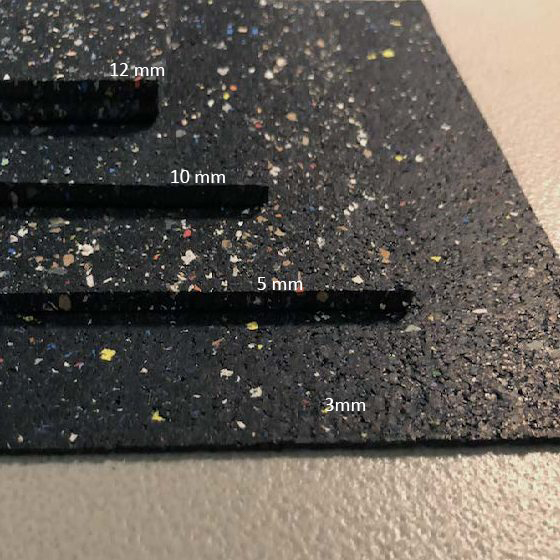
AcoustiStep is a recycled rubber sound mat that works under any floor, including tile, in floating, glue-down and nail-down installs. It comes in 2, 3, 5, 10 and 12 mm thicknesses; thicker mats add more, from Delta IIC 20 up to 26. On wood or concrete subfloors it reaches IIC 50+ with any finish floor, IIC 60+ on concrete, and IIC 70+ on concrete with a resiliently mounted ceiling below.
Rubber is mainly for impact noise. It acts as a shock absorber for footsteps, but it doesn’t have the mass to block voices the way MLV does.
Installing AcoustiStep:
- Let it acclimate in the room for 48 hours.
- Start in a corner and unroll it flush along the wall, perpendicular to the direction of the finish floor.
- Under tile or glue-down hardwood, adhere it to the subfloor with a high-quality urethane adhesive.
- Butt the sheets edge to edge. Taping the seams is optional.
- Let it fully bond, then install the finish floor per its manufacturer’s instructions.
Soundproof Underlayment for Laminate and Engineered Hardwood
Laminate and engineered hardwood are usually floated, and a floating floor is loud underfoot: each step drums on the subfloor. Floor Blokker Lite is made for these floors. It is only 0.10″ thick, made from resilient polyester fibers with no plasticizers, and adds Delta IIC 25, with IIC 56 tested under laminate on a concrete slab.
Lay it poly side up regardless of the floor, edge to edge, tape the seams, and float the floor on top. If you also need to block voices from below, use Floor Blokker under laminate instead.
Soundproof Underlayment for Vinyl Flooring
Vinyl plank and LVT are thin and hard, so on their own they pass footsteps straight into the subfloor. Floor Blokker is the strongest choice under vinyl: tested at IIC 56 with LVT on a wood truss floor and IIC 70 on concrete, and it blocks voices too. AcoustiStep in 2 or 3 mm is the thinner option when you only need to cut footstep noise.
Check your vinyl’s installation guide before you buy. Some click-lock planks come with an attached pad and limit what can go under them.
Soundproofing Under Tile
Tile is the loudest floor to live under because it’s hard and rigid. The underlayment has to be bonded to the subfloor so the tile doesn’t flex and crack. Adhere AcoustiStep with urethane adhesive and set the tile on it, or use Floor Blokker, which is approved by the Tile Council of North America for light commercial use under ceramic and porcelain tile, with polymer-fortified grout. Floor Blokker tested at IIC 53 under ceramic tile on concrete.
How to Soundproof a Floor With Underlayment
When starting to soundproof a floor you have two options:
- Remove the existing finish floor and install the underlayment directly on the subfloor, then the new floor on top. This is the recommended way.
- Keep the existing floor and lay the underlayment over it, as long as you add a new layer of flooring on top of the mat.
Either way, don’t let the floor touch the walls. Hold the baseboard 1/8″ off the floor and seal the gap with acoustical caulk, or footsteps travel into the walls and around the underlayment. If the noise is your upstairs neighbors and you can’t touch their floor, see how to block noise from neighbors for fixes from your side of the ceiling.
Frequently Asked Questions
What is the best soundproof underlayment?
For blocking both footsteps and voices, a mass loaded vinyl underlayment like Floor Blokker. For footsteps only, a rubber sound mat or a thin polyester mat under laminate does the job with less thickness.
Can you use mass loaded vinyl as underlayment?
Yes. MLV underlayment such as Floor Blokker is 1 lb/sf mass loaded vinyl fused to a polyester scrim, so the vinyl blocks airborne noise and the scrim cushions impact. Plain wall MLV has no cushion layer, so it does much less for footsteps.
What is a good IIC rating for a floor?
IIC 50 is the building code minimum between stacked apartments and condos. IIC 55–60 is noticeably quieter, and 60+ is a high-end target.
Can you put soundproof underlayment under tile?
Yes, if it’s bonded to the subfloor. Adhere a rubber mat like AcoustiStep with urethane adhesive, or use Floor Blokker, which is TCNA-approved for light commercial use under ceramic and porcelain tile.
Does underlayment stop footsteps from upstairs?
It does when it’s installed under the floor upstairs, where the footsteps happen. Adding underlayment to your own floor won’t quiet the people above you.