Table of Contents
Home Theater Soundproofing vs Acoustic Treatment
A home theater has two separate sound jobs. Soundproofing keeps the movie in the room, so the explosions don’t wake the kids upstairs, and keeps the house out of it. That takes mass, airtight seals and, for bass, walls and ceilings that aren’t rigidly connected to the rest of the house. Acoustic treatment makes the room itself sound good: clear dialogue, tight bass and no echo. That takes absorbing panels, bass traps and a ceiling cloud.
Most people start with panels because they’re easy, then find the rest of the house still hears every movie. Panels do nothing to stop sound leaving the room. Decide which problem you’re solving first, because the budget goes to very different places.
Quick answer To soundproof a home theater, seal every gap, fit a solid door with seals, and add mass loaded vinyl to the walls and ceiling, hung on resilient channel so bass isn’t carried through the framing. Then treat the inside with panels at the first reflection points, bass traps in the corners and a cloud over the seats.
Soundproofing Home Theater Walls
Bass is what makes home theater soundproofing hard. A subwoofer puts out energy below the range an STC rating even measures, and those long waves shake the whole wall. A wall that stops dialogue can still pass the rumble of every action scene.
- Seal first. Caulk every drywall edge, outlet and penetration with acoustical caulk. In-wall speakers and their back boxes are holes in the wall; seal around them and back them with mass.
- Add mass. Wall Blokker PRO is 1.1 lb/sf with a fused scrim, the heaviest barrier we sell, at $299 per 100 sq ft. Standard 1 lb/sf mass loaded vinyl is $199. Tape every seam with MLV seam tape.
- Decouple for bass. Hang the new drywall on resilient channel or isolation clips so it isn’t screwed straight to the studs, or build a separate stud wall inside the old one. This is the step that actually cuts subwoofer rumble.
- Fill the cavity with sound insulation.
Commercial theaters face the same bass problem at a larger scale. At Cinepolis Hamlin in Winter Garden, Florida, our sister company Commercial Acoustics used mass loaded vinyl in the auditorium walls to reach STC 65+ and keep low-frequency rumble from bleeding between screens.
Home Theater Ceilings and Floors
If there’s a room above the theater, the ceiling usually leaks more than the walls, because bass travels straight up through the joists.
- Ceiling: fill the joists with insulation, add a layer of mass loaded vinyl, and hang the drywall on resilient channel. Seal around every recessed light, or use surface-mounted fixtures.
- Floor above the theater: if the theater sits above living space, put an isolation underlayment under the finished floor. Floor Blokker is rated for IIC 50+ under hardwood and laminate, at $240 per 100 sq ft.
- Subwoofers: keep them off shared walls, and put them on an isolation pad so they don’t drive the floor.
Soundproofing the Home Theater Door
The door is the weakest part of most home theaters. A hollow interior door with a gap underneath undoes a heavily soundproofed wall.
- Use a solid-core door, or two doors with an air gap between them in a dedicated theater.
- Seal it completely: perimeter gaskets on the frame and an automatic door bottom.
- Put the door at the back of the room, away from the screen wall and the main speakers.
Home Theater Sound Dampening Panels
Once the room is sealed, it will sound boomy and echoey until you treat it. Sound dampening panels absorb reflections so dialogue is clear and effects are placed where the mix intended. They don’t stop sound leaving the room.
- First reflection points on the side walls, between the screen and the seats. Sit in the main seat and have someone slide a mirror along the wall: wherever you see a front speaker, a panel goes.
- The rear wall, so sound from the front speakers doesn’t bounce back at the audience.
- Bass traps in the corners, where low frequencies build up. Thick panels across the corners, floor to ceiling if you can.
- A ceiling cloud over the seating. Acoustic ceiling cloud panels start at $119.
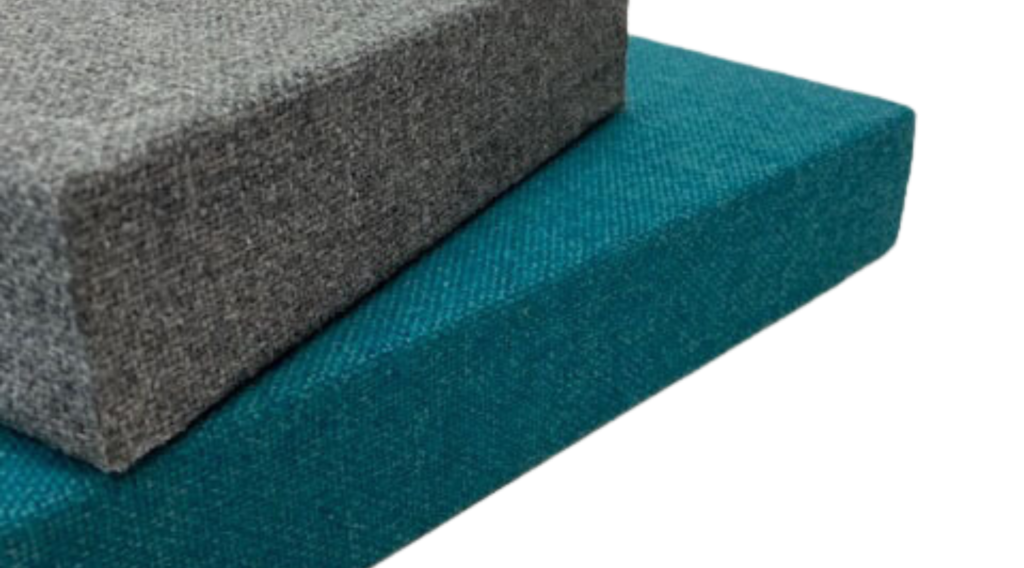
Our sound absorbing wall panels are 2″ fiberglass (NRC 1.05) from $109, in 24 fabric colors, so a dark theater can have dark panels. As a starting point, cover about 25–35% of the wall area in a dedicated theater. Too much absorption makes a room sound dead, so add panels in stages and listen.
Soundproofing a Basement Home Theater
Basements are the best place for a home theater. The concrete walls and slab floor already block a lot, and there’s earth on the other side of some walls. The weak points are what’s left:
- The ceiling under the main floor, which carries bass straight up. Treat it as above: insulation, MLV and resilient channel.
- Framed walls between the theater and the rest of the basement, including the stairwell.
- The mechanical room. A furnace or water heater next door adds background noise; give that room a solid, sealed door.
- HVAC ducts, which carry sound to every room on the system. Lined ducts with a bend in them before the grille help.
The same steps, with more on bass and decoupling, are covered in how to soundproof a music room.
Movie Room Ideas That Also Improve Sound
- Carpet and a thick pad absorb reflections from the floor and cut footsteps for the room below.
- Upholstered theater seating absorbs sound, so the room sounds the same empty or full.
- A stepped riser for the back row. Built hollow and filled with insulation, it also works as a bass trap.
- Heavy curtains over windows and along the side walls block light and soften echo, but they don’t soundproof. Use them for the look, not to keep sound in.
- Dark, matching panels in fabric that suits the room, so the acoustic treatment looks like part of the design.
Home Theater Soundproofing Costs
| Fix | What it does | Cost |
|---|---|---|
| Caulk gaps and outlets | Closes the small leaks | $ — $17.99 a tube |
| Door seals and automatic door bottom | Closes the biggest leak | $$ |
| Panels, bass traps and a cloud | Clear dialogue, tighter bass inside | $$ — panels from $109 |
| Solid-core door | Blocks sound through the door itself | $$$ |
| MLV in walls and ceiling | Blocks dialogue and effects | $$$ — $199–299 per 100 sq ft, plus drywall |
| Resilient channel or a separate stud wall | Blocks subwoofer bass | $$$$, usually a contractor |
Frequently Asked Questions
How do you soundproof a home theater?
Seal every gap with acoustical caulk, fit a solid-core door with perimeter seals and an automatic door bottom, and add mass loaded vinyl to the walls and ceiling. Hang the drywall on resilient channel to stop bass, then add panels, bass traps and a ceiling cloud to treat the sound inside.
How do you stop home theater bass from going through walls?
Mass alone isn’t enough for bass; the wall also has to be decoupled. Add mass loaded vinyl and hang the drywall on resilient channel or isolation clips, or build a separate stud wall. Keep subwoofers off shared walls and on isolation pads.
Do soundproof curtains work in a home theater?
Not for soundproofing. Heavy curtains block light and soften echo, but they’re too light and too leaky around the edges to keep sound in the room. Use them for the look and for light control; use mass, seals and decoupling to keep sound in.
How many acoustic panels does a home theater need?
Start with panels at the first reflection points on the side walls, the rear wall, bass traps in the corners and a cloud over the seats. That is usually 25–35% of the wall area in a dedicated theater. Add them in stages and listen, since too much absorption makes the room sound dead.
What is the difference between soundproofing and acoustic treatment in a home theater?
Soundproofing keeps sound in the room; acoustic treatment makes the room sound good. Soundproofing uses mass, seals and decoupling in the walls, ceiling and door. Treatment uses panels, bass traps and clouds inside the room. Most home theaters need both.