Table of Contents
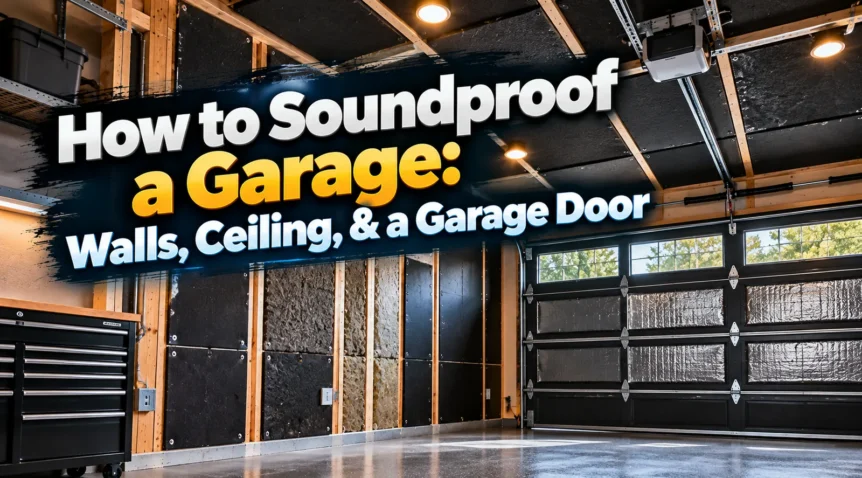
How to Soundproof a Garage: Start With the Leaks
A garage is the hardest room in the house to soundproof and the easiest to get wrong. It has the biggest door in the building, usually a thin sheet of steel with gaps on all four sides. The walls often have drywall on one side or none. And the space above the ceiling is open attic with vents to the outside.
That is why foam panels, egg crates and moving blankets disappoint so many people. They make the garage sound less echoey to whoever is inside, but the noise still walks out through the gaps. Soundproofing a garage means closing the gaps first, then adding mass, in the order below.
Quick answer Seal the gaps around the garage door, add mass to the door (or build a wall behind it), then put mass loaded vinyl and drywall on the walls and ceiling. If the garage is attached, treat the wall and door into the house before anything facing the street. Acoustic panels come last: they cut echo, they don’t block sound.
Where Sound Gets In and Out of a Garage
Sound takes the easiest path, so a garage is only as quiet as its weakest surface. Fix the paths roughly in this order, because a big gap makes everything behind it pointless: a wall with an STC of 50 next to a door with a 1/4″ gap under it performs like the gap.
- The gap under the garage door. Worn bottom seals and uneven slabs leave openings you can see daylight through.
- The sides and top of the door. Sectional doors sit inside the opening with a gap on every edge.
- The door panels themselves. A residential steel door is a thin skin, often 24 or 25 gauge, and it rattles at low frequencies.
- Windows. Single-pane glass in the door or walls, plus the gaps around the frame.
- The ceiling and attic. Open joists, no insulation, and gable or soffit vents that open straight outside.
- The wall and door into the house. The one that matters if the complaint is coming from inside your own home.
How to Soundproof a Garage Door
The garage door is the biggest, lightest and leakiest surface in the room, and none of the usual advice deals with the fact that it still has to open. Work through it in three steps.
1. Seal every edge. This is the cheapest, biggest improvement on almost any garage. Replace the bottom seal with a new rubber seal that suits your door’s retainer, and add a threshold seal on the slab if the floor is uneven. Fit vinyl stop molding with a flexible flap along both jambs and the header so it presses against the door when closed. Close the door from inside with the lights off: anywhere you see light, sound gets through.
2. Add mass to the panels, carefully. Mass loaded vinyl cut to fit between the ribs of each door section, glued or screwed in place and taped at the edges with MLV seam tape, makes the steel skin heavier and stops it ringing. Cut it section by section so the door can still fold at the hinges. The catch is weight: standard MLV is 1 lb per sq ft, so a 16′ × 7′ double door gains about 112 lb. The torsion springs are set for the door’s original weight, and too much extra makes the door hard to lift, strains the opener and lets the door drop when it’s released.
Door weight check Before adding mass, pull the emergency release and lift the door halfway by hand. A balanced door stays put. After adding mass, check again, and have a garage door technician adjust the springs if it drifts down. Don’t adjust torsion springs yourself: they are under enough tension to cause serious injury. Wall Blokker Lite at 0.6 lb/sf adds about 67 lb to the same double door, so it’s the easier choice when the door has to keep opening every day.
3. Or build a wall behind the door. If the garage has become a studio, gym or office and the car lives in the driveway, the best fix is not on the door at all. A framed stud wall built just inside the opening, insulated and covered with MLV and drywall like the other walls, blocks far more sound than any door treatment. The garage door stays for curb appeal and you can take the wall down later. Check with your city first if you are converting the space, since some count it as a change of use.
| Garage door option | Blocks sound | Door still opens | Rough cost |
|---|---|---|---|
| New bottom, side and top seals | Good gain for the money | Yes | $ |
| Moving or acoustic blankets | A little; mostly cuts echo | Yes, if hung on a track or hooks | $ |
| Insulated replacement door | Somewhat better than a single-skin door | Yes | $$$ |
| MLV on the door panels | Good, with sealed edges | Yes, after a spring check | $$ |
| Framed wall behind the door | Best | No | $$–$$$ |
Insulated doors are worth knowing about but easy to oversell. Foam insulation is light, so a two-skin insulated door blocks somewhat more than a single steel skin, not dramatically more. If you are replacing the door anyway, choose an insulated sectional door; if you are not, seals and mass get you further for the money. Tilt-up and swing-out doors tend to seal better than sectional and roll-up doors, which have more joints.
Soundproofing Garage Walls
Unfinished garage walls are the easy part, because the studs are open. The build that works is the same one used in home theaters and studios:
- Fill the stud cavities with fiberglass or mineral wool insulation. It absorbs sound inside the wall and stops the cavity ringing like a drum.
- Staple or screw mass loaded vinyl to the studs. Wall Blokker (1 lb/sf, 1/8″ thick) adds 6–12 STC points to a stud wall, about the same as 3 to 4 extra layers of drywall. For a band or drums, Wall Blokker PRO adds 3–5 STC points more than a standard barrier on the same wall.
- Tape every seam that doesn’t land on a stud with MLV seam tape, and cut tight around outlet boxes.
- Cover it with 5/8″ drywall, leaving a 1/4″ gap at the floor, ceiling and corners.
- Seal the edges and penetrations with acoustical caulk, which stays flexible so the gaps don’t crack open again.
Already have drywall up? You don’t need to tear it out. MLV can go over the existing board with a second layer of drywall on top; see installing mass loaded vinyl on top of an existing wall. For the full fastening pattern, see how to install mass loaded vinyl.
For a drum kit or amplified bass, add decoupling: resilient channel or isolation clips with hat channel so the drywall isn’t screwed straight to the studs. Low frequencies travel through rigid connections, and mass alone only goes so far against them.
Soundproofing the Garage Ceiling and Attic
An open garage ceiling is a straight path into the attic, and the attic is vented to the outside by design. Sealing the walls and leaving the ceiling open is like closing the windows of a car with no roof.
- Insulate between the joists, then hang MLV and drywall on the underside, exactly like the walls. Overhead MLV is heavy, so fasten it at close spacing and work with two people.
- Room above the garage? This is the most common complaint in attached garages. Use the full ceiling build with resilient channel or clips, since a bedroom over a garage gym gets both airborne noise and impact from dropped weights.
- Leave the attic vents alone. Gable and soffit vents keep the roof deck dry. Seal the ceiling below them instead, so the vents stay outside your soundproofed space.
- Seal the attic hatch and any pull-down stairs. A loose plywood hatch is a hole in an otherwise sealed ceiling. Weatherstrip it and add mass to the panel.
Soundproofing the Wall Between the Garage and the House
If the noise problem is inside your home, a workshop compressor waking the kids or a garage gym under the bedroom, this wall matters more than the garage door. It is also the wall with code rules attached: in most US jurisdictions the garage side of a wall shared with the house needs gypsum board, and a ceiling under a habitable room needs 5/8″ Type X fire-rated drywall. MLV and drywall fit straight into that requirement, so you can soundproof and keep the fire separation intact. Check your local code before you start.
The door from the garage into the house is usually the weak point. Most codes require it to be solid wood, solid or honeycomb-core steel, or fire-rated, and those doors are heavy enough to block sound well once the gaps are sealed. Add perimeter seals and an automatic or fixed bottom seal. Don’t swap it for a lighter interior door, and don’t add a pet flap to it.
Sound Dampening Panels for a Garage Band, Gym or Workshop
Once the garage is sealed and has mass, it gets louder inside. Concrete floors, bare drywall and a steel door bounce sound around, so a band sounds muddy and a workshop sounds harsh. That’s where sound dampening panels come in. Sound absorbing wall panels with a 6 pcf fiberglass core (NRC 1.05) soak up those reflections. They don’t stop sound leaving the garage, so they go in after the soundproofing, not instead of it.
How far to go depends on what you are doing in the garage. STC is the rating for how much a wall blocks; higher is better, and every 10 points sounds roughly half as loud on the other side.
| Garage use | Target wall STC | What it takes |
|---|---|---|
| Home office, keep street noise out | 40–45 | Sealed door, MLV and drywall on the street side |
| Workshop or power tools | 45–50 | Full MLV walls and ceiling, sealed door, wall to the house first |
| Garage gym | 45–50, plus impact | MLV walls and ceiling, rubber flooring under the weights |
| Band practice or drums | 55–60+ | MLV, decoupled drywall, a wall behind the garage door, panels inside |
For a garage gym, the slab carries impact straight into the foundation and any room over it. Rubber gym flooring under the weight area helps, and an acoustic rubber underlayment under a finished floor cuts footstep and drop noise. For a band, also see how to soundproof a music room, which covers drums and bass in more detail.
Keep the Garage Ventilated After You Seal It
A garage that is properly sealed for sound is also sealed for air, and that causes two problems people don’t expect. It gets hot or stale fast with a band or a workout going, and anything that burns fuel loses its air supply.
- Never seal off combustion air to a gas water heater, furnace or dryer in the garage. Those vents are there for safety. Talk to an HVAC tech before closing any of them, and keep a carbon monoxide alarm in the garage.
- Don’t run engines in a sealed garage, even briefly with the door open a crack.
- For comfort, a ductless mini-split is the usual answer for a garage studio or gym. It heats and cools without a hole to the outside large enough to leak much sound.
- If you need fresh air, run it through a lined duct with a bend or two rather than a straight hole, so sound has to turn corners to get out.
Garage Soundproofing Cost
Here is what each stage costs in materials for a typical two-car garage, using our current prices. Labor, drywall and spring adjustment are extra.
| Stage | What you buy | Materials cost |
|---|---|---|
| 1. Seal the gaps | Door bottom, jamb and header seals, a tube or two of acoustical caulk ($17.99 each) | About $75–$250 |
| 2. Add mass to the door | 16′ × 7′ door is about 112 sq ft: 2 rolls of Wall Blokker Lite ($169 per 100 sq ft) or MLV ($199), plus seam tape | About $350–$450 |
| 3. Walls | Three 20′ walls at 8′ tall, less the door: roughly 450–500 sq ft, 5 rolls of Wall Blokker ($219 per roll) | About $1,100, plus insulation and drywall |
| 4. Ceiling | A 20′ × 20′ ceiling is 400 sq ft: 4 rolls of MLV or Wall Blokker | About $800–$900, plus drywall |
| 5. Echo control | 4–8 sound absorbing wall panels ($109–$359 each) | About $450–$2,800 |
Most people don’t need all five. A street-noise problem usually stops at stages 1 and 2. A workshop or gym in an attached garage needs stages 1 and 3 on the house side, plus the ceiling if there is a room above. A drum kit needs everything, done properly.
Before You Buy Anything
- Decide which way the noise goes. Keeping a band in is a much bigger job than keeping street noise out of a garage office.
- Find out who is hearing it. If it is people in your house, start with the shared wall and the door into the house. If it is neighbors, start with the garage door.
- Do the light test. Close the garage door at night with the lights on inside and walk around outside. Every line of light is a leak to seal first.
- Check the door balance before you hang anything on it.
- Measure in square feet, wall by wall, and add 10% for cuts and overlaps. MLV comes in 4′ × 25′ rolls (100 sq ft).
Frequently Asked Questions
Can you soundproof a garage door?
Yes, partly. Sealing the bottom, sides and top and adding mass loaded vinyl to the panels makes a clear difference. Check the door balance before and after, since the springs are set for the door’s original weight. For the biggest reduction, build an insulated wall behind a door you rarely open.
What is the best way to soundproof a garage?
Seal the gaps first, then add mass. Fix the garage door seals, add MLV to the door or build a wall behind it, then put MLV and drywall on the walls and ceiling. Acoustic panels go last, to cut echo inside.
Do acoustic panels soundproof a garage?
No. Acoustic panels absorb echo inside the garage, so a band or workshop sounds better to the people in it, but sound passes straight through them. Blocking noise takes mass and sealed gaps.
What is the cheapest way to soundproof a garage?
New seals on the garage door and acoustical caulk in the wall gaps, usually under $250 in materials. It won’t make the garage band-proof, but it removes the biggest leaks.
How much does it cost to soundproof a garage?
About $75 for seals alone, to around $2,800–$5,500 in materials for a two-car garage with MLV on the walls, ceiling and door plus echo panels. Labor, drywall and insulation are extra.