Table of Contents
Soundproof Panels vs. Acoustic Panels: The Short Answer
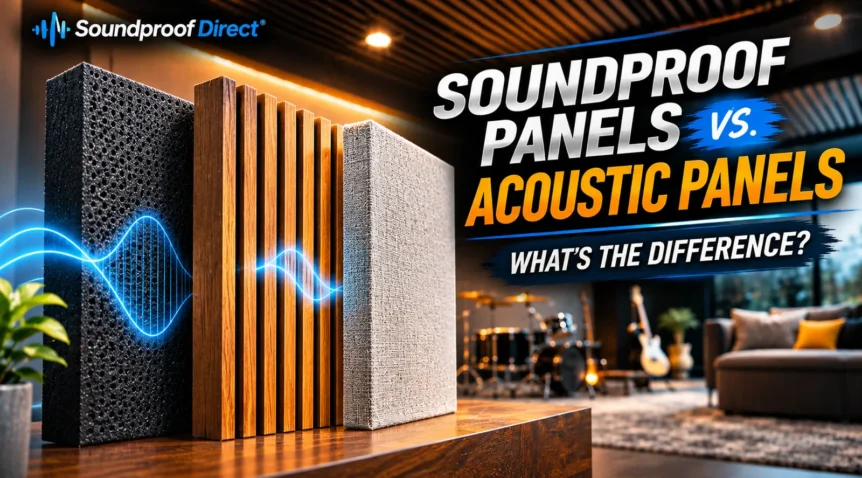
Most people who search for “soundproof panels” want something they can hang on a wall to stop the neighbor’s TV. That product doesn’t exist. A panel you hang on a wall absorbs sound inside your room. Keeping sound from passing between rooms is a different job, and it takes mass and a tight seal.
The two get mixed up constantly, partly because a lot of sellers use the words interchangeably. Buying the wrong one is the most common reason someone spends a weekend on a room and it sounds exactly the same afterward.
Quick answer Acoustic panels absorb echo inside a room. Soundproofing blocks noise passing between rooms. If you hear your neighbors, you need mass and sealing. If your room sounds boomy or hollow, you need acoustic panels.
What Acoustic Panels Do
A hard wall sends back almost everything that hits it. In a room finished in drywall, glass, and tile, every voice reaches you once directly and again a split second later off the surfaces around you. That smear is what makes a room tiring to talk in and a recording hard to clean up.
An acoustic panel swaps a reflective surface for an absorptive one. Sound passes through the fabric into a fiberglass core, and the fibers turn it into a tiny amount of heat instead of bouncing it back. Our Sound Absorbing Wall Panels use 2 inches of 6 pcf fiberglass, which gives an NRC of 1.05.
NRC runs from 0, where a surface absorbs nothing, to about 1, where it absorbs nearly everything that reaches it. It tells you how much echo a panel removes. It tells you nothing about soundproofing.
How many you need depends on the room. For speech spaces like classrooms, offices, and dining rooms, cover 15 to 25% of the floor area. For music, high ceilings, or a lot of glass, go to 25 to 35%. Spread them out instead of grouping them on one wall, since sound has to reach a panel before it can be absorbed, and the exposed edges do some of the work too.
What Soundproofing Does Instead
Soundproofing stops sound from getting through a wall, floor, or ceiling. The rating for that is STC, Sound Transmission Class. Every 10 points is roughly half as loud on the other side. A basic wall with one layer of drywall on each side lands around STC 33 to 35, which is why you can follow a normal conversation through it. Building code asks for STC 50 between apartments and hotel rooms.
Getting there comes down to mass, seals, and separation. Mass means heavy material in the structure, such as an extra layer of drywall or a barrier like mass loaded vinyl or Wall Blokker. Seals matter because sound is air pressure, and it will pass through any gap you leave, so caulk and tape close the joints. Separation means the two sides of the wall aren’t rigidly tied together, which keeps vibration from traveling straight through the studs.
None of that looks like a panel, because it all sits behind the finished surface. So when you see a panel hanging on a wall, you can be fairly sure it’s an absorber.
Why a Sound Absorbing Panel Can’t Block Noise
This part surprises people. A 2-inch panel of 6 pcf fiberglass weighs about 1 pound per square foot. That’s the same weight as standard 1 lb mass loaded vinyl, which rates STC 26 on its own. So why does one block sound and the other doesn’t?
Air. Fiberglass is porous on purpose. Sound has to get into the fibers to be absorbed, so the panel is built to let air move through it. Vinyl is solid, and air can’t pass through it at all. The same open structure that makes a panel absorb so well is what makes it useless as a barrier.
Coverage is the other problem. Even a well treated room has panels on maybe a quarter of the wall area. The bare drywall between them, plus the door, the outlets, and the gap under the door, still carry sound through. A barrier only works if it’s continuous, and panels never are.
Foam has the same issue, only worse, because it’s lighter. Egg crate foam marketed as “soundproofing foam” can tame a little flutter echo. It won’t do anything about a barking dog next door.
Soundproof vs. Acoustic Panels Compared
| Acoustic panels | Soundproofing | |
|---|---|---|
| Solves | Echo, boominess, hard-to-follow speech | Hearing neighbors, traffic, or the next room |
| What it does | Absorbs sound inside the room | Blocks sound passing through the structure |
| Rating that matters | NRC | STC |
| Where it goes | On walls and ceilings, in view | Inside walls, floors, and ceilings, and at gaps |
| Made of | Fabric-wrapped fiberglass core | Mass loaded vinyl, extra drywall, insulation, sealant |
| Stops noise from next door | No | Yes |
Which Do You Need? Match the Problem
If the room sounds echoey, boomy, or hollow, or people keep asking each other to repeat themselves, you want acoustic panels. Start with the types of acoustic wall panels. When the ceiling is the biggest hard surface in the room, which it usually is in open offices and restaurants, ceiling clouds get you more for the money than more wall panels.
If you can hear neighbors, traffic, or the TV in the next room, you want soundproofing. How to block noise from neighbors covers the quick fixes, and how to soundproof an existing wall covers adding mass without tearing the room apart.
A trick for telling them apart: clap once, hard, in the middle of the room. If you hear a ring or a flutter after the clap, that’s echo, and panels will fix it. If the room sounds fine but you can still make out words from next door, that’s transmission, and no number of panels will help.
Home Theaters, Music Rooms, & Other Rooms That Need Both
Some rooms have both problems. A home theater needs to keep the subwoofer out of the bedrooms and also sound clear in the seats. A music room has to keep drums in and keep the room from turning to mush. A conference room needs privacy for what’s said inside and needs to be easy to hear on a call.
In all of these, soundproof first and treat the echo second. The soundproofing goes inside the walls, so it has to happen before the drywall is finished and painted. Panels go on last and can be moved or added to once you hear the room. Home theater soundproofing walks through that order in a real build.
Common Mistakes With Soundproof & Acoustic Panels
The big one is covering a shared wall in panels to block a neighbor. It’s the most natural thing to try and it does almost nothing for the noise. The room will sound a little calmer, so some people think it worked for a day or two.
The second is soundproofing the wall and ignoring the door. A hollow core door with a gap underneath leaks more than a plain wall ever will, so a heavy wall next to it gets you very little. The same goes for outlets placed back to back on a shared wall and ducts that connect two rooms. Sound takes the easiest path, and fixing the strongest part of the wall while leaving the weakest open is wasted effort.
The third is relying on insulation alone. Batts in the stud cavity help some, mostly by damping the hollow drum effect inside the wall, but they don’t add real mass. On their own they won’t take an ordinary wall anywhere near code level. Pair them with a barrier and sealed seams, and the MLV installation guide shows how that goes together.
Can Acoustic Panels Reduce Noise at All?
Inside the room, yes, and sometimes by a lot. A loud restaurant, gym, or classroom gets louder because sound keeps bouncing around and stacking up, and people raise their voices to talk over it. Take away the bounce and the whole room settles down. That’s a real noise reduction for the people in the room. It just doesn’t change how much sound passes through the walls to the room next door.
Are acoustic panels soundproof?
No. Acoustic panels absorb echo inside a room. They don’t stop sound passing through a wall, because that takes mass and sealed gaps.
Do soundproof panels exist?
Not as a simple panel you hang on a wall. Blocking sound takes a heavy, continuous, sealed barrier built into or onto the wall, such as mass loaded vinyl with caulked joints. Products sold as soundproof wall panels are almost always absorbers.
What is the difference between STC and NRC?
STC rates how much sound a wall or floor blocks between rooms. NRC rates how much sound a surface absorbs inside a room. Panels are rated by NRC, and walls are rated by STC.
Do acoustic panels reduce noise from neighbors?
No. They make your own room less echoey, which can make it feel quieter, but the noise still comes through the wall. To cut noise from neighbors, add mass and seal the gaps, starting with the door.
Can I use soundproofing and acoustic panels together?
Yes, and many rooms need both. Soundproof the walls first to stop noise passing through, then add acoustic panels to control the echo that’s left.