Table of Contents
Why School Cafeterias Are So Loud
Cafeterias are built to be easy to clean: tile or sealed concrete floors, block walls, hard ceilings and stainless serving lines. Every one of those surfaces reflects sound. Put two or three hundred people in the room at lunch and the noise keeps bouncing between the floor and ceiling long after each word is spoken.
Then the room feeds itself. As the echo builds, everyone raises their voice to be heard, their neighbors do the same, and within minutes staff can’t give instructions over the noise. Acousticians measure this as reverberation time (RT60), how many seconds a sound takes to die away. Untreated cafeterias often measure 2–3 seconds. For a room where people need to talk, the target is about 1.0–1.5 seconds.
Quick answer Cafeteria noise is an echo problem, so the fix is absorption, not soundproofing in the wall. Hang acoustic baffles from the ceiling across the dining area, add acoustic panels to the upper walls, and keep the kitchen and dish room behind closed doors. Most cafeterias need absorption equal to 25–35% of the floor area.
Hanging Acoustic Baffles for Cafeterias
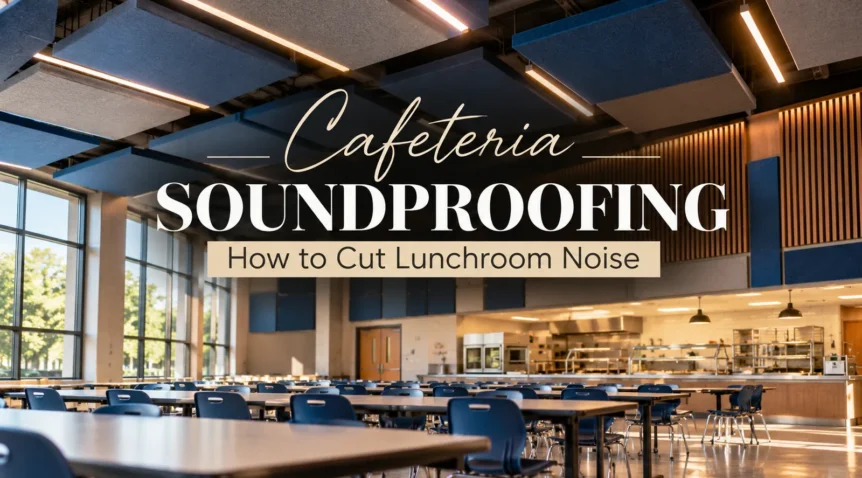
In a large, open cafeteria the walls are too far from the tables to do most of the work. The sound is generated in the middle of the room and bounces between the floor and ceiling, so the absorption needs to hang in the air above the diners. That is what baffles do.
- Both faces absorb. A baffle hangs on edge, so a 2 ft × 4 ft baffle gives about 16 sq ft of absorbing surface. That is why baffle counts come in lower than the wall panel area you’d need for the same result.
- Spread them evenly in rows across the whole dining area rather than bunching them in one spot. Run the rows around lights, sprinklers and ducts.
- Hang them low enough to work but above reach, typically a few feet below a high deck and well above the tables.
- Fabric or wipeable? Our acoustic ceiling baffles are 2″ fabric-wrapped fiberglass in 24 colors, from $99. They suit the dining area, where they hang well above the tables. Near food prep and the serving line, health rules may call for wipeable PVC-wrapped baffles.
At Marchman Technical College in Pasco County, Florida, our sister company Commercial Acoustics hung 100 baffles across the main dining hall. Reverberation dropped sharply and staff could be heard again at lunch.
How Many Baffles a Cafeteria Needs
A practical starting point is absorption equal to 25–35% of the floor area, which is the range for rooms with high ceilings and a lot of hard surfaces. Count each baffle by the area of both faces.
For example, a cafeteria 80 ft × 60 ft has 4,800 sq ft of floor. At 25–35%, that is 1,200–1,700 sq ft of absorption, or roughly 75–105 baffles at 2 × 4 ft (16 sq ft each). That lines up with the 100 baffles used at Marchman. For a closer estimate from your room’s volume and target reverb time, the formula is worked through in auditorium soundproofing.
Cafeteria Acoustic Panels for Walls
Wall panels add to baffles rather than replace them, and they do most of the work in smaller lunchrooms and break rooms where the walls are close to the tables.
- Mount them high, above about 7 ft, out of reach of chairs, trays and hands. Below that, keep the durable block or wainscot.
- Treat opposite walls, not just one, to stop sound flicking back and forth across the room.
- Use color. Our sound absorbing wall panels are 2″ fiberglass (NRC 1.05), Class A fire rated, from $109, and come in 24 fabric colors, so they can carry school colors or a mural layout.
Ceiling Clouds for Lower Cafeteria Ceilings
Break rooms, office cafeterias and lunchrooms with lower, flat ceilings often don’t have the height for baffles. Clouds hang flat a short distance below the ceiling and absorb on both sides. Acoustic ceiling cloud panels start at $119. If the room already has a drop ceiling, check the tiles: basic tiles absorb far less than they look like they should, and higher-NRC replacement tiles are a cheap upgrade.
Kitchen, Dish Room and Serving Line Noise
- Keep the dish room door closed during service, or add a door if it’s an open pass-through. Dish machines and tray returns are some of the loudest sources in the building.
- Use soft tray-return surfaces and rubber mats where trays and dishes are stacked.
- Put felt pads on chair legs. Scraping chairs on a hard floor add a lot to the noise, and pads cost almost nothing.
- Use wipeable materials near food. Over the serving line and in prep areas, choose finishes that can be cleaned to health code, and put the fabric treatment over the dining area.
Cafeteria Soundproofing Costs
| Fix | What it does | Cost |
|---|---|---|
| Felt chair pads, tray-return mats | Cuts scraping and clatter at the source | $ |
| Closing off the dish room | Keeps the loudest equipment out of the dining room | $$ |
| Higher-NRC drop ceiling tiles | Adds absorption where a drop ceiling exists | $$ |
| Wall panels above 7 ft | Absorbs reflections near the walls | $$$ — from $109 each |
| Hanging baffles across the dining area | The main fix for echo in a large cafeteria | $$$$ — about $9,300–13,000 for 75–105 baffles at $124 |
Frequently Asked Questions
How do you soundproof a cafeteria?
Cafeteria noise is mostly echo, so the fix is absorption. Hang acoustic baffles from the ceiling across the dining area, add acoustic panels to the upper walls, and close off the dish room. Felt pads on chair legs and mats at the tray return cut noise at the source.
How many acoustic baffles does a cafeteria need?
Plan on absorption equal to 25–35% of the floor area, counting both faces of each baffle. An 80 ft × 60 ft cafeteria needs roughly 75–105 baffles at 2 × 4 ft. A school cafeteria treated by Commercial Acoustics used 100.
Can fabric acoustic baffles be used in a cafeteria?
Yes, over the dining area, where they hang well above the tables. Near food prep and the serving line, health rules may require wipeable PVC-wrapped baffles, so check your local code for those areas.
Do acoustic panels reduce cafeteria noise?
Yes. They absorb echo, which stops the room getting louder as people raise their voices. In a large cafeteria, panels on the walls work best alongside hanging baffles, because the walls are far from where most of the noise is made.
How much does cafeteria soundproofing cost?
Chair pads and closing off the dish room cost little. For an 80 ft × 60 ft cafeteria, 75–105 baffles at $124 each run about $9,300–13,000 in material, before hanging hardware and installation.