Table of Contents
Library Acoustics vs Library Soundproofing
A noisy library usually has two separate problems. The first is echo: hard floors, glass and high ceilings keep sound bouncing, so a conversation at one table carries across the room. That is fixed with acoustics, meaning soft absorbing panels and baffles. The second is sound passing through walls, doors and windows, from the street, the children’s area or a meeting room. That is soundproofing, and it takes mass, airtight seals and better doors.
Modern libraries make both harder. They are no longer only quiet reading rooms; the same building hosts story time, tutoring, classes, maker spaces and public events. Good library acoustics means letting the busy areas be busy while keeping the quiet areas quiet.
Quick answer To soundproof a library, control echo with acoustic panels on the walls and baffles or clouds overhead, place group and children’s areas away from quiet reading with the stacks in between, and give study and meeting rooms sealed doors and walls with added mass. Sound masking covers what’s left in open areas.
Library Acoustic Panels: Where and How Many
Sound absorbing panels are the main tool for library acoustics. They take reflections out of the room, which lowers the overall noise level and stops voices carrying.
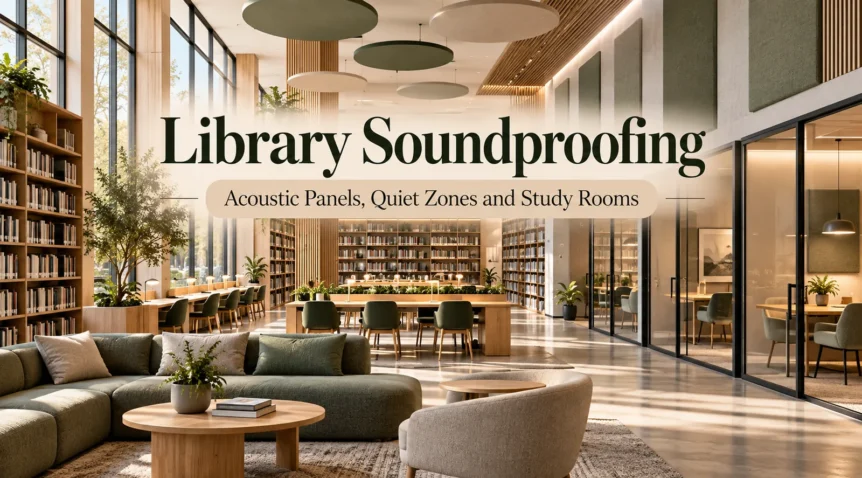
- Reading rooms: spread panels on the walls at and above head height, on opposite walls rather than one. Carpet and full shelves help, but rarely enough on their own.
- Group, teen and children’s areas: treat these most heavily. They make the most noise, and absorbing it at the source keeps it from reaching the rest of the floor.
- Atriums, stairwells and entrances: tall, hard spaces that carry sound between floors. Treat the walls and the ceiling.
As a starting point, cover wall area equal to 15–25% of the floor area for speech spaces, and more in tall or glass-heavy rooms. A 3,000 sq ft reading room would take about 450–750 sq ft of panels, or roughly 19–31 panels at 4 × 6 ft. Our sound absorbing wall panels are 2″ fiberglass (NRC 1.05), Class A fire rated for public buildings, and come in 24 fabric colors from $109 to $359.
Ceiling Baffles and Clouds for Open Libraries
In large open floors, the ceiling is the biggest surface and the one furthest from the shelves, so overhead treatment does a lot of the work.
- Acoustic ceiling baffles (from $99) hang on edge in rows and suit open, exposed or high ceilings in atriums and event spaces.
- Acoustic ceiling clouds (from $119) hang flat and suit lower ceilings over reading tables and study areas.
At Conyers-Rockdale Library in Georgia, our sister company Commercial Acoustics added ceiling baffles and wall panels to the group activity rooms, dining area and corridors during a renovation. Echo dropped noticeably, so classes and meetings could run without disturbing the rest of the library.
Zoning Quiet and Group Areas in a Library
Layout is the cheapest acoustic fix a library has. Distance and shelving do a lot of the work before any product is involved.
- Put noisy areas together near the entrance: the circulation desk, children’s area, teen space, group tables and printers.
- Put quiet reading at the far end, away from the entrance and stairs.
- Use the stacks as a buffer between the two. Full bookshelves break up the direct line for sound across the floor.
- Enclose the loudest activities. Story time, tutoring and meetings belong in rooms with doors, not in open corners of the main floor.
Soundproofing Library Study Rooms
Bookable study and meeting rooms are where patrons most expect privacy and most often don’t get it. The usual leaks are the door, a glass front with unsealed joints, and walls that stop at the ceiling tiles.
- Doors: solid core, perimeter seals and an automatic door bottom.
- Walls: caulk the edges and outlets with acoustical caulk, and add Wall Blokker Lite ($169 per 100 sq ft) to the metal-stud walls most libraries use, taken up to the deck above.
- Glass fronts: laminated glass and gaskets at every joint.
Each of these is covered in detail in how to soundproof a study room, including the glass-front rooms common in academic libraries.
Street Noise, Doors and HVAC
- Entrance vestibules with two sets of doors keep street noise and the sound of people arriving out of the main floor.
- Window inserts on reading room windows facing a busy road block far more noise than curtains.
- HVAC: lined ducts and lower air speeds at the grilles keep background noise down. Loud diffusers are a common complaint in quiet reading rooms.
- Sound masking in open study areas adds a low, even background sound so nearby conversations are harder to follow.
Library Acoustic Spec Basics
For a refurbishment brief or acoustic spec, these are typical targets. Your acoustic consultant will set the exact figures for each room.
| Space | Typical reverb time (RT60) | What gets you there |
|---|---|---|
| Quiet reading room | About 0.8–1.2 seconds | Wall panels, clouds, carpet, low HVAC noise |
| Group study and collaboration | About 0.6–1.0 seconds | Heavier panel coverage, clouds or baffles |
| Study and meeting rooms | About 0.6–0.8 seconds | Panels on two walls, sealed doors and walls |
| Atrium or event space | About 1.0–1.5 seconds | Baffles overhead, panels on upper walls |
For wall and ceiling panels, specify an NRC of 0.85 or higher. Our 2″ fiberglass wall panels are rated NRC 1.05.
Frequently Asked Questions
How do you soundproof a library?
Control echo with acoustic panels on the walls and baffles or clouds overhead, place noisy group areas away from quiet reading with the stacks in between, and give study and meeting rooms sealed doors and walls with added mass. Entrance vestibules and window inserts keep street noise out.
What are the best sound absorbing panels for libraries?
Fabric-wrapped fiberglass panels at least 2″ thick, with an NRC of 0.85 or higher and a Class A fire rating for public buildings. They absorb across the speech range and can be ordered in colors that match the interior.
Do acoustic panels soundproof a library?
No. Panels reduce echo inside a room but don’t stop sound passing through walls or doors. For noise between rooms or from the street, you need sealed doors, walls with added mass and better windows.
How do you keep a library quiet with group study areas?
Zone the floor: put group, teen and children’s areas near the entrance, quiet reading at the far end, and the stacks between them. Treat the busy areas most heavily with panels and baffles, and move tutoring and meetings into rooms with doors.
What acoustic materials are used in libraries?
Fabric-wrapped wall panels, ceiling baffles and clouds for absorption; carpet and upholstered seating; mass loaded vinyl, acoustical caulk and door seals for study and meeting rooms; and sound masking in open study areas.