
Table of Contents
Sound Masking to Prevent Eavesdropping
In an open office it’s hard to concentrate when you can hear every conversation around you. Closed offices have the same problem in reverse: voices leak through walls, under doors and over the ceiling grid when the walls stop at the tiles. If you can hear your neighbors, they can hear you, which is a real problem when your conversations involve clients, legal matters, health or someone’s job.
Quick answer A sound masking machine prevents eavesdropping by raising the background sound to about 45 dB, so speech coming through a wall or door can still be heard but can’t be understood. Put it by the door or the shared wall, not on your desk. For a whole office, ceiling sound masking systems cover about 200 sq ft per speaker.
That is why banks, law offices, HR departments and clinics often require sound masking. It is one of the cheapest ways to improve speech privacy, and a desktop machine needs no construction at all.
How a Sound Masking Machine Works
Sound masking, also called noise masking, is a steady background sound, usually a shaped white or pink noise, played just loud enough to cover speech. Contrary to what some people believe, it is not noise cancellation that “vacuums” up sound. A sound masking machine adds sound to a room.
What makes speech understandable is how far it rises above the background. In a quiet office at around 35 dB, a voice coming through the wall at 50 dB is 15 dB louder than everything else, and every word is clear. Raise the background to 45 dB and the same voice is only 5 dB above it. You can tell someone is talking, but not what they’re saying.
Too loud and the masking becomes a noise problem of its own. Commercial systems are tuned to about 43–45 dB in closed offices and 46–48 dB in open offices, roughly the sound of a quiet air conditioning system.
Where to Put a Sound Masking Machine
Where you put the machine depends on whose conversation you’re trying to cover:
- To keep your conversations private, put the machine between you and the listener: by the door if people in the hallway overhear you, or against the shared wall if it’s the office next door. The masking needs to be loud on their side, where your voice arrives.
- To stop hearing other people, put it closer to your desk, but not right next to you. Too close and too loud, the white noise is more annoying than the conversations.
- Point it at the room, not into a corner or under the desk, where the sound is absorbed before it spreads.
Start at a low volume and raise it until voices from the next room blur into the background. If you notice the machine after a few minutes, it’s too loud.
What Makes the Best Sound Masking Machine
Most white noise machines are built for sleep. For eavesdropping and office privacy, look for:
- Several tones. Pink and lower “brown” tones cover speech better and are easier to listen to all day than hissy white noise.
- Real volume range. It has to reach about 45 dB on the far side of the room, not just at the pillow.
- Steady noise, no loop. Nature sounds and short recorded loops have gaps your ear locks onto. A continuous noise doesn’t.
- Power that suits a desk. A wall plug or USB from your computer, so it runs all day without batteries.
Our Portable Sound Masking White Noise Machine is $60, with 10 tones, power from an outlet or your PC, and an input to play music through it. One machine covers a private office or a small room. For more than a couple of offices, a ceiling system is the better fit.
Office Sound Masking Systems
An office sound masking system puts small speakers above the ceiling tiles, spread evenly across the floor, so the masking is the same level everywhere and nobody has a box on their desk. Each speaker covers about 200 sq ft, and the system is tuned zone by zone after it’s installed.
Our sister company Commercial Acoustics designs and installs these: plug-in, non-networked systems for offices, libraries and clinics under 5,000 sq ft, and networked systems for larger floors. See their sound masking case studies.
| Desktop sound masking machine | Office sound masking system | Soundproofing | |
|---|---|---|---|
| Covers | One office or room | A whole suite or floor, about 200 sq ft per speaker | The wall, door or ceiling you treat |
| What it does | Covers speech with background sound | Covers speech evenly across the space | Blocks sound from passing through |
| Install | Plug it in | Above the ceiling, professionally tuned | Construction or renovation |
| Best for | Private offices, home offices, small clinics | Open offices, banks, law firms, HR | Exam rooms, therapy offices, conference rooms |
Sound Masking vs Soundproofing
Sound masking covers speech; it doesn’t block it. If a conversation in the next room is loud and clear, masking alone won’t hide it. You’ll need to cut how much sound gets through first, and then masking covers what’s left. The two work best together:
- Seal the gaps around outlets and along the wall edges with acoustical caulk. Small gaps let through far more speech than you’d expect.
- Add mass to the wall with Wall Blokker under new drywall where a shared wall is the problem.
- Then add masking so the little that still comes through can’t be understood.
This is the approach in our guides to medical office soundproofing and soundproofing a therapy office, where privacy matters most.
Sound Masking Machine for Home
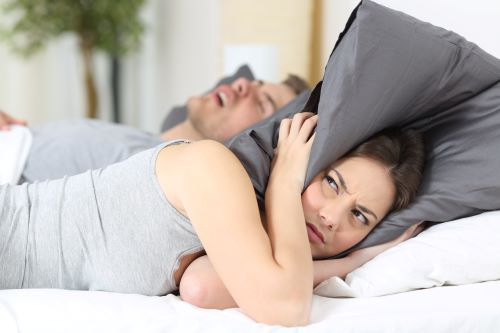
The same machine works at home. A sound masking machine helps in a home office during calls, and it’s the reason so many people use white noise to sleep: next to a snorer, on a busy road, or with people in the house who stay up later than you. It covers the sudden sounds that wake you, the same way it covers voices in an office.
Frequently Asked Questions
Does a white noise machine prevent eavesdropping?
Yes, if it’s loud enough and in the right spot. Placed by the door or shared wall at about 45 dB, it makes speech that comes through hard to understand. It won’t hide a conversation that is loud and clear in the next room.
What is the difference between sound masking and white noise?
White noise is one kind of masking sound. Sound masking is usually shaped closer to pink noise, with less hiss, so it covers speech and is easier to listen to all day.
How loud should sound masking be?
About 43–45 dB in a closed office and 46–48 dB in an open office. If you notice it after a few minutes, it’s too loud.
How much area does one sound masking speaker cover?
A ceiling sound masking speaker covers about 200 sq ft. A desktop sound masking machine covers a single private office or small room.
Is sound masking the same as soundproofing?
No. Soundproofing blocks sound from getting through walls, doors and ceilings. Sound masking covers the sound that still gets through. For real speech privacy, use both.