
Table of Contents
What Is Airborne Noise?
Airborne noise, or airborne sound, is sound that travels through the air from its source to your ears. Voices, TV, music, a barking dog, and traffic are all airborne noise. When the sound reaches a wall, floor, or window, part of it bounces back, and part of it makes that surface vibrate and re-radiate the sound on the other side.
Quick answer Airborne noise is sound carried through the air, like voices, music, and traffic. To reduce it, seal every gap first, because sound leaks through cracks the way water would. Then add mass to the wall, such as mass loaded vinyl under a new layer of drywall. Decoupling the layers and filling the wall cavity with insulation add more. Walls are rated by STC: the higher the number, the less airborne sound gets through.
Airborne sound loses energy every time it passes through something solid, so a wall never fully stops it. The goal is to make the wall heavy enough, airtight enough, and separated enough that what comes through is too quiet to bother you.
Airborne vs. Structure-Borne Noise
The other kind is structure-borne noise, which starts as vibration in the building itself, like footsteps, slammed doors, or a rooftop AC unit. Airborne noise is mostly voices and mid to high notes, and it comes through walls, doors, windows, and vents. Sealing gaps makes a big difference to airborne noise and almost none to structure-borne noise. Many real problems are a mix, such as music with heavy bass, so it pays to know which one is doing most of the damage before you buy anything.
How Airborne Sound Gets Through Walls: STC & Weak Spots
Walls, doors, and windows are rated by Sound Transmission Class, or STC. It measures how much airborne sound an assembly blocks across the speech range. As a general guide, a basic interior wall with one layer of drywall on each side and no insulation sits around STC 33 to 35. Here’s the rule of thumb most acousticians use for what each level means in practice:
| STC | What you hear through the wall |
|---|---|
| 25 | Normal speech, clearly understood |
| 30 | Normal speech heard; loud speech understood |
| 35 | Loud speech heard but not understood |
| 40 | Loud speech heard as a murmur |
| 45 | Loud speech barely heard |
| 50 | Loud sounds faint; music bass may still come through |
| 60+ | Most everyday sounds inaudible |
A wall is only as good as its weakest spot. Airborne sound finds gaps at the floor and ceiling edges, outlet and switch boxes, recessed lights, ducts, door undercuts, and window frames. Sound going around a wall instead of through it is called flanking. A small gap can undo most of the gain from an expensive wall. For how these numbers apply to specific materials, see STC ratings for mass loaded vinyl and sound batts.
How to Reduce Airborne Noise: Seal, Add Mass, Decouple, & Fill the Cavity
Airborne noise reduction follows four steps. Do them in order, because each one depends on the one before it.
- Seal the gaps. Run acoustical caulk along baseboards, around outlets and switch plates, and where walls meet the ceiling. Unlike regular caulk, it stays flexible, so it doesn’t crack and reopen the gap. It’s the cheapest step and often the most noticeable.
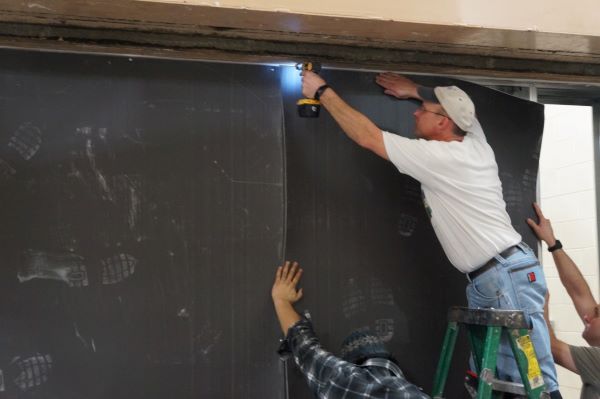
- Add mass. Heavier walls block more airborne sound. Wall Blokker™ is a 1 lb per sq ft mass loaded vinyl that goes over existing drywall under a new layer of drywall, and it adds 6 to 12 STC points to a typical stud wall. Wall Blokker™ Pro adds 3 to 5 points more, and Wall Blokker™ Lite suits metal studs. Plain mass loaded vinyl works the same way. Tape the seams with MLV seam tape, and keep cutouts around boxes tight and caulked.
- Decouple. When the drywall on both sides is screwed to the same studs, sound passes through the framing. Resilient channel, sound isolation clips, staggered studs, or a separate stud wall break that path. Decoupling matters most for bass, which mass alone struggles with.
- Fill the cavity. Insulation in the stud bays absorbs sound bouncing inside the wall and stops the hollow drum effect. It adds a few STC points for very little money, and on an existing wall it can be blown in through small holes.
You don’t always need all four. For voices through a shared wall, sealing plus one layer of mass is often enough. For music, home theaters, or a bedroom next to a living room, plan on mass and decoupling together. How to soundproof existing walls walks through the install, and noise between walls covers why sound still sneaks around a good wall.
Real project: a condo wall from STC 50 to 58 In an 18-floor Orlando condo tower, residents could hear music and voices from the unit next door through walls that met the Florida code minimum of STC 50. Commercial Acoustics added Wall Blokker™ Pro over the existing drywall with a new layer on top, with no demolition, and sealed the outlets and baseboards with acoustical caulk. Field tests measured the walls at STC 58 afterward. New solid-core entry doors with gaskets and automatic door bottoms went from STC 26 to 36.
Airborne Noise Through Windows, Doors, & Floors
Even a good wall is let down by its openings. Fix these alongside the wall, or the noise just takes the easier path.
- Windows. Glass is light, so it’s usually the weakest part of an outside wall. Seal the frame, replace worn weatherstripping, and consider laminated glass or a secondary window insert for traffic noise.
- Doors. Hollow-core interior doors are very weak, and the gap underneath leaks a lot of sound. A solid-core door with perimeter gaskets and a door bottom or sweep helps the most, as the Orlando project showed. If the problem is a door that slams rather than sound coming through it, see how to make a door close quietly.
- Floors and ceilings. Voices and TV from the unit above or below are airborne too. Under new flooring, sound barrier underlayment adds mass for airborne noise and cushioning for footsteps. See the best soundproof underlayment for floors.
- Vents and ducts. A duct that serves two rooms carries conversation between them. Lined ducts or a longer duct run with bends help.
If the noise is from next door and you’re not sure where it’s getting in, start with our guide to blocking noise from neighbors, or call us at 855-667-6863.
Frequently Asked Questions
What are examples of airborne noise?
Voices, TV, music, barking dogs, and traffic are the most common. Anything you hear that reached you through the air, rather than as vibration through the building, counts as airborne noise.
What is the best way to reduce airborne noise?
Seal the gaps first, then add mass. Mass loaded vinyl under a new layer of drywall, with the seams taped and the edges caulked, is a common upgrade that doesn’t need demolition.
Does insulation stop airborne sound?
It helps, but not on its own. Insulation in the wall cavity absorbs sound inside the wall and adds a few STC points. It works best combined with added mass and sealed gaps.
What STC rating do I need to block voices?
As a rough guide, STC 45 to 50 makes loud speech faint or barely audible. For music or home theaters, aim higher, around STC 55 to 60.