
Table of Contents
What Is Structure-Borne Noise?
Structure-borne noise is sound that travels through the solid parts of a building, such as floors, walls, joists, studs, and pipes, rather than through the air. Something makes the structure vibrate. That vibration runs through the framing or slab, and a surface somewhere else, often a ceiling or wall in another room, re-radiates it as sound you can hear.
Quick answer Structure-borne noise, also called structure-borne sound or structural noise, is vibration carried through a building’s solid materials. Footsteps, slammed doors, washing machines, HVAC units, and pipes are common sources. Mass alone won’t stop it. You reduce it by isolating the source, decoupling the surfaces it travels through, and damping the vibration, then sealing gaps for the airborne part.
There are two broad kinds. Impact noise comes from something striking the structure, like heels on a hardwood floor or a dropped weight. Vibration-driven noise comes from equipment that runs constantly and shakes whatever it’s fixed to, like a rooftop AC unit or a pump. Both travel the same way, and both are hard to fix once a building is finished. Because solid materials carry vibration so well, the noise can show up several rooms away from where it started.
Structure-Borne vs. Airborne Noise: How to Tell Which You Have
Airborne noise, like voices, TV, or music, starts in the air and hits a wall. Structure-borne noise starts in the building itself. Most real problems are a mix of the two, because a loud speaker also shakes the floor it sits on, so it helps to know which one is doing most of the damage:
| Sign | Likely airborne | Likely structure-borne |
|---|---|---|
| What it sounds like | Voices, TV, mid and high notes | Thuds, knocks, hums, deep bass |
| Where it seems to come from | A shared wall, a door, a vent | The ceiling or floor, or everywhere at once |
| Can you feel it? | No | Often, in the floor or a wall |
| Sealing gaps helps? | A lot | Very little |
| Main fix | Mass and airtight seals | Isolation, decoupling, and damping |
A quick test: have someone tap or walk in the noisy room while you listen with your hand on the wall or floor. If you feel it, the structure is carrying it. Our sister company Commercial Acoustics has a longer guide to airborne vs. structure-borne noise if you want the full comparison.
Common Sources: Footsteps, Doors, HVAC, & Machinery
- Footsteps from above. The most common complaint in apartments and two-story homes. Hard flooring laid straight on the subfloor passes every step into the ceiling below.
- Doors, cabinets, and furniture. Slammed doors, kitchen drawers, and chairs dragged across the floor all hit the framing directly.
- HVAC and rooftop units. Units, fans, and ducts that are rigidly mounted send a steady hum into the structure.
- Plumbing. Pipes clamped tight to studs or joists carry water hammer and drain noise. Trash chutes in apartment buildings do the same.
- Appliances and equipment. Washers, dryers, treadmills, and pumps vibrate whatever they stand on.
- Construction and renovation. Hammering and drilling travel far through framing and concrete.
- Bass and subwoofers. Low notes shake the floor and walls as well as the air, which is why bass gets through when voices don’t.
How to Reduce Structure-Borne Noise: Isolate, Decouple, & Damp
Structure-borne noise reduction comes down to breaking the solid path between the source and your room. In order of what usually works best:
- Isolate the source. Stop the vibration before it reaches the structure. Put rubber pads or isolation mounts under machines, a soft underlayment under hard floors, and felt bumpers on doors and cabinets. It’s almost always the cheapest fix.
- Decouple the path. Separate the surface you hear from the structure that vibrates. Resilient channel or sound isolation clips hold drywall off the studs or joists. A separate stud wall or a floating floor goes further. Decoupling is the only real answer once the noise is already in the framing.
- Damp the vibration. Damping turns vibration into a little heat inside the material. Rubber, limp and heavy barriers like mass loaded vinyl, and a soft layer sandwiched between two rigid ones all help.
- Add mass and seal for the airborne part. Most structure-borne problems arrive with airborne noise. Mass loaded vinyl or Wall Blokker™ under a new layer of drywall handles that. Wall Blokker™ adds 6 to 12 STC points to a typical stud wall, and Wall Blokker™ Pro adds 3 to 5 more. Seal the seams with MLV seam tape and the edges and outlets with acoustical caulk.
Mass on its own is the most common mistake. A heavier wall blocks more airborne sound, but if it’s still screwed tight to the same studs, vibration crosses straight over it. Pair the barrier with decoupling wherever the structure is the problem. How noise moves between walls covers the wall side in more detail.
Real project: a good wall that didn’t solve the problem A Crunch Fitness on the second floor of an Ohio building shared a wall with a day spa. That wall tested at ASTC 53, which is solid, and the spa still complained. The noise was weights and machines vibrating a 4 in slab. Commercial Acoustics recommended underlayment across the floor, machine isolators, drop platforms, and sealed joints, which are structure-borne fixes rather than a thicker wall.
Floors & Ceilings: Stopping Footfall Noise
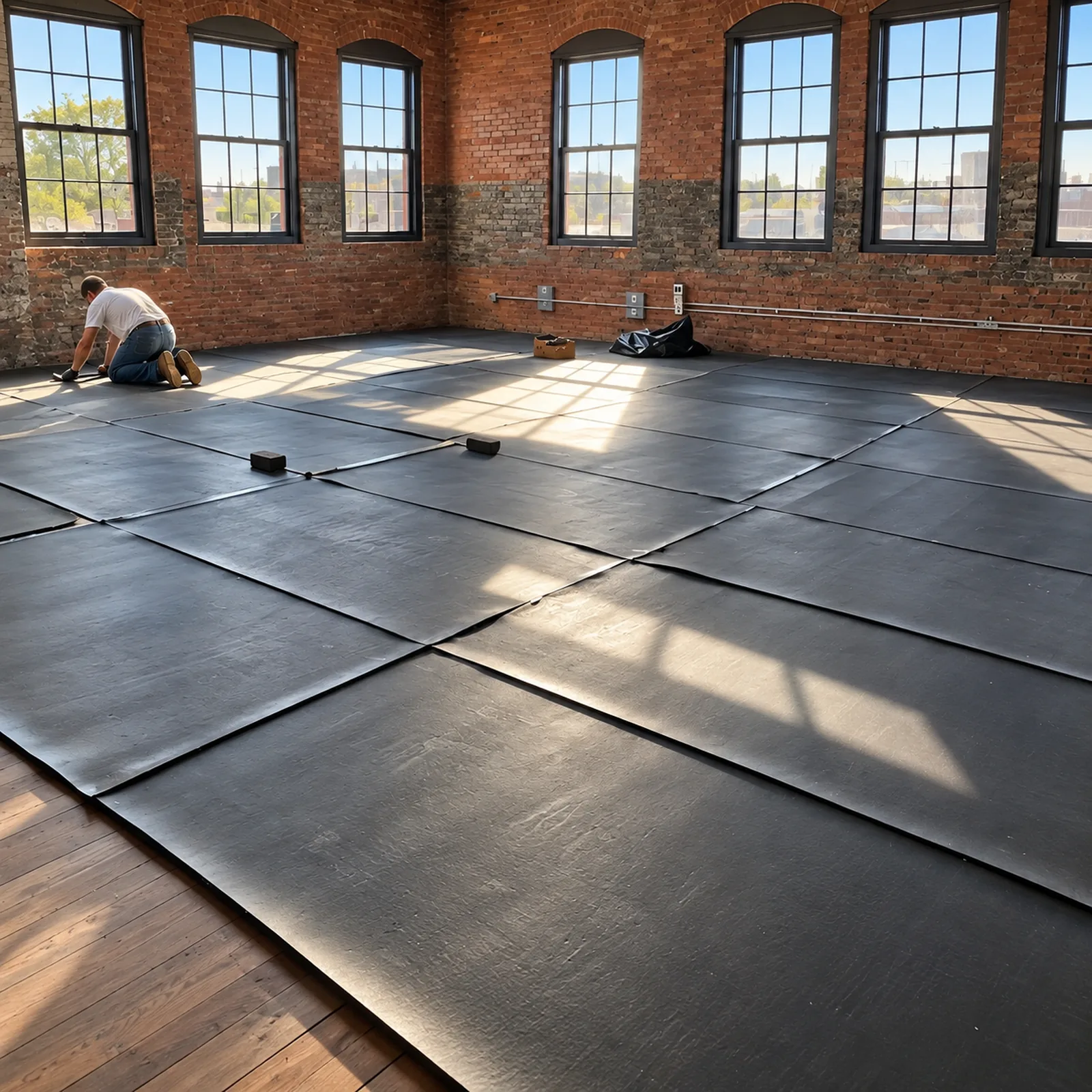
Footfall is best fixed from above, by putting a resilient layer between the finished floor and the subfloor. Floors are rated by IIC (Impact Insulation Class), and the “Delta IIC” on an underlayment is how much it improves a floor in a tapping-machine test.
- Acoustic rubber underlayment: Delta IIC 20 to 26 depending on thickness, $129 to $219 per 100 sq ft roll.
- Sound barrier underlayment: Delta IIC 26, with added mass for airborne noise too, $259 per 100 sq ft roll.
Run the underlayment wall to wall and leave a small gap at the edges so the floor doesn’t touch the walls. Area rugs with thick pads help renters who can’t change the floor. If the noise comes from a neighbor’s floor you can’t touch, the options from below are a decoupled ceiling on resilient channel or clips, with insulation in the joist space. That helps, but it won’t match fixing the floor itself. See our guides to the best soundproof underlayment for floors and blocking noise from neighbors.
Machinery & Equipment: Vibration Isolation & Dampers
To reduce structure-borne noise in machinery, treat the machine before the building. The usual steps:
- Vibration isolators. Neoprene pads, rubber mounts, or spring isolators under the unit, sized to its weight and running speed. These are the “structure-borne sound dampers” most people are searching for.
- Flexible connectors. Short rubber or braided sections where ducts, pipes, and conduit join the machine, so vibration can’t ride out along them.
- Resilient pipe hangers. Isolated clamps instead of metal straps fixed tight to the framing.
- Maintenance. Worn bearings, unbalanced fans, and loose panels make far more vibration than a machine in good shape.
Rooftop units, chillers, and large pumps need isolators chosen by an engineer or the maker, because the wrong stiffness can make vibration worse. For loud rooms like a basement mechanical room or a CrossFit gym, our guides cover the full setup. If you’re not sure which path the noise is taking, call us at 855-667-6863 before you buy.
Frequently Asked Questions
What is an example of structure-borne noise?
Footsteps from the apartment above are the classic example. Others are a slammed door, a washing machine on its spin cycle, a rooftop AC unit, and water hammer in the pipes.
What is the difference between airborne and structure-borne noise?
Airborne noise travels through the air before it reaches a wall, like voices or a TV. Structure-borne noise starts as vibration in the building itself and travels through floors, walls, and framing.
Does mass loaded vinyl stop structure-borne noise?
Not on its own. Mass loaded vinyl blocks airborne sound and damps some vibration, but if the wall is still rigidly fixed to the same framing, vibration gets past it. Pair it with decoupling, like resilient channel, clips, or a separate wall.
How do you reduce structure-borne noise from upstairs?
The best fix is an underlayment beneath the floor above, plus rugs with thick pads. If you can’t change that floor, a decoupled ceiling with insulation in the joists helps, but less.