
Table of Contents
How to Soundproof a CrossFit Gym
Noise can get expensive for a CrossFit gym. In Manhattan’s Chelsea neighborhood, a condo board sued a gym in its building over noise, mainly from dropped weights. The owner told DNAinfo the gym would spend about $250,000 on floor padding, an acoustical ceiling and other soundproofing, and the lawsuit was still going at the time.
Most boxes will never face a bill like that, but the problem behind it is common. A regular gym can ask members not to drop weights. In a CrossFit box, dropping the bar is part of the workout, so you have to plan for it.
Quick answer To soundproof a CrossFit gym, start with the floor, because dropped barbells travel through the building’s structure. Use thick rubber flooring over an isolation underlayment, and engineered drop platforms for heavy lifts. Then add mass to shared walls and cap the music level. Thin stall mats won’t solve it, and acoustic panels only treat echo.
Why a CrossFit Box Is So Hard to Soundproof
A box usually has two separate noise problems:
- Impact noise. A dropped barbell hits the floor and sends energy straight into the slab. That energy travels through the structure and comes out as a thud in the unit next door or below, where neighbors can feel it as well as hear it.
- Airborne noise. Music, coaches and the crowd cheering on a workout travel through walls, ceilings and gaps.
Owners often start with the walls, because that’s where they can see a problem. A good wall does nothing about a thud coming through the slab, so spending there first can leave the main complaint untouched.
Real project: when the wall wasn’t the problem Crunch Fitness opened a second-floor lifting gym in Ohio above a healthcare tenant and a retail space. Tenants complained of thuds and vibration, yet our sister company Commercial Acoustics field-tested the wall beside the day spa next door at ASTC 53. The walls weren’t the failure path. The energy was going through the 4 in concrete slab.
CrossFit Flooring: Stopping Dropped Barbells
Your floor needs to absorb the hit and also separate the impact from the slab. Here’s how the common options compare:
| Option | What it does | The limit |
|---|---|---|
| 3/4 in stall mats | Protects the slab and your barbells | Does little for the noise of a dropped weight |
| Thick rubber gym tiles | Absorbs far more of the hit | Check the rated drop weight and height |
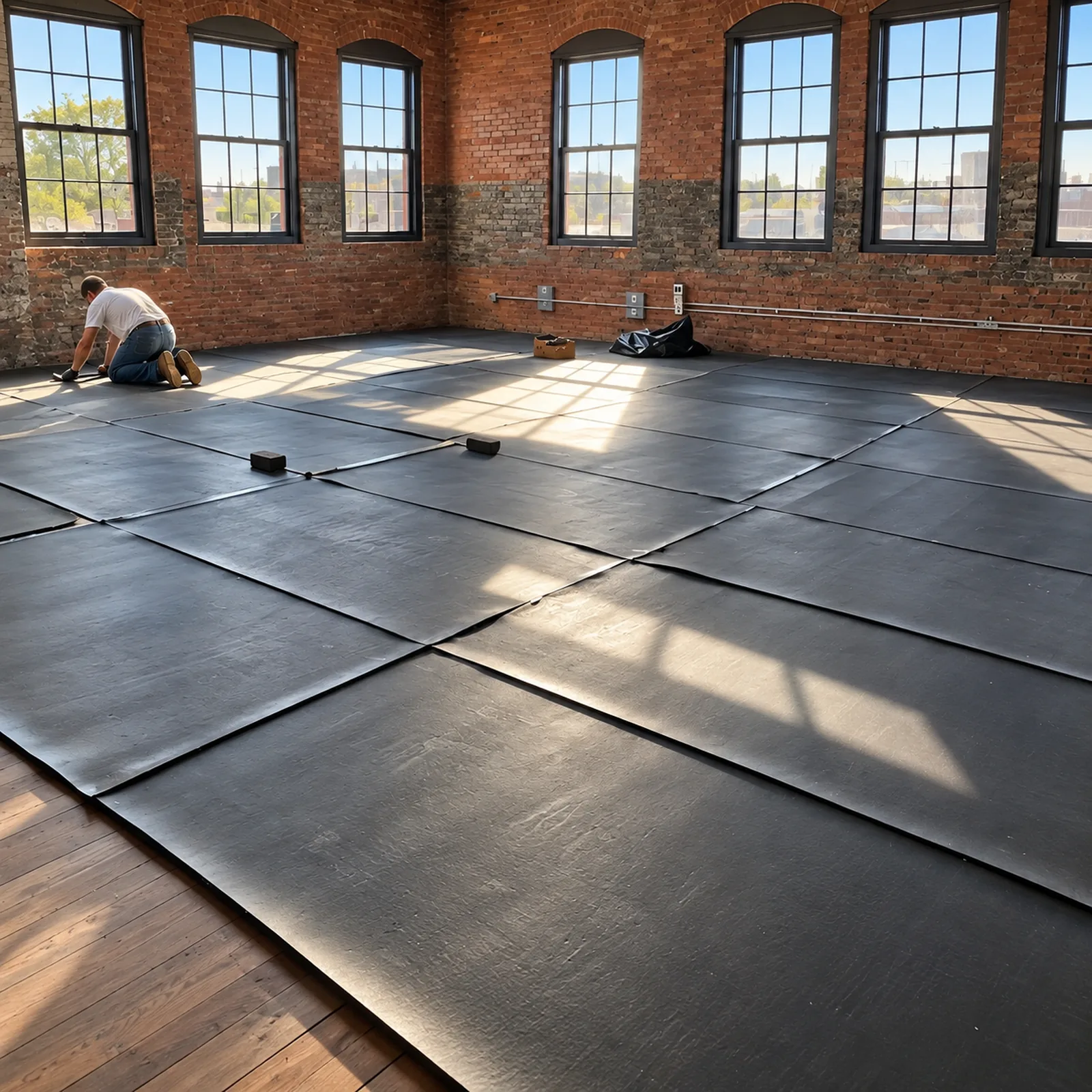
| Isolation underlayment under the floor | Separates the whole floor from the slab | Must be continuous; helps with heavy drops but won’t solve them alone |
| Drop pads or crash pads | Cheap and portable for heavy singles | Only covers where the bar lands |
| Engineered drop platforms | Floats the lifting zone off the slab | The most effective option, and the most expensive; needs design work |
Stall mats. One box owner in a flooring vendor’s customer story said 3/4 in stall mats “did very little to dampen the noise of dropped weights.” They’re a fine floor surface, but they aren’t soundproofing.
Underlayment. We don’t sell gym tiles or platforms, but we do sell what goes beneath a floor. Acoustic rubber underlayment comes in up to 10 mm (Delta IIC 26), and sound barrier underlayment adds mass (also Delta IIC 26). Those ratings come from a tapping machine, so they don’t predict what a loaded barbell will do. Treat them as a way to compare products, not as a promise. See the best soundproof underlayment for floors.
Don’t bolt through it. This is the mistake from the Crunch project. The gym installed underlayment under its equipment floor, then bolted machines through it into the slab. Commercial Acoustics found that this created “a rigid bridge that defeated every benefit of the isolation layer.” Plan your anchors before the floor goes down.
Gym habits matter too. Use bumper plates instead of iron, keep lifting zones away from shared walls, and teach members not to drop an empty bar. Scheduling heavy days away from your neighbor’s business hours costs nothing.
Tires, Slam Balls, & Rig Noise
- Tire flips. A big tire lands hard across a wide area. Give flips their own lane on your thickest flooring, away from the shared wall.
- Slam balls and wall balls. Slam balls are a floor impact, so treat them like a light barbell drop. A wall ball target on a shared wall sends the hit straight into your neighbor’s space, so move the targets to a wall that faces outside or an interior rig.
- Rigs. A rig anchored to the wall or slab carries every kip and rattle into the structure. Tighten loose hardware first. If you’d like to add isolation at the anchors, ask the rig maker first, since a rig has to stay safely anchored.
Loud Music, Coaches, & Roll-Up Doors
Cap the music. This is the cheapest airborne fix there is. The kickboxing studio below set a 90 dBA average at the class floor, on a central system locked at the manager level so coaches can’t turn it up. Keep speakers off shared walls and mount them on isolators.
Close the roll-up door when it counts. Warehouse boxes love an open door, but it sends everything straight to the neighbors. Close it during loud classes, and add weather seals around the edges for a better fit. Seal any door to the lobby or office with a sweep and perimeter seals as well.
Treat the echo separately. A metal building makes coaches hard to hear, and they respond by shouting. Panels and baffles help with that, but they won’t stop noise reaching neighbors. See gym acoustic panels.
Shared Walls in a Strip Mall or Warehouse
Standard retail walls are often only around STC 45, which won’t hold back a loud class. Wall Blokker™ Pro and a new layer of 5/8 in drywall adds mass without any demolition or a second stud wall, and takes up very little of your floor. Standard Wall Blokker™ costs less if the music is your smaller problem. Tape the seams with MLV seam tape, and use acoustical caulk around the edges and any openings.
Real project: kickboxing in a retail strip A kickboxing studio in Alpharetta, GA faced possible lease violations when music and bag noise reached the shops beside it. Commercial Acoustics specified Wall Blokker™ Pro over the existing drywall with 5/8 in drywall on top, targeting STC 55, along with the locked 90 dBA music cap. The studio kept all of its floor space.
Check that the wall reaches the deck above. Many warehouse and retail walls stop short, and sound travels straight over the top. If you have tenants upstairs, the ceiling matters too. See how to soundproof existing walls and how to install mass loaded vinyl. For a general gym or fitness studio, see how to soundproof a gym.
Choosing a Location & Reading Your Lease
The cheapest soundproofing happens before you sign. Consultants at Acentech advise putting weight rooms on grade or below, away from homes and sensitive offices. Before you commit to a space:
- Look at the neighbors. A tire shop is a better neighbor than a dentist, a day spa or apartments.
- Prefer a ground-floor unit. Being on grade helps, but it doesn’t solve everything, because a slab that runs under the neighbors can still carry the impact to them.
- Test before you sign. Bring a loaded bar and drop it with the landlord listening next door. One gym owner was told: “They wouldn’t give me a lease until I agreed to purchase the soundproof flooring.”
- Read the noise clause. Find out what your lease says about noise and who pays for any fix, and get a clear answer on what counts as a violation.
When Soundproofing Isn’t Enough
Some spaces won’t work, whatever you spend. Acentech warns that heavy impacts can overwhelm flooring on lightweight structures, and that some of these gyms “just may not be able to coexist with sensitive neighbors.” Lightweight steel framing and thin slabs are the warning signs. Bring in an acoustic consultant if:
- You’re above another tenant, especially a home or a healthcare office.
- You already have a complaint, or a lease or legal issue over noise.
- You’re planning heavy Olympic lifting and need a drop platform designed.
Testing the floor before and after gives you real numbers to show a landlord. Our team can help you figure out where to start: 855-667-6863.
CrossFit Soundproofing Cost
Here’s what our materials cost, using a 1,000 sq ft lifting zone and a 40 ft × 12 ft shared wall as the example:
| Item | Price | For this example |
|---|---|---|
| Rubber underlayment, 10 mm, 100 sq ft roll | $219 a roll | 1,000 sq ft: 10 rolls, $2,190 |
| Sound barrier underlayment, 100 sq ft roll | $259 a roll | 1,000 sq ft: 10 rolls, $2,590 |
| Wall Blokker™ Pro, 100 sq ft roll | $299 a roll | 480 sq ft wall: 5 rolls, $1,495, plus drywall |
| Wall Blokker™, 100 sq ft roll | $219 a roll | 480 sq ft wall: 5 rolls, $1,095, plus drywall |
| MLV seam tape, 150 ft roll | $24.99 a roll | One or two rolls |
| Acoustical caulk | $17.99 a tube | A few tubes |
Prices are before shipping and installation. Gym tiles, drop platforms, drywall and consulting are extra and vary widely, so get quotes for those. Compare that with the cost of losing a lease or fighting a lawsuit.
Frequently Asked Questions
How do you soundproof a CrossFit gym?
Start with the floor, since dropped barbells are usually the main complaint. Use thick rubber flooring over an isolation underlayment, with drop platforms for heavy lifts. Then add mass to shared walls and cap the music level.
Do stall mats stop dropped weight noise?
Not really. Stall mats around 3/4 in thick protect the slab and the bar, but they do little for the noise. Thicker tiles, an underlayment or a drop platform will do far more.
Can a CrossFit gym be on the second floor?
It can, but it’s the hardest setup to make work, and some buildings won’t allow it. Heavy drops carry through the slab to tenants below. Have an acoustic consultant and a structural engineer review the space before you sign a lease.
How much does it cost to soundproof a CrossFit gym?
It depends on the building and your neighbors. With our materials, underlayment for a 1,000 sq ft lifting zone runs about $2,190 to $2,590, and treating a 480 sq ft shared wall about $1,095 to $1,495 plus drywall. Tiles, platforms and installation are extra.
Will acoustic panels stop CrossFit noise from reaching neighbors?
No. Panels reduce echo inside the gym, which makes coaches easier to hear. Noise reaching the neighbors takes floor isolation for impacts and more mass in the walls for music.