
Table of Contents
How to Reduce Noise in a Coffee Shop
A little buzz is part of why people like a coffee shop. The trouble starts when customers lean across the table to hear each other, baristas have to shout orders back, and people take their drinks to go because the room is tiring to sit in.
Most of that isn’t about how many people are in the shop. It’s the room. The good news is that you don’t need to soundproof anything to fix it, and most of the work can happen without closing for a day.
Quick answer To reduce noise in a coffee shop, add sound absorption to the hard surfaces, using acoustic wall panels or ceiling clouds. Then deal with the loudest sources: put a sound enclosure on the blender, move or cushion the grinder, and keep the music low enough that people don’t have to talk over it. The goal is less echo, not silence. Panels won’t stop noise from reaching a neighbor, which takes mass and sealing.
Why Coffee Shops Get So Loud
Today’s coffee shop look is about as hard on the ears as a room can get. Concrete floors, exposed ceilings, big front windows, tile and metal all reflect sound, so each voice and clatter keeps bouncing around after it should have faded. Then a chain reaction starts: as the room gets louder, people raise their voices to be heard, and that makes the room louder still. Acousticians call this the Lombard effect.
On top of that, a small shop has machines running a few feet from the seats. Here’s how to match what you’re hearing to the fix:
| What you notice | The problem | The fix |
|---|---|---|
| A constant roar when the shop is busy | Echo | Wall panels, ceiling clouds or baffles |
| Customers can’t hear each other at the table | Echo, sometimes loud music | Absorption, then lower music |
| Baristas and customers mishear orders | Echo and machines near the register | Panels near the counter; move the grinder |
| Short, loud bursts that stop conversations | Blender or grinder | Sound enclosure, mat, new location |
| Scraping and clatter | Chairs and dishes on hard surfaces | Felt chair pads, rubber mats at the dish area |
| The neighbor next door or upstairs complains | Sound leaving the space | Wall mass, sealed gaps, lower bass |
How Quiet Should a Coffee Shop Be?
A quiet coffee shop doesn’t need to be silent. In a series of lab experiments published in 2012, people did better on creative tasks with moderate background noise of 70 dB than with 50 dB, and worse at 85 dB. That wasn’t a test of real coffee shops, but it fits what many customers say: some activity in the room is pleasant, and too much isn’t.
There’s no official target for coffee shops, so the most useful number comes from restaurants. Echo is measured as reverberation time, or RT60: how long a sound takes to fade by 60 dB. Commercial Acoustics uses these ranges:
| Room | RT60 |
|---|---|
| Casual dining | 0.6 to 0.8 seconds |
| Fine dining | 0.8 to 1.0 seconds |
| Lively bar-style restaurant | Up to 1.0 second |
| Rooms that consistently draw complaints | Above 1.2 seconds |
For a shop where people sit and talk, somewhere under 1 second is a sensible goal, and closer to 0.8 is better if you want people to stay and work. A phone RT60 app can give you a rough reading. Take it when the shop is empty, since a slow afternoon has fewer bodies absorbing sound than a packed morning.
Coffee Shop Acoustic Panels for Walls
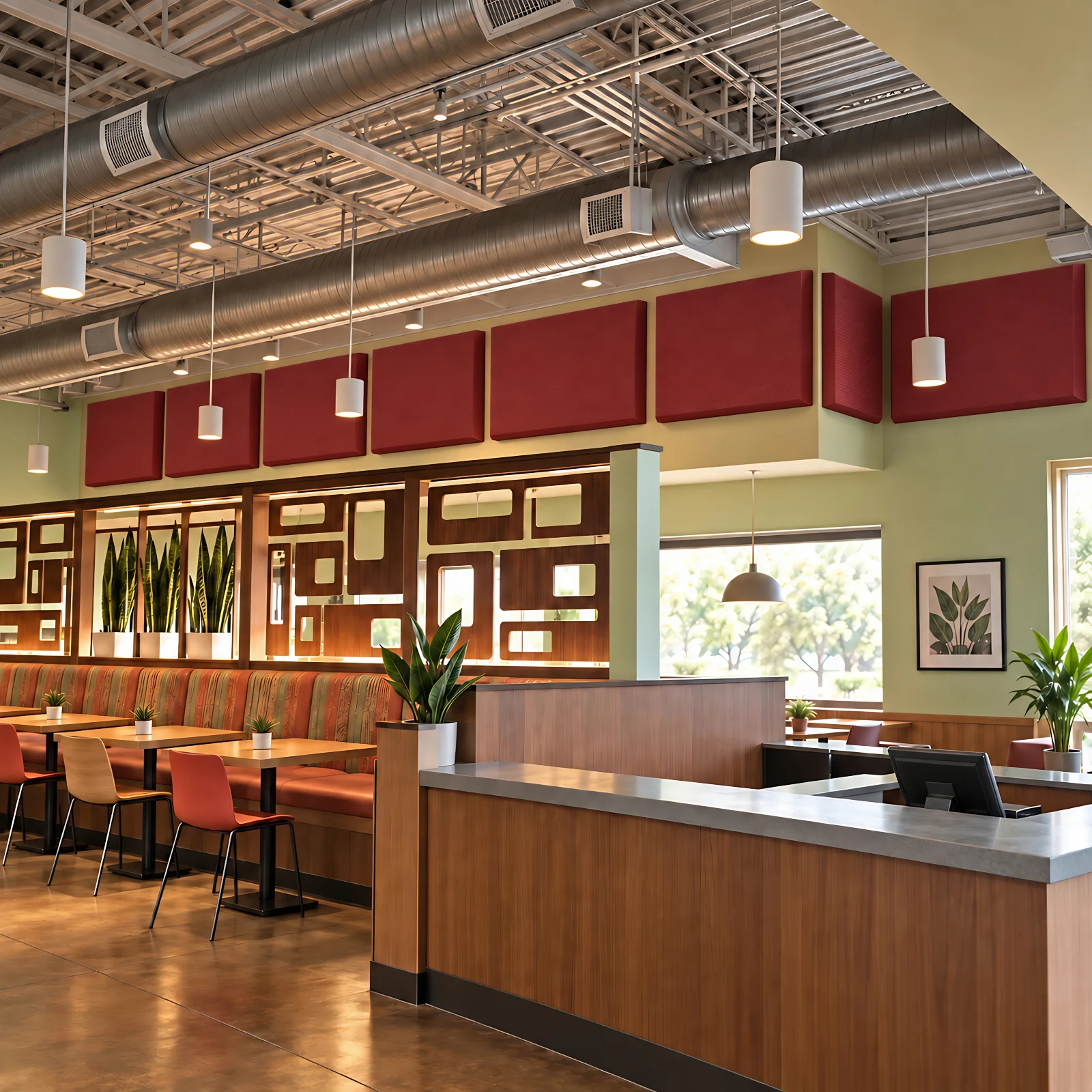
Sound absorbing wall panels are usually the simplest fix. Ours are 2 in fiberglass, rated NRC 1.05, and come in 24 colors, so they can blend into the wall or become part of the design.
How many? Plan on panels equal to 15–25% of the floor area. Take a 25 ft × 30 ft shop with a 12 ft ceiling. That’s 750 sq ft, or 7 to 12 of our 4 ft × 4 ft panels. If that room measures 1.2 seconds, the Sabine formula says about 11 panels gets it to 0.8.
Where to put them:
- Spread them around the room, especially on long walls facing each other and on the walls near the seating.
- Mount them high if the seats are close to the wall, so they stay clear of chair backs, bags and shoulders.
- Keep them away from food and splash zones. Fabric doesn’t belong behind the espresso machine or over the prep area. Put panels on the customer side, and check your local health and fire requirements for wall finishes.
If you’d rather not see them, panels can also go somewhere less obvious. See hidden acoustic panels under tables and decorative acoustic panel ideas, and how to hang acoustic panels for the install. Skip the foam tiles. They’re thin and absorb less than a 2 in panel, so you’d need far more of them, and they rarely suit a customer-facing room.
Real project: 1.6 seconds down to under 1 This one is a restaurant rather than a coffee shop, but the problem is the same. Speaks Clam Bar in Sarasota had marble finishes and tile floors, and it measured 1.6 seconds of reverberation. Customers couldn’t easily talk at their own table. Our sister company Commercial Acoustics installed custom panels sized for the room, which brought it to under 1 second.
Ceiling Clouds & Baffles for Cafes
When the walls are all windows, shelves and menu boards, look up. The ceiling is often the largest bare surface in the room, and it keeps the absorption out of reach and away from the food.
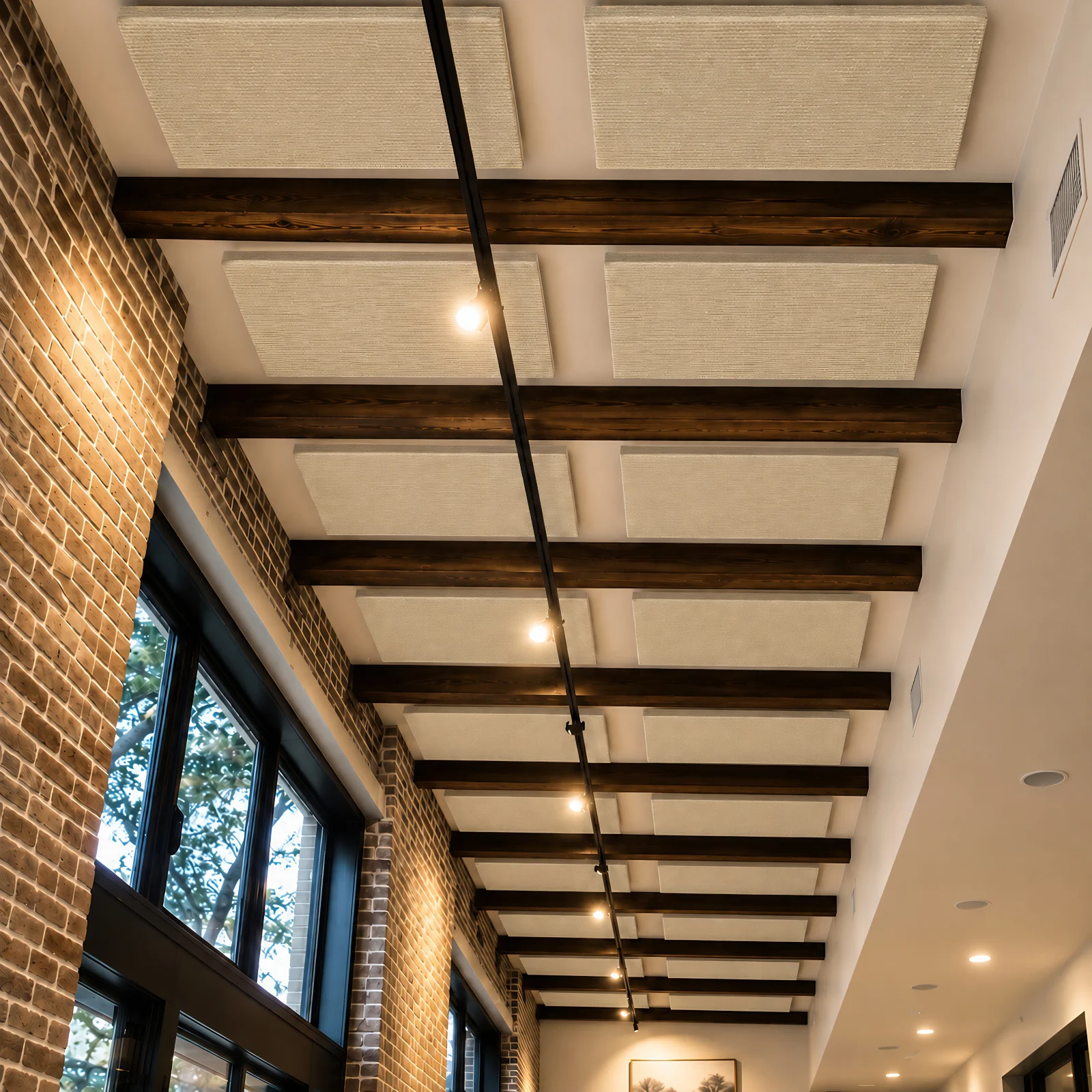
- Acoustic ceiling clouds hang flat, and they work well over the seating area or between beams.
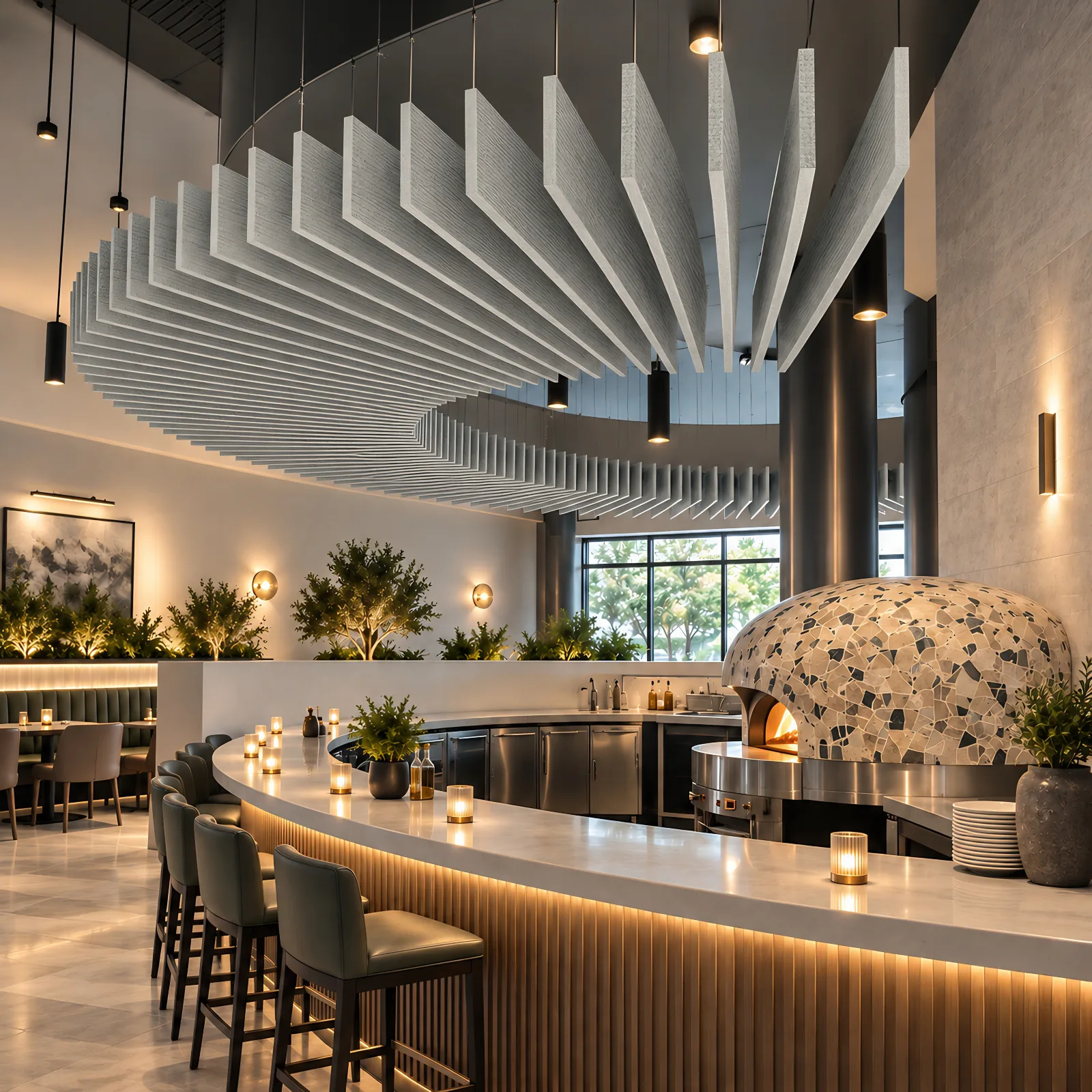
- Acoustic ceiling baffles hang on edge, so both faces absorb sound. They suit high, open ceilings and can follow the line of the counter or the seating.
You can also mix these with wall panels, and that often sounds better than putting everything on one surface. Hang them clear of sprinklers and lights, and check with your landlord before you attach anything to the ceiling.
Real project: 40 clouds over a stylish dining room Olivia Italian in Tampa has exposed ceilings, wood slats and floor-to-ceiling glass, and guests struggled to hold a conversation, particularly in the bar area. Commercial Acoustics installed 40 custom ceiling clouds to control the echo while keeping the look of the room. It’s a restaurant and a bigger job than most coffee shops, but exposed ceilings and glass are common in cafes too.
Grinder, Blender, & Espresso Machine Noise
Panels make the whole room calmer, but they don’t quiet the machines. These sudden noises need their own fixes:
- Blenders. This is usually the worst offender, and the easiest to fix. Many commercial blender makers, including Vitamix, Blendtec and Waring, sell models or add-ons with a sound enclosure, a clear cover that goes over the jar. It won’t silence the blender, but it’s the first thing to try if you’re wondering how to make a blender quieter.
- Grinders. Put them as far from the seats and the register as your workflow allows. A rubber mat underneath can keep the counter from buzzing along with the motor, as long as the grinder stays stable and its vents stay clear.
- Espresso machines. Steam noise is hard to avoid. Keep the machine away from the nearest tables, and add absorption on the customer side of the counter where you can.
- Knock boxes and dishes. Rubber mats at the dish area and a padded knock box cut the clatter. Bus tubs on a rubber mat are quieter than ones on steel.
- Chairs and doors. Felt pads on metal or wood chair legs stop the scraping on concrete or tile. A door closer keeps a heavy front door from banging.
Coffee Shop Music & Background Noise
Background noise is useful in a coffee shop, since it keeps nearby conversations private. It only becomes a problem when people have to raise their voices over it. A few simple habits help:
- Use more speakers at a lower volume. Several small speakers spread sound evenly, so no table sits right under a loud one.
- Change the volume through the day. A level that suits the morning rush is too loud for three people at 2 p.m.
- Test it from the seats. Staff get used to the volume behind the counter, so sit at a table now and then and try having a conversation.
- Treat the echo first. In a room with less echo, the music stays clear at a lower volume.
Noise Complaints From Neighbors
This one is a different problem. Absorption tames sound inside the room, but it won’t do much to stop it from reaching the business next door or the apartment upstairs. Blocking sound takes mass and sealing.
- Shared walls. Seal gaps with acoustical caulk first. Then add Wall Blokker™ over the existing drywall with a new layer of drywall on top, which adds 6 to 12 STC points to a typical stud wall. On metal studs, use Wall Blokker™ Lite. See how to soundproof existing walls for the steps.
- Speakers and machines. Move them off the shared wall, and set speakers on isolating pads or stands. Turning down the bass often makes the biggest difference for neighbors.
- Apartments above. Low-frequency music and chair noise are hard to contain. Lower the bass and add felt pads, and if you’re doing a build-out, talk to an acoustic consultant about the ceiling.
Check your lease and local noise rules as well, since they may set limits or tell you who pays for the work. For more on how sound moves between units, see noise between walls.
Making a Coffee Shop Better for Laptop Workers
If remote workers are a big part of your business, a quiet workspace comes down to layout as much as materials:
- Create zones. Put the outlets and solo seats at the far end from the counter and the door, and put groups closer to the action.
- Treat the work area first. If the budget is limited, put your panels or clouds over the seats where people stay longest.
- Give calls somewhere to go. A corner or a separate room keeps video calls from taking over the shop.
Coworking spaces are a different case. They often have workable acoustics already, and the usual complaint is that private conversations carry. That’s a job for sealed rooms and masking, so see how to soundproof a conference room and how sound masking works.
What Coffee Shop Noise Reduction Costs
Here’s what our materials cost for the same 25 ft × 30 ft shop:
| Item | Price | For this shop |
|---|---|---|
| Acoustic wall panel, 4 ft × 4 ft × 2 in | $259 each | 7 to 12 panels: $1,813 to $3,108 |
| Acoustic ceiling cloud, 4 ft × 4 ft × 2 in | $279 each | Or 7 to 12 clouds: $1,953 to $3,348 |
| Acoustic ceiling baffle | $99 to $219 each, by size | Depends on layout; send us your room size |
| Wall Blokker™, 100 sq ft roll | $219 a roll | Only for a shared wall. 30 ft × 12 ft: 4 rolls, $876, plus drywall |
| Acoustical caulk | $17.99 a tube | A few tubes for a shared wall |
Prices are before shipping and installation. Drywall and labor vary by area, so get local quotes for those. On a tight budget, start with the cheap fixes: felt chair pads, mats, a lower music volume and a better spot for the grinder. Then add panels in stages, starting with the seats where the noise bothers people most, and stop when the room feels right.
Frequently Asked Questions
How do you reduce noise in a coffee shop?
Absorb the echo first, then quiet the loudest machines. Add acoustic wall panels or ceiling clouds, put a sound enclosure on the blender, cushion and relocate the grinder, and keep the music low enough to talk over easily. Felt chair pads and rubber mats help with the clatter.
Why is my coffee shop so loud?
Hard surfaces are usually the main reason. Concrete floors, exposed ceilings, glass and tile reflect sound back into the room, so people raise their voices and the room gets louder. Machines close to the seats add to it.
How many acoustic panels does a coffee shop need?
Plan on panels equal to 15–25% of the floor area. A 750 sq ft shop would need about 7 to 12 panels of 4 ft × 4 ft. Very hard rooms and high ceilings land toward the upper end, and ceiling clouds can replace some of the wall panels.
How do you make a commercial blender quieter?
Use a sound enclosure. This clear cover goes over the jar, and several commercial blender makers sell one as an add-on or as part of the machine. It reduces the noise but won’t remove it, so also keep the blender away from seats and on a rubber mat.
Will acoustic panels stop noise from reaching my neighbors?
Not by much. Panels absorb sound inside the room, but blocking it from a neighbor takes mass and sealing. Caulk the gaps, add a barrier like Wall Blokker™ and a new layer of drywall on the shared wall, and lower the bass.