
Table of Contents
Classroom Soundproofing
Students can’t learn what they can’t hear. In a noisy classroom, the teacher’s voice has to compete with hallway traffic, the class next door, a rattling air vent and its own echo off hard walls and floors. Teachers strain their voices, and students in the back miss words.
Classroom soundproofing is really two jobs, and the fix depends on which one you have. Echo inside the room and noise coming in from outside take completely different products, so start by working out which you’re dealing with.
Quick answer To soundproof a classroom, first identify the problem. For echo, add acoustic panels on the walls or ceiling, equal to 15–25% of the floor area. For noise from hallways or the next room, seal the door, then add mass to the wall. For loud air vents, have the HVAC balanced. The common target for a typical classroom is about 0.6 seconds of reverberation and 35 dBA of background noise.
| What you hear | The problem | The fix |
|---|---|---|
| Voices sound muddy; the room rings when students talk | Echo | Acoustic wall panels or ceiling clouds |
| Hallway noise and passing classes | Door leaks | Door sweep and perimeter seals; a solid door |
| The class next door | Thin wall | Mass loaded vinyl behind drywall; sealed gaps |
| Footsteps and chairs from above | Impact noise | Underlayment on the floor above |
| A steady hum or air rush | HVAC | Balance the system; line the ducts |
| Traffic, buses and recess | Windows | Seal the frames; upgrade the glass |
Classroom Noise Standards
The main US guideline is ANSI/ASA S12.60. For a typical classroom under 10,000 cubic feet, it sets these limits, measured in a furnished room with no students in it:
- Reverberation time: 0.6 seconds. This is how long a sound takes to fade away. Rooms between 10,000 and 20,000 cubic feet get 0.7 seconds.
- Background noise: 35 dBA. This covers the HVAC and noise from outside the room.
The standard is voluntary unless a code or regulation refers to it, though school systems can require it for new construction. It also sets ratings for walls and doors between rooms. If you are bidding a project that has to meet it, check the current edition with your architect or acoustician.
Acoustic Panels for Classrooms
If your classroom has an echo, this is the fix. Panels absorb sound before it can bounce around the room, which makes speech clearer and calms the whole room down. There are three types to choose from:
- Sound absorbing wall panels: the default for most classrooms. Mount them on the back and side walls, high enough that students can’t pick at them.
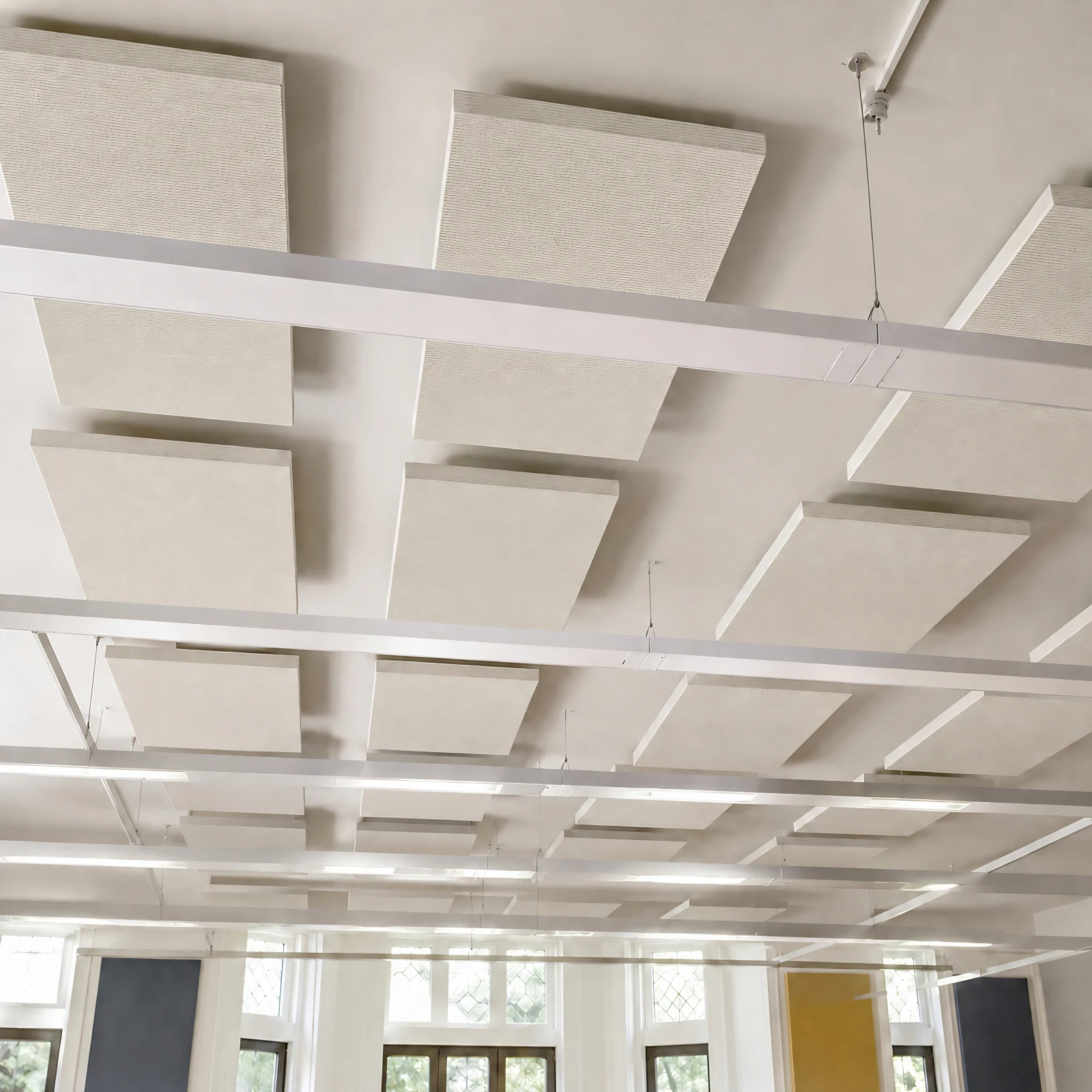
- Acoustic ceiling clouds: the answer when whiteboards, windows and shelves leave little free wall. They hang flat below the ceiling, well out of reach.
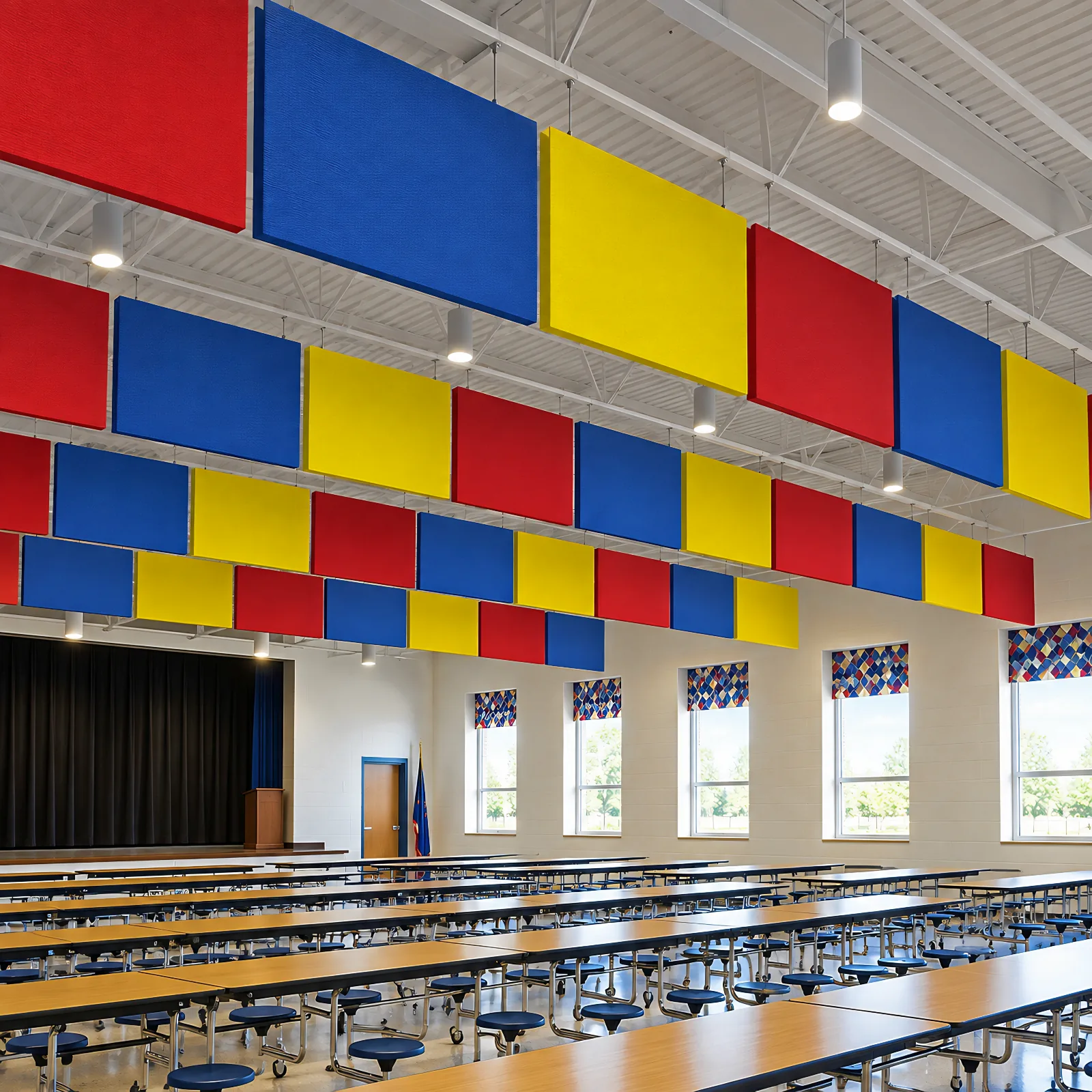
- Acoustic ceiling baffles: hung on edge in rows, these suit tall spaces like lecture halls, band rooms and open-plan learning areas.
Our wall panels and clouds are 2 in fabric-wrapped fiberglass with an NRC of 1.05, and come in 24 fabric colors, so they can match school colors. Panels only treat echo inside the room. They won’t stop the class next door from being heard.
Real classrooms: St. Johns River State College Our sister company Commercial Acoustics made and installed custom wall panels during a classroom renovation at this Florida college, to improve speech clarity and control reverberation in several rooms. The panels were cut to fit and wrapped in three fabric colors.
How Many Acoustic Panels Does a Classroom Need?
For a space where speech matters, plan on panels equal to 15–25% of the floor area:
- Measure the floor. A 30 ft × 30 ft classroom is 900 sq ft.
- Take 15–25% of that. That gives 135 to 225 sq ft of panel.
- Divide by the panel size. A 4 ft × 4 ft panel covers 16 sq ft, so this room takes 9 to 14 panels.
Use the low end for a room with carpet and a tile ceiling, and the high end for hard floors and hard ceilings. Spread panels around the room rather than bunching them on one wall. See how to hang acoustic panels for placement and mounting. If you send us the room size and what the room is used for, we can help lay it out: 855-667-6863.
Soundproofing Classroom Doors & Walls
Start with the door. Noise from class changes usually comes through the door, which has a much lower sound rating than the wall around it. A door sweep or automatic drop seal closes the gap at the floor, and perimeter seals close the sides and top. Doors with vision panels or vents leak more, so check those too.
Then the walls. If you can hear the next class through the wall, the wall needs more mass. Mass loaded vinyl behind a new layer of drywall adds that mass with little lost space. Wall Blokker™ adds 6 to 12 STC points to a typical wall, and Wall Blokker™ Lite is made for the metal-stud walls common in schools. See how to soundproof existing walls.
Also check whether the wall stops at the drop ceiling. Many classroom walls don’t go all the way up to the deck, so sound travels over the top through the open space above the tiles. In that case the wall needs extending to the deck, or the problem will remain. Seal outlets, pipe holes and the edges of the wall with acoustical caulk.
Classroom HVAC, Windows, & Floors
- HVAC. Air noise is one of the most common reasons classrooms miss the 35 dBA target. A mechanical contractor can balance the system and slow the air, and can add flexible duct, duct lining or silencers near the room. Wall units are harder to quiet and may need replacing.
- Windows. For bus loops, roads and playgrounds, seal the frames first. For a bigger cut, add secondary glazing or replace the glass with laminated, sound-rated units.
- Floors. Where classrooms stack, footsteps and chairs travel down through the structure. During a floor replacement, put an underlayment like acoustic rubber underlayment or sound barrier underlayment under the new floor. See the best soundproof underlayment for floors.
Soundproofing for Schools
Across a whole school, prioritize the rooms where hearing matters most and the rooms that make the most noise. Keep noisy spaces away from classrooms where you can, and treat them first if you can’t. Each one has its own needs:
- Gyms: long echo from a huge hard room. See gym acoustic panels.
- Cafeterias: loud crowds on hard floors. See cafeteria soundproofing.
- Music and band rooms: the loudest rooms in the building. A band room above or below a classroom usually needs a suspended ceiling on spring hangers, not just a mat. See how to soundproof a music room.
- Libraries and study rooms: quiet rooms where small noises carry. See library soundproofing and how to soundproof a study room.
- Auditoriums: speech and performance in one room. See auditorium soundproofing.
Classroom Soundproofing Cost
| Item | Price | For a 30 ft × 30 ft classroom |
|---|---|---|
| Acoustic wall panel, 4 ft × 4 ft × 2 in | $259 each | 9 to 14 panels: $2,331 to $3,626 |
| Ceiling cloud, 4 ft × 4 ft × 2 in | $279 each | 9 to 14 clouds: $2,511 to $3,906 |
| Wall Blokker™, 100 sq ft roll | $219 a roll | One 30 ft × 10 ft wall: 3 rolls, $657, plus drywall |
| Acoustical caulk | $17.99 a tube | One to two tubes for a typical room |
| Door sweep + perimeter seals | Roughly $100 to $300 a door | Most rooms have one door |
Prices are before shipping and installation. Most of this work is light construction, so schedule it for summer or a long break, and start planning early enough to fit your purchasing cycle. Treat your worst room first if the budget is tight, since it shows what the rest of the school could get.
Frequently Asked Questions
How do you soundproof a classroom?
Find out what the problem is first. Use acoustic panels for echo, door seals and added wall mass for noise from outside the room, and HVAC balancing for a loud air system. Most classrooms need more than one of these.
What is the recommended reverberation time for a classroom?
ANSI/ASA S12.60 sets a limit of 0.6 seconds for classrooms under 10,000 cubic feet, and 0.7 seconds for rooms up to 20,000 cubic feet, along with 35 dBA of background noise.
How many acoustic panels does a classroom need?
Plan on panels equal to 15–25% of the floor area. A 900 sq ft classroom takes about 135 to 225 sq ft of panel, or 9 to 14 panels at 4 ft × 4 ft.
Do acoustic panels soundproof a classroom?
No. Panels reduce echo inside the room, which makes speech much clearer. They won’t stop noise from the hallway or the next classroom. That takes sealed doors and more mass in the walls.
How much does it cost to soundproof a classroom?
Treating echo in a 900 sq ft classroom with our panels runs about $2,300 to $3,600 before shipping and installation. Door seals add a few hundred dollars, and wall work costs more because it includes drywall and labor.